By Julie Schlesselman, Local History & Genealogy Department Manager, FCPLD
“This is the day of the camera. The click of the picture-making machine has become one of the biggest noises of the age. Yet, it was only sixty-eight years ago that the world first learned of the marvelous discovery of Louis Jacques Mandé Daguerre. It was a year later in 1840 that the first sunlight picture of a human face was made by an American. Wonderful has been the development of the camera from that day to this.” This statement was made in the year 1907.
Legend has it that the first daguerreotype created in Indiana was made right here in Franklin County. Some might say, “Big deal, and what’s a daguerreotype anyway?”
Well, yes, it’s a big deal, and a daguerreotype was one of the very first forms of a photograph. In 1839, Frenchman Daguerre introduced publicly to the world a photo process that became widely used for the following two decades. A daguerreotype is an image on a mirror-like surface and can appear either as a positive or negative, depending on the angle at which it’s viewed. The process to create an image was somewhat labor-intensive. A daguerreotypist would polish a sheet of silver-plated copper to a mirror finish. He would then treat it with fumes that made its surface light-sensitive. Next he would expose it in a type of box for as long as was judged to be necessary, which could be as little as a few seconds for brightly sunlit objects, or much longer with less intense lighting. This exposure would make a latent image on the surface that could be made visible by fuming it with mercury vapor. He would then remove its sensitivity to light with a liquid chemical treatment, and rinse and dry it.
In 1907, the November 7 Indianapolis Sunday Star noted, “There is still living in Indiana the man who made the first daguerreotype in this state.” The newspaper ran a feature article on Dr. Oscar Fitch, who at the time lived in Morristown, Indiana, and was nearing his ninetieth birthday. While the ability to create a photo has now been around for us modern readers about 180 years, at the time of the Indy Star article, it had been less than 70 years that the camera had been in use.
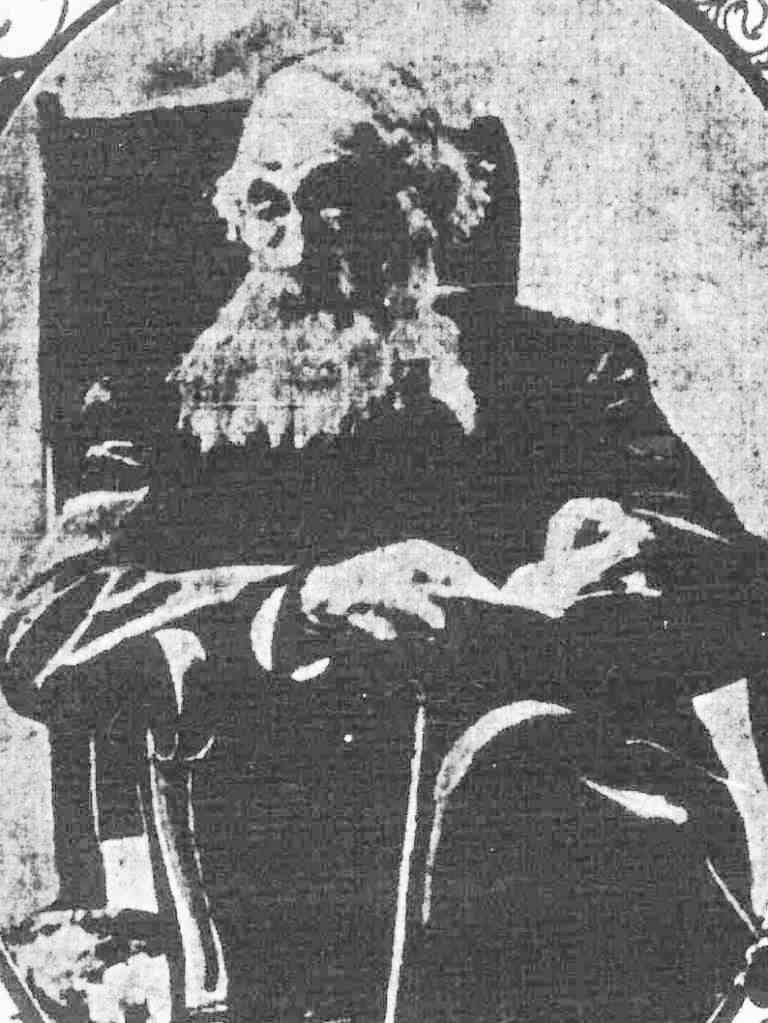
“The camera with which Dr. Fitch made his first picture would be very much of a curiosity if exhibited today….There were many failures before the first Hoosier amateur photographer succeeded in getting his camera and material in shape to put it to the supreme test – that of attempting a picture of the young woman whom he had learned to love.”
Oscar Fitch was born in Penn Yan, New York, in February 1818. According to the article, his father, who was a poor man, died when Oscar was only 13. As the eldest of a family of seven children, he felt it his duty to help his mother provide for the family. He did this, and, in addition, managed to complete a college education by the age of 21. After teaching for four years in the state of New York, in 1843 Oscar came to Franklin County and began teaching. Within a year, in 1844, he was teaching in Fairfield and did so at the rate of $20 per month. While there, Oscar also worked as a harvest hand for the father of the minister, Reverend C.N. Sims.
Fitch first became aware of the wonderful sun-picture process invented by Daguerre through reading newspapers. He soon learned that the photo process had recently been “perfected” by John W. Draper of New York, who in 1840, shortly after the Daguerre invention, had succeeded in making an image of his sister, Dorothy Draper. Fitch read all that he could find about the topic, brushed up on his knowledge of chemistry that he obtained in college, and was determined to make his own daguerreotype.
The article said that Fitch was hindered by the lack of funds, and as materials were very costly, it was not until in 1844, after months of work and saving that he was able to construct a crude camera. In the winter months, he continued to teach the district school, and the rest of the year, he worked constantly as a farm hand, so he had very little time for experimenting.
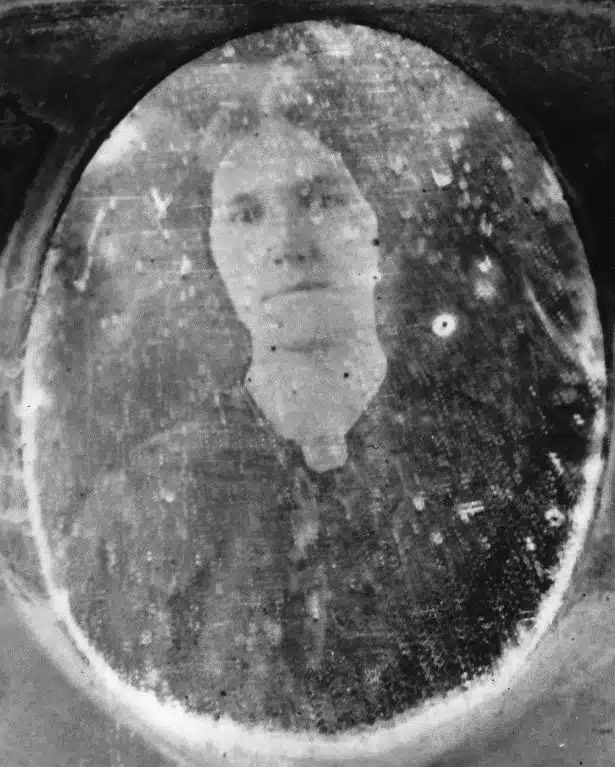
Phebe Shirk was the daughter of Reverend Shirk, who preached at the Big Cedar Church in Springfield Township. She attracted the attention of the young schoolteacher the first Sunday he saw her at church services. The schoolmaster himself was a devout Baptist and got along well with the Reverend Shirk, who often invited him to his home. In time, Oscar and Phebe became intimate friends, and “he told her of his hopes of perfecting the new picture-making process and of his desire to make a picture of her.” The picture was a success, and the romance was a success, for the subject of the first daguerreotype made in the state of Indiana later became the bride of Oscar Fitch.
Shortly after his marriage, Oscar attended medical college. Not content, he hoped to be better able to provide for his growing family, and eventually ventured out on an extended trip. He, like many other men during this time, caught gold fever, believing that they could amass great wealth in a short amount of time. Leaving his wife and baby son, Oscar set out with a few other Franklin County men for the gold fields of California. Dr. Fitch and his friends had little luck in hitting it big during the gold rush, and he finally returned home “poorer in purse than when he started.”
Unbeknownst to Oscar, a great sorrow awaited his return in 1853, for his wife had been buried only a few days before he made it home from California. According to Phebe’s obituary, at the time of her death, she died in Mt. Carmel. It said that she suffered much for the last year of her life with pulmonary disease, of which she died. She was only 25 years old, and she and Oscar had only been married for five years.
The year 1853 was an important, life-altering one for Dr. Fitch. Not only had his beloved wife died, but it was also the beginning of his connection with the Brookville College. The college was opened that year by Reverend Goodwin, who was president of the institution. In fact, for a while, Goodwin and Fitch were the two men who comprised the entire faculty of the college. It’s been said that Oscar “sought solace in the arduous duties attended upon the faculty position at Brookville College.” While there, Dr. Fitch taught science and mathematics and was paid $6 a week.
Oscar eventually met Mary Baker of Metamora and married her sometime around 1855. At the time of the Indy Star article, they had been married for just over 52 years.
In 1857, the Fitches moved to Morristown, Indiana, so Oscar could take charge of the seminary at that place. He continued as a teacher there until the frailty of advanced age forced him to retire. His overall teaching experience covered a period of fifty years. When he died in 1911, his obituary said he was one of the oldest schoolteachers and astronomers in the state.
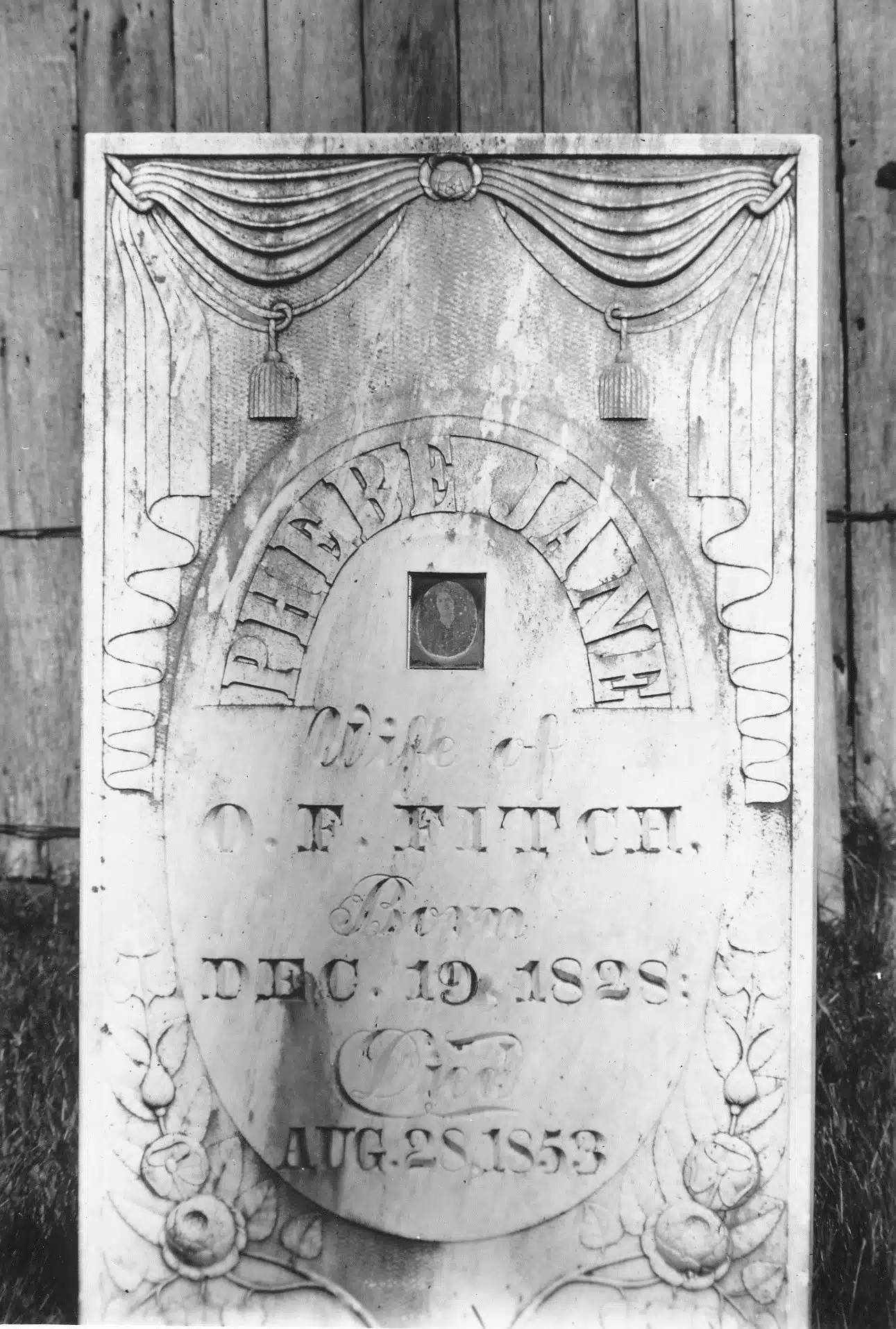
What’s most interesting about the daguerreotypist and Phebe Fitch is, according to the 1907 Indy Star article, after Phebe died, Oscar placed a marble tombstone at her grave, and in it, he set the daguerreotype image of his young wife. The article went on to declare, “Since the death of Mrs. Fitch, in 1853, the picture has faced storm and sunshine unprotected, and yet the hand of love had done its work so well that the picture may be copied today [1907] by any ordinary camera.”
So what happened to the first daguerreotype that was made in the state of Indiana? It ended up at the Big Cedar Cemetery in Springfield Township, where Phebe had been buried. It stayed securely lodged in the specially carved niche of her tombstone for at least 54 years, for Ben Winans took a photograph of it in August of 1907. Being a photographer himself, Winans obviously knew the history and importance of the daguerreotype and probably admired Fitch for having accomplished such a feat with a crude handmade apparatus. Unfortunately, today, the historic image of a young Phebe Jane Fitch no longer adorns her stone.
Did the image fall from the tombstone and eventually get buried in the ground? Did someone pry it out for a souvenir? The fate of the first daguerreotype made in Indiana is a mystery.
The Indy Star article said that Dr. Fitch seldom spoke of his original daguerreotype, but that the making of the picture was one of the most sacred memories of his life. “The process which he employed was practically the same as that of Daguerre and Draper, although his work was necessarily more crude in every way, as he was forced to do without some materials that he had not the funds to purchase.”
Keep in mind that for Fitch to have created a daguerreotype in Indiana by his own means in the 1840s, just a few years after the process was invented, was truly amazing. And it was done right here in Franklin County.