By Julie Schlesselman, Local History & Genealogy Department Manager, FCPLD
Nice surprises happen on a regular basis at the History Department of the Franklin County Public Library District. In August of 2019, I had a phone call from a man in Florida. He straightaway asked, “What do you know about W.S. Baker?”
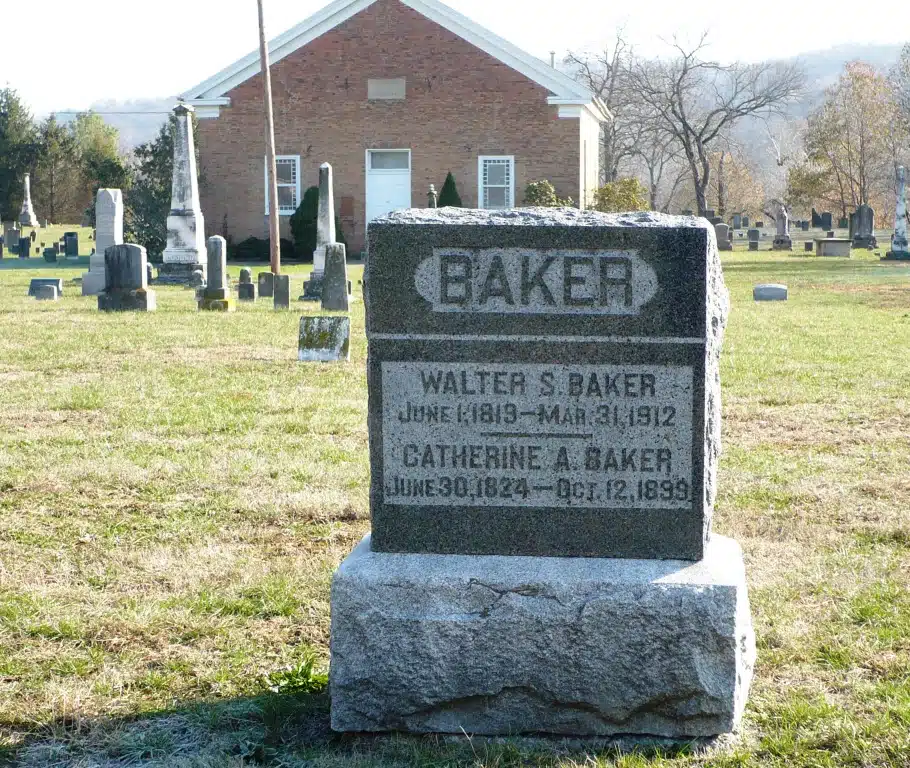
It was like the final question in a game show that I could bet my entire winnings on, and positively answer correctly! How could I not have known something about W.S. Baker? Walter S. Baker was an early resident of Franklin County and a man as prominent as the large granite gravestone that marks his final resting place at the Old Brookville Cemetery.
I think the gentleman on the phone was quite surprised when I rattled off Baker’s burial location, said he was a carpenter and contractor, and was one of the oldest residents in Franklin County in the first decade of the 1900s, having been a recipient of one of the gold-tipped canes given out by the Pioneer Association at the Old Settlers picnics. I proceeded with, “What can I help you with?” I thought that the call had been disconnected, for the man was quiet for a moment but finally replied, “How do you know that? Yes, that is the man, and I have his cane.” After we talked for a few minutes, the caller mentioned that he was contacting the library because he wanted to find a permanent home for this piece of Franklin County history. I was thrilled and told him he needed to look no further. Needless to say, we now have a fabulous and most unique example of Franklin County memorabilia in our collection – a truly rare piece of which we are quite proud.
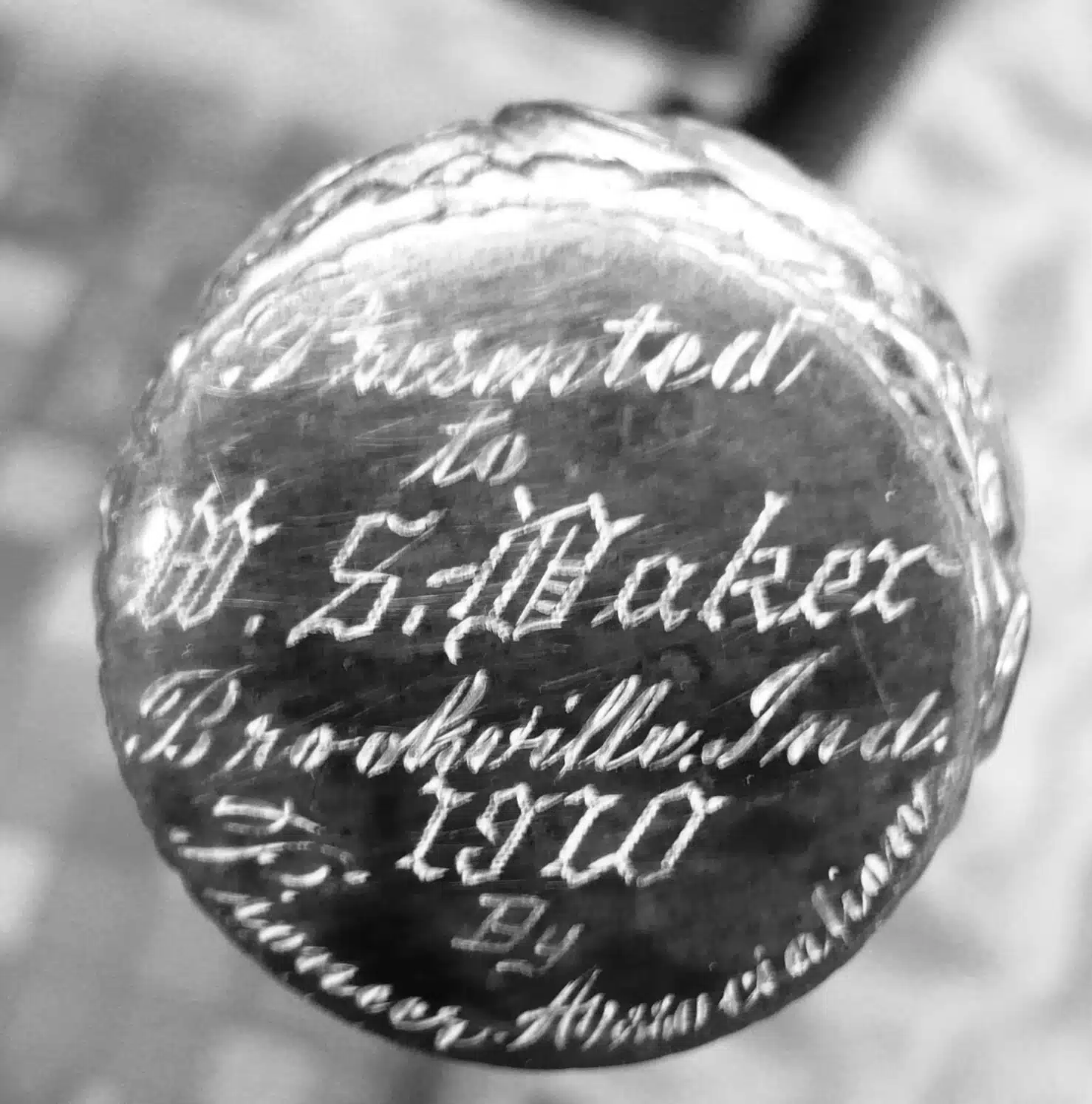
The cane was presented to Baker in 1910. His age at the time was “91 years, 2 months, and 26 days,” and considered one of the oldest living residents of Franklin County at that time. The sleek wooden cane has a metal tip and a metal top that’s inscribed to Baker, with the date and from whom.
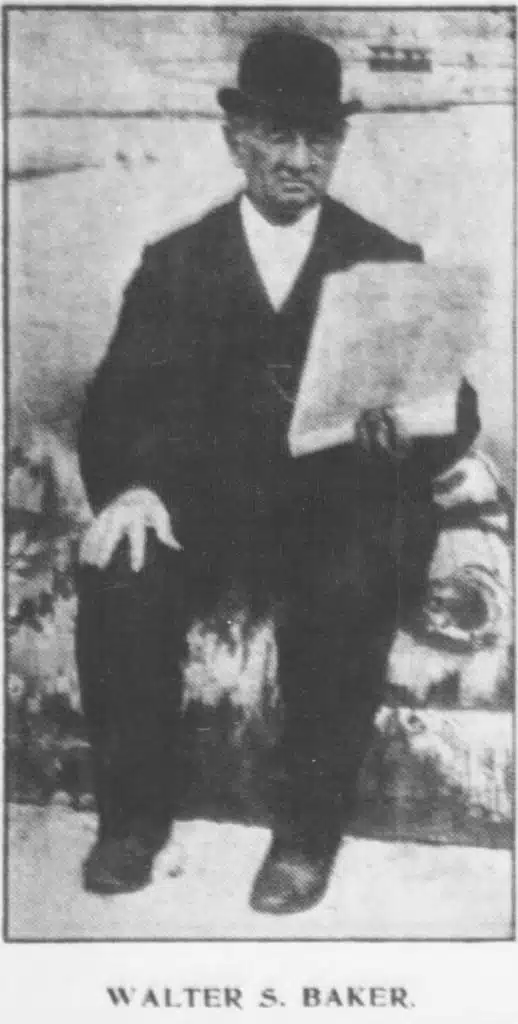
Walter S. Baker came to Franklin County when he was twenty years old. That was in 1839. He had ambition and drive and was truly a self-made man. The accompanying photo of Walter appeared in the Brookville Democrat twice – once in 1907, when he was honored with a biography, being a highly respected citizen of the county, and again in 1912, accompanying his obituary. For an individual to have a photograph of himself in the newspaper at that time was quite remarkable. It just wasn’t done. Over one hundred years later, this photographic clue exemplifies how respected and important he was to the community. Oddly, however, nothing of any substance was written about W.S. Baker in the 1915 county history. Perhaps family modesty prevailed.
Walter S. Baker was born in Snyder County, Pennsylvania, in 1819. Both his maternal and paternal grandfathers were veterans of the Revolutionary War. In his youth, he worked with his father, but his father died when he was only 17. At that time, Walter commenced an apprenticeship with a carpenter, completing the trade at the end of just three years.
In 1839, Walter started for Brookville, walking the entire distance with his gun on his shoulder and accompanying his brothers-in-law, John B. Thurston and John Wise, and their families. The trip took 28 days, and the party finally reached Brookville on November 3, 1839.
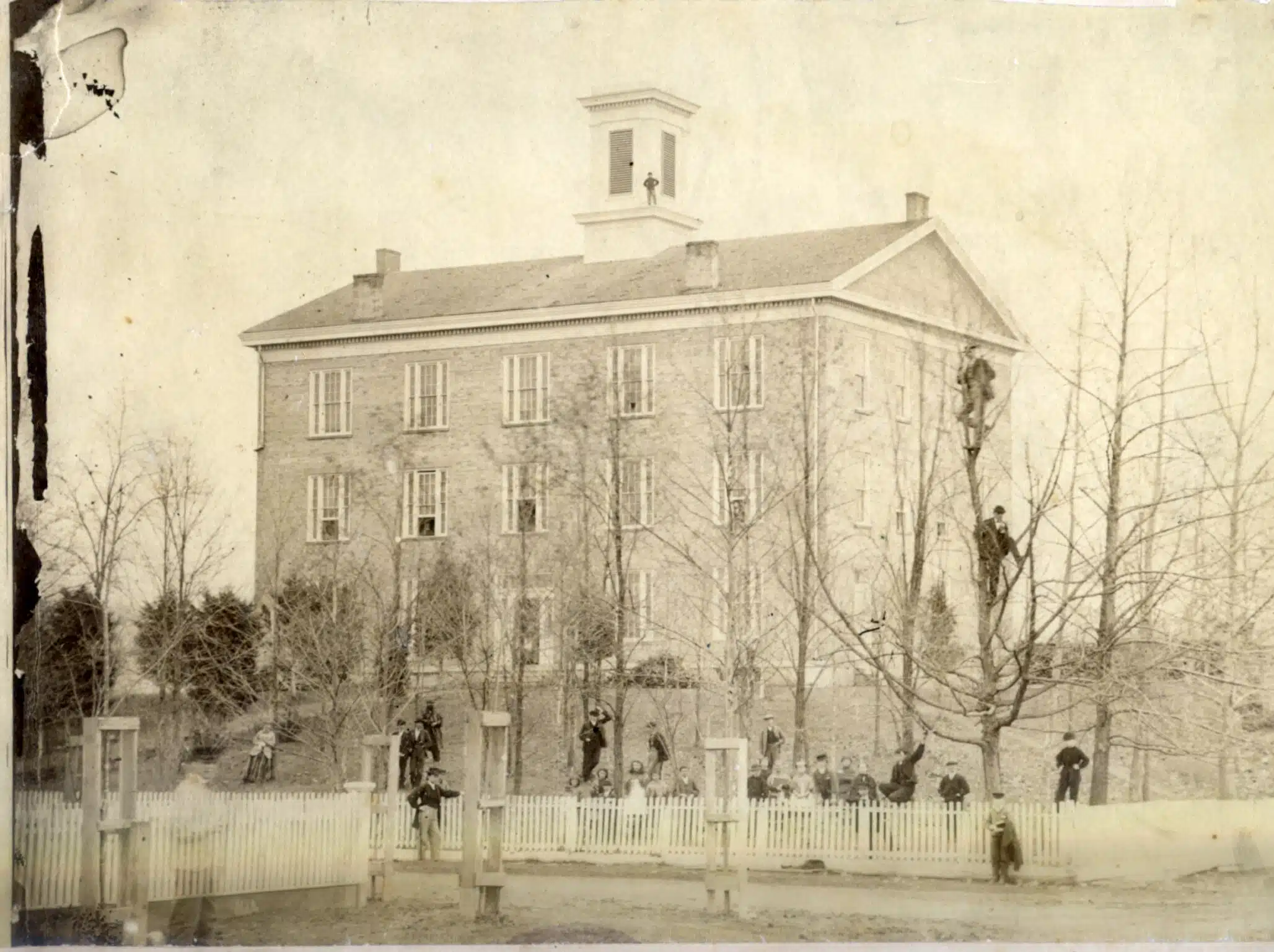
For two years, Mr. Baker worked at his trade in carpentry, and then branched out into the more opportune field of contracting. He was involved heavily in this type of work from 1841-1862. He worked primarily in or near Brookville, building many of the best frame and brick houses and business blocks in town. Among one of the grandest Baker structures was the Brookville College, built in the 1850s.
As just mentioned, Baker was honored with a story in 1907. In the February 28th installment of that year, Theophilus L. Dickerson wrote about Walter Baker. Dickerson said, “Though almost 88 years of age this pioneer citizen is well preserved in mind and body, and can readily call to mind the early historical events of Franklin County that have taken place since 1840.”
Dickerson also acknowledged that Baker was an expert carpenter and joiner. “He introduced the first simplified form of window boxing and skeleton frame for buildings in Brookville, and…built a frame addition to his home residence, doing all of the carpenter work himself.”
In the last few months and weeks of Walter’s life in 1912, the town discussed tearing down the old Brookville College building, which by that time had been used as the public school for approximately the last 40 years. It was a masterpiece that he had created while in his prime. That had to be terribly sad for a man who was 93 years old to realize that the new generation of town leaders wanted one of his best creations torn down to make way for something more modern and up-to-date.
As with all subjects, people are either for it or against it, and expressed opinions in the newspaper. Regarding the old building, one writer to the February 15, 1912 Democrat noted, “…the old school building is solid, and would stand for years, why should we tear it down?” The same writer said, “all things considered, I think it would be a great mistake to tear down the Old School Building.” The somewhat lengthy commentary was signed, “A School Patron.” Was this patron actually Baker, or one of his family members making one last plea to save the school before he died? We will never know, but it’s an interesting thought.
Just four days after Walter S. Baker died, the Brookville Democrat of April 4, 1912, announced the winning bidder of the new school contract. It was awarded to Colvin & Anderson. Their construction bid was $30,703. Their bid for the demolition of the old school building was $1,900. Demolition and construction were to be completed in just over six months, and the new building ready for classes in November 1912.
Within a few days, work was begun. The Democrat of April 25th noted that the work of tearing down the old school had started. “Rapid progress is being made and this historic landmark will soon be a thing of the past.” Colvin & Anderson had a crew of 25 men at work.
Apparently, some recycling and salvage operations were undertaken, for in the Democrat of June 6, 1912, all of the doors, windows, and tin roofing of the old school were for sale at Fieber & Holmes.
Walter is buried at the Old Brookville Cemetery with his first wife, Catherine Thurston Baker, who died in 1899 at the age of 75. They were married for 58 years.
When Walter died, he was living with his second wife, Eveline Knotts, whom he married in 1902. His death occurred “at 8 o’clock Sunday morning [March 31] at his home on Tenth Street.” Pulling details from the auction announcements that appeared a year after his death, and assessor records, “the most desirable property on Tenth Street close to the school building, many feet above any danger from high water,” that was going up for sale in April of 1913, was a part of lots 44 & 45 of Amos Butler’s Plat. The public announcement made sure potential buyers knew the property was on high ground. Since the town had just experienced monumental devastation and loss of lives from the March 1913 flood, good land on dry ground was now on the minds of everyone.
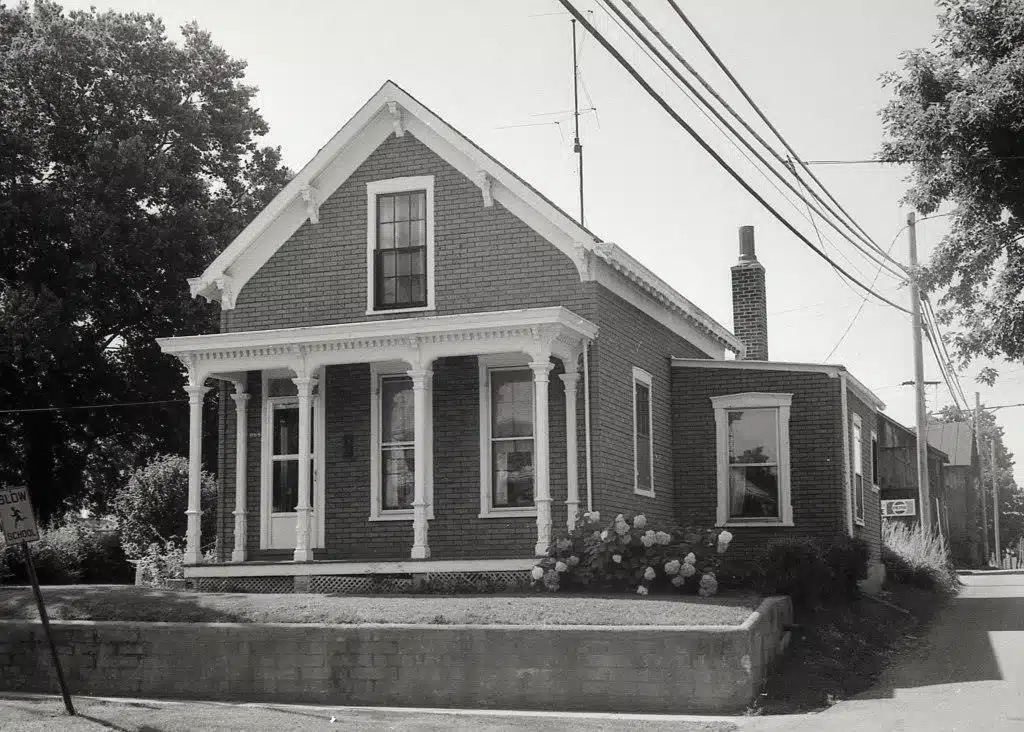
What’s most fascinating about this story is the cane and its journey. The house on Tenth St. in which W.S. Baker lived last appears to be the small home at the end of the alley that passes between the library buildings. It is at 122 E. 10th Street.
The donor of the cane couldn’t quite remember the details, but said he thought it was purchased at an auction in Anderson, Indiana, about 35 years ago. Could that have been from the estate of Gene Bock, the man whom we have discussed in the past – the man who originally rescued Ben Winans’ glass plate negatives from the dump? Interesting, as Bock was into antiques and collecting also.
From Brookville, Indiana, to Anderson, Indiana, to Marco Island, Florida, and back to Brookville. That cane traveled thousands of miles across the country, simply to end up back home only a few hundred feet from where it started.