By Julie Schlesselman, Local History & Genealogy Department Manager, FCPLD
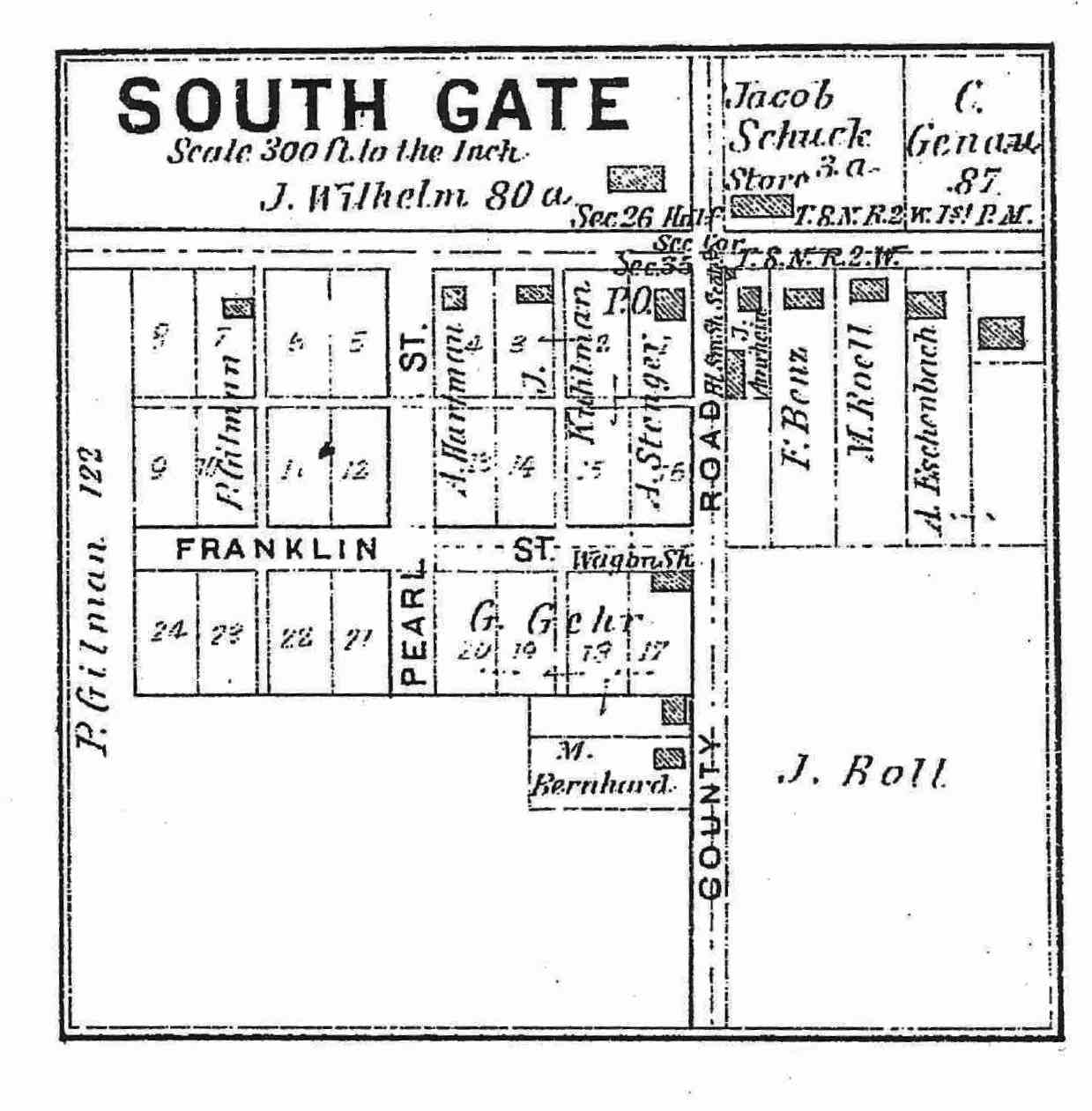
From the Franklin County Atlas of the same year.
This article ran in the January 5, 2022, edition of the Brookville American and in Volume 3 of Forgotten Franklin County.
Southgate, interchangeably referred to as South Gate, is in Highland Township, and many of you probably pass through it on a regular basis and don’t even know that it was a small successful town. What’s left of the town today is not much except for a crumbled and broken building that was once one of the most prominent structures around. Southgate was a small town situated at the crossing of two locally important roads, SR 1 and St. Peter’s Road. Southgate was laid out in September 1850 by Richard Wood, although John Fread, a blacksmith, had opened a shop in this area long before the town was laid out.
Richard Wood was born in England about 1821. He was a land speculator, as he did not stay in Franklin County long. By the 1870 census, he and his wife, Mary, had moved south to Louisiana and lived in New Orleans.
Catherine Cresswell, who studied the St. Peter area, also acknowledged Southgate in her dissertation. She said, “Southgate was undoubtedly very important as a nineteenth-century reconnaissance point, where farmers could get information……There was a store in which to rest, wait, and talk, and above it an inn, where one could stay the night in an emergency, and there were both wagon shop and blacksmith’s shop, for wagons needing repairs…”
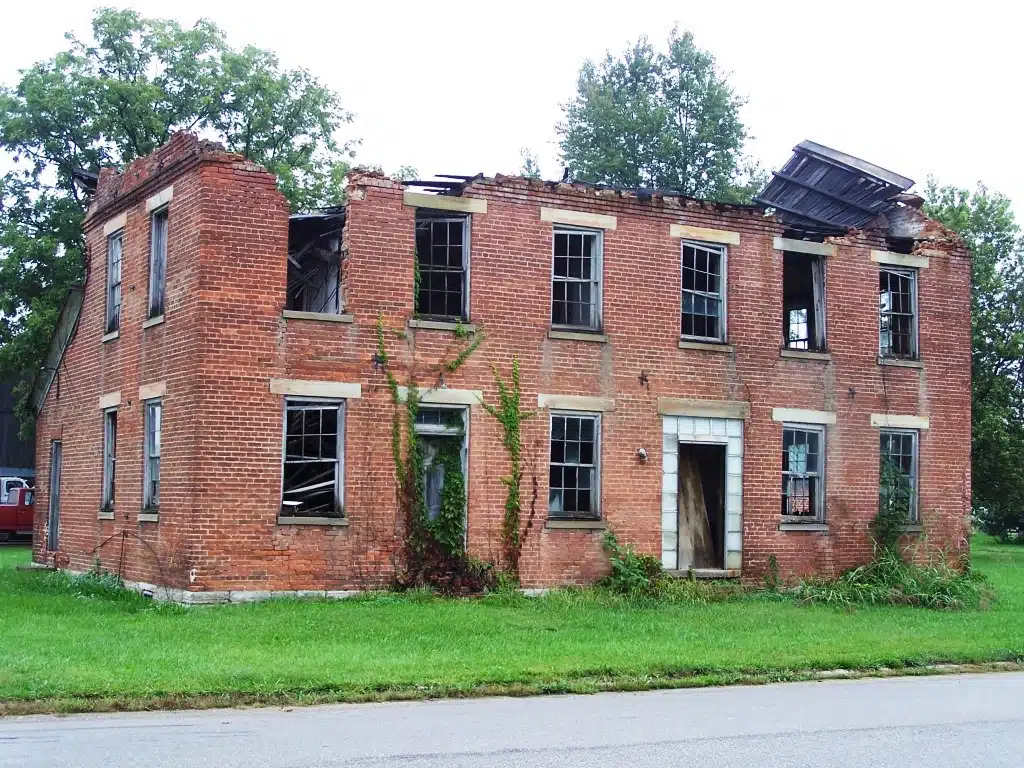
“Formally Southgate is notable as an example of a crossroads hamlet in which all of the buildings, whether commercial, residential, or sacred, are located in direct relationship to the road.” Cresswell stated, “The four corners are occupied by an inn/general store, a post office, and agricultural scale, and a blacksmith’s shop, all of which are commercial operations, though with social functions as well…”
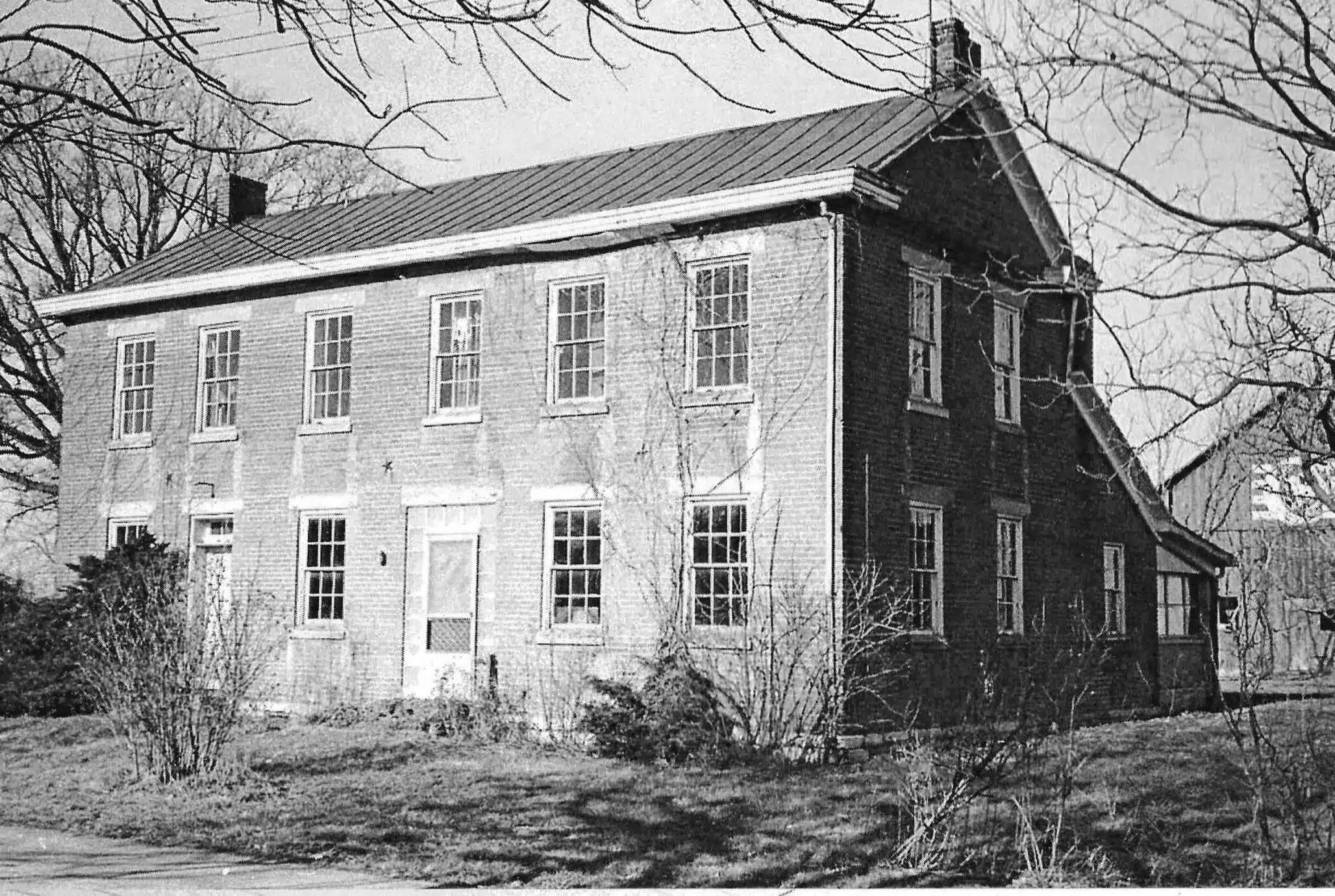
“Two beautiful brick structures, remarkable for a hamlet this small – one and inn and general store and the other, the Italianate Peterson School – grace the northeast and southeast corners.
From the Carter-Stanton Collection, FCPLD.
In 1999, she said, “Although many of its older buildings remain, they are in ruins,” and “Indiana 1 has become a high-speed road.”
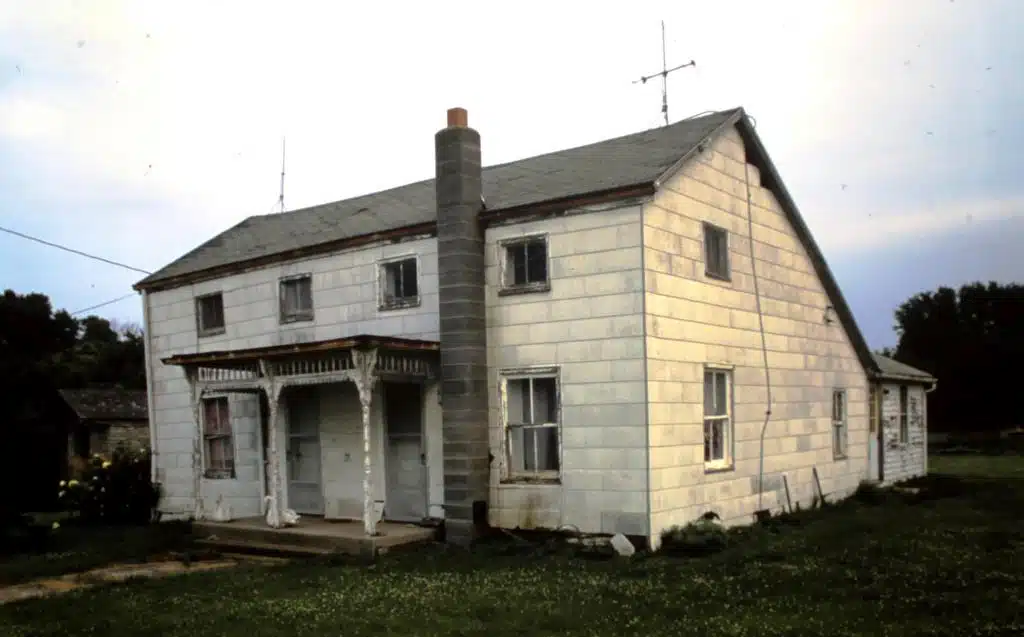
“Although many of the smaller structures on the western side of the hamlet have disappeared…they were log structures, story-and-a-half houses close to the road, sided in wood clapboards and unpainted. The post office was on the southwest corner.”
Cresswell said, about three-quarters of a mile to the West of the crossroads stood the Franklin Meeting House, the first church in Highland township. “It was built of logs, and was established by the first settlers in the neighborhood, ‘as a Methodist Episcopal preaching place.’ The church is designated ‘Protestant Evangelical’ on the 1882 map…indicating that Protestant German-Americans were dominant in Southgate by 1882, an inference confirmed by the German family surnames indicated as landowners.”
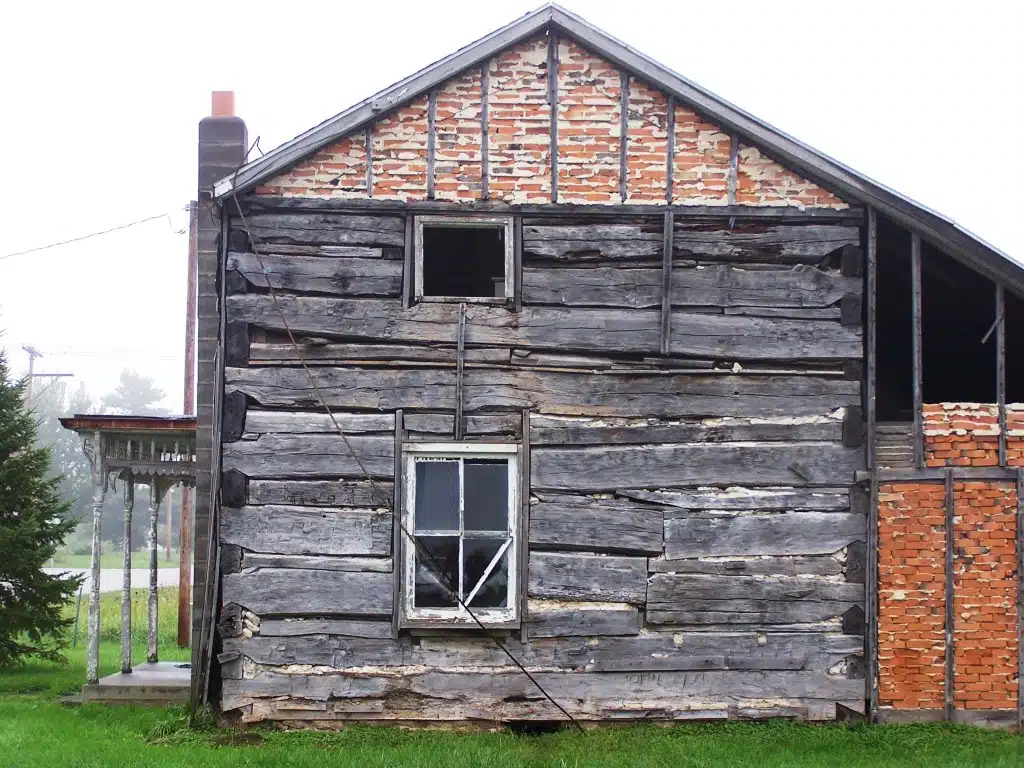
From Indiana SHAARD documentation done in 2011.
Prior to what Cresswell stated, pretty much the only information we had about Southgate was from Reifel’s 1915 history. He said the population of the village is about one hundred and that “the usual amount of stores and shops of a hamlet of its size are found there.” In February 1915, the list of businesses were general dealer, Jacob Schuck; blacksmith, Peter Emerin; postmaster, Adam Stinger. The post office was established in 1843.
The only way to add to the research that Cresswell has documented, and that Reifel so briefly touched on, is to do genealogical research on the families known to have lived here. This can be done by conducting extensive newspaper research and surname research on known property owners retrieved from the multiple plat maps of the county.
I hope that by mentioning researchers Catherine Creswell, Gary Stanton, Thomas Carter, and Warren Roberts over the last few weeks that you get the idea that Franklin County history can be found in a variety of unexpected places. Think outside the box when looking for Franklin County history. I will mention one more source in closing, since it is Southgate specific.
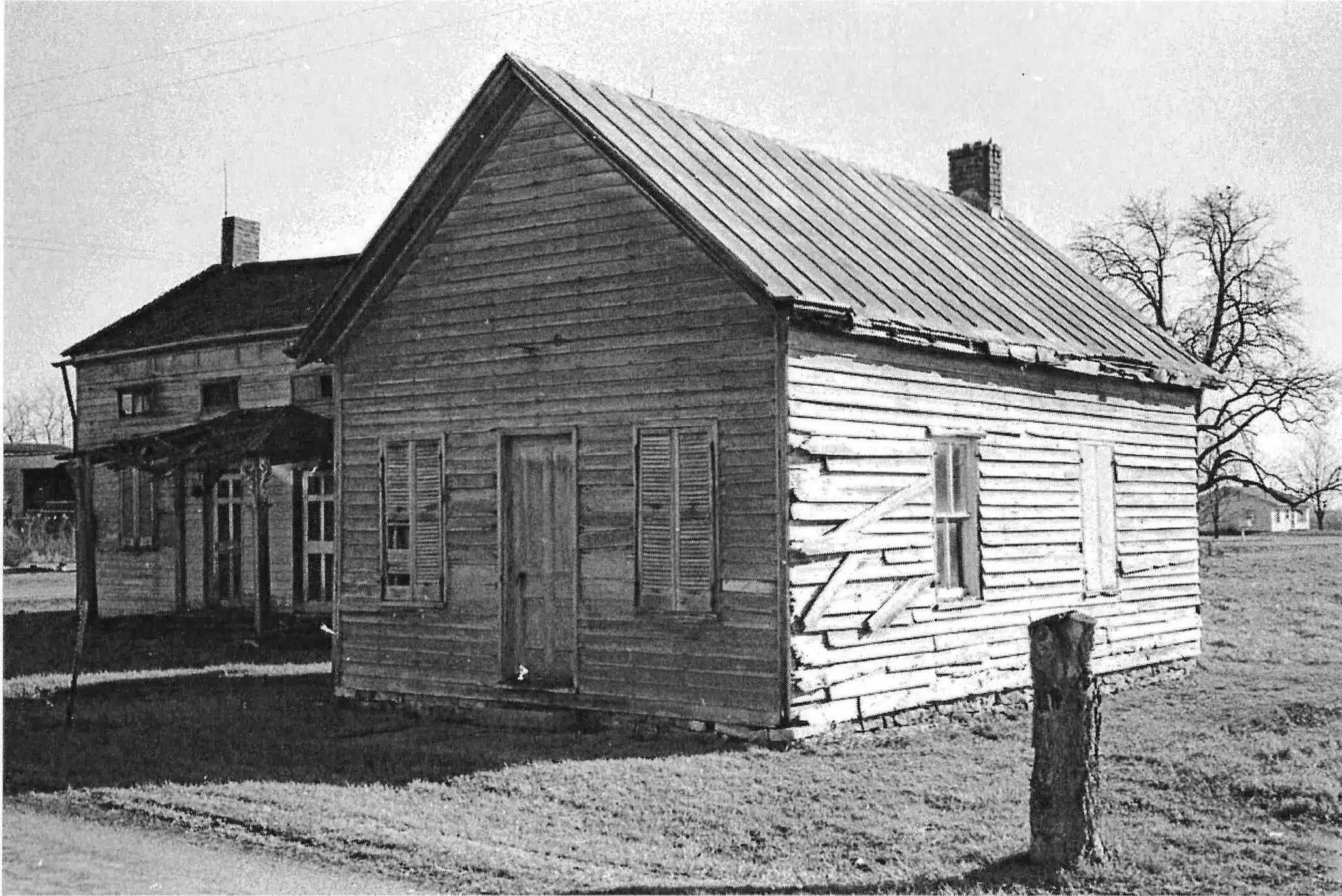
From the Franklin County Historic Structures Inventory of 1978.
In 2018, Caitlyn Barhorst won 2nd place as a Peterson Prize Winner, which is part of the Heritage Documentation Program. In short, it is a student competition of measured drawings and is intended to heighten awareness of historic buildings in the United States and to augment the Historic American Buildings Survey (HABS) collection of measured drawings at the Library of Congress. The lovely little brick Southgate School No. 1 was Caitlyn’s research and documentation project. The schoolhouse has been owned by her family since 1972.
Barhorst states, “Built in 1861-62, it is one of the oldest township schoolhouses with such a high level of integrity still standing in Indiana.” Even the original hardware is still present on the door and windows.
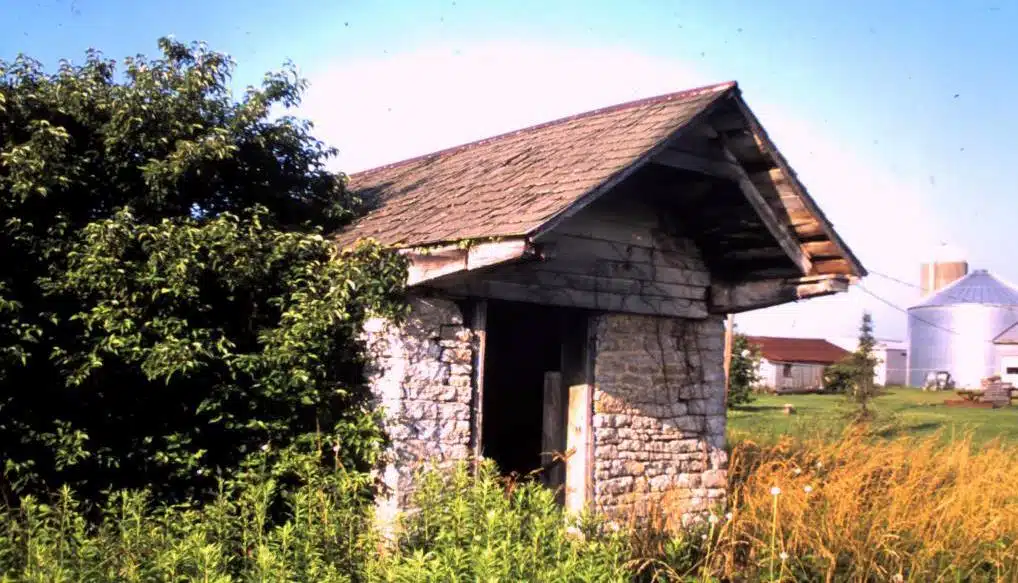
From the Carter-Stanton Collection, FCPLD.
Caitlyn Barhorst was part of Ball State University at the time and earned her master’s in both architecture and historic preservation while working on the Southgate School project. Scaled drawings and her research can be found at http://www.nps.gov/hdp/competitions/Peterson_winners.htm. Check out the Library of Congress for other Franklin County goodies. Caitlyn’s project is not the only mention of Franklin County, Indiana, at the Library of Congress.
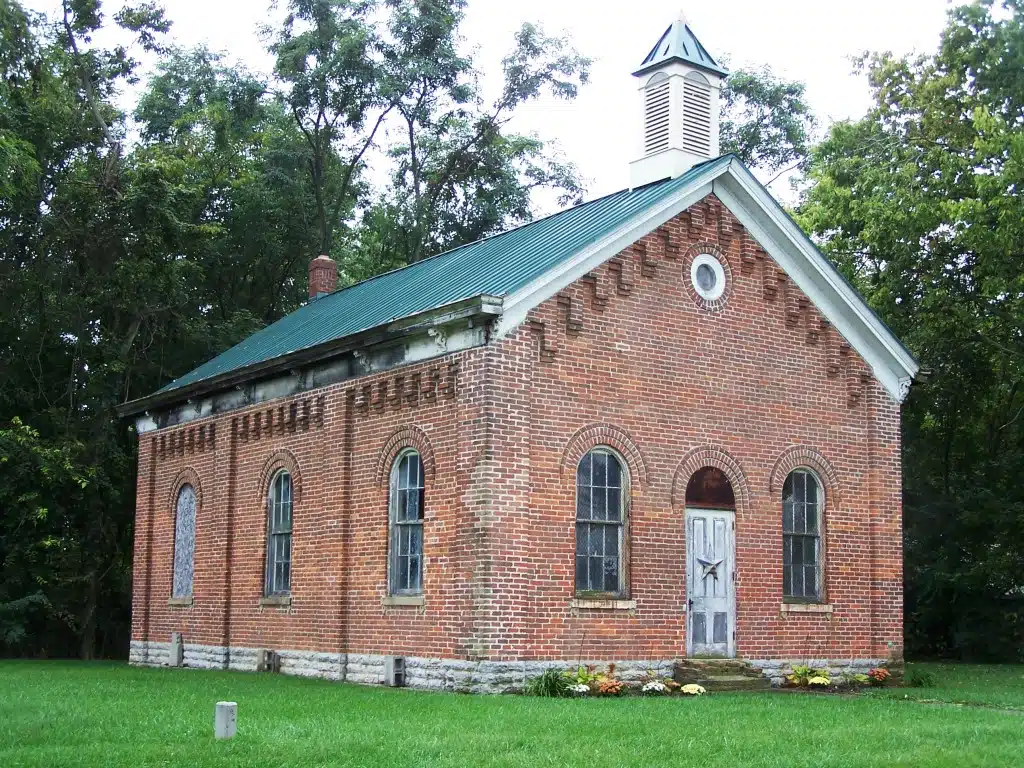
From Indiana SHAARD documentation done in 2011.
You must be logged in to post a comment.