By Julie Schlesselman, Local History & Genealogy Department Manager, FCPLD
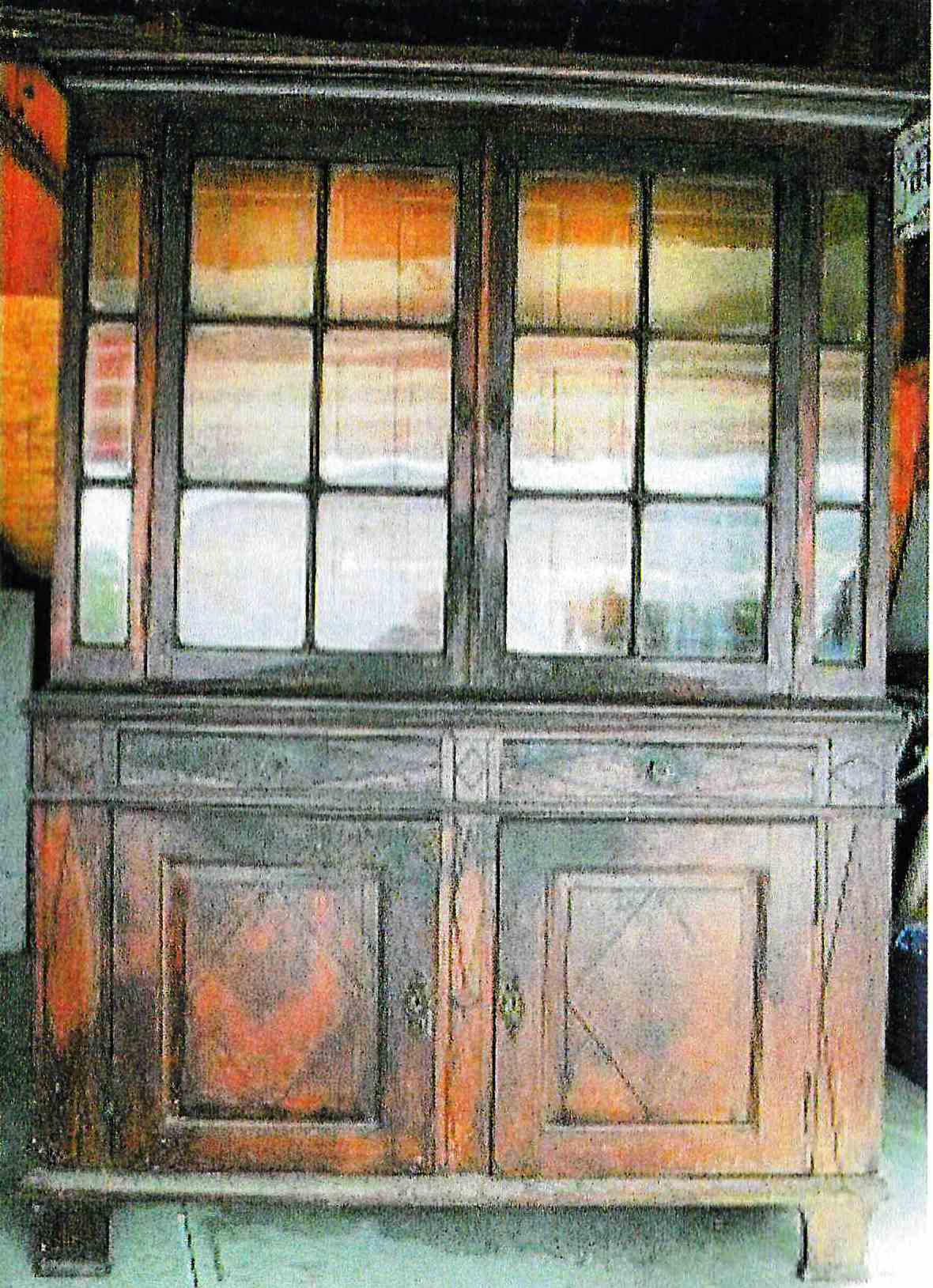
When I write something for the Forgotten Franklin County page, I am always fearful that what I contribute is old news to everyone. I always wonder how I can write something that people will not already know. Fortunately, so many of you have commented that you never heard about some of the people and places I have written about, so I am glad to be able to bring a new variety of interesting subjects to an eagerly awaiting audience. I hope today is no exception and that this is also a new subject for most of you.
Over the years, there were countless furniture makers in Franklin County – some professional and some simply novices who created unique pieces of folk art for family or friends. In the early pioneer days up through the late 1800s, typically our furniture makers were also our undertakers. Those who made our furniture were also the ones who made our coffins and buried us.
Betty Lawson Walters compiled a book in 1972 called Furniture Makers of Indiana, 1793 to 1850. As we combed through the entries in that book, we hoped to find the names of furniture makers in Oldenburg. To our surprise, not a single one was listed.
What brought Oldenburg furniture to my attention was not only the fact that our local historical society has a fine example, but also a single piece of paper in our library’s Local History Department files. The paper claimed that in 2008 a piece of Oldenburg furniture sold for $27,000. It was praised as “one of the finest examples of ‘untouched, as-found’ furniture…in some time, a real time capsule of American country furniture.”
There are all kinds of enthusiasts and collectors out there. Many seek out primitives and Americana, and some collectors seek out only historical items relating to where they live – and furniture is no exception. These are commonly called regional collectibles and will fetch much higher prices among locals than on the national market. Not to retell the entire story of the $27,000 piece of Oldenburg furniture, but to bring you up to speed – here’s a synopsis.
The Oldenburg cupboard that sold for five times as much as was expected was a family piece of the Kleine brothers, who lived in an old house on Kleine Road in Batesville. The auctioneer noted, “Mr. Kleine was 89 years old, and most of these items have been in his family for generations. Unbelievable, interesting, hard to find” objects were going to be sold on June 29, 2008.
Some members of the Kleine family thought the old piece of furniture, which was a cupboard, was not worth selling at the auction. Unbeknownst to them, it was the most perfect piece. It was never cleaned and had its original paint, and most importantly, to collectors, a historically appropriate patina for a piece that was probably just over 150 years old.
The men who were bidding on, and won, the Oldenburg cupboard were from Ohio. They knew what Kleine had, and they were determined to get it, as evident from the price they paid. The new owners could tell from the cupboard’s form and construction that it was made in nearby Oldenburg. One of the distinguishing features was the wooden diamond shapes on the base.
I figured if a piece of furniture that distinctive and that grand was sold for such a high price, there would be scads of articles and scholarly writings, as well as numerous entries in our old history books about all the manufacturers of Oldenburg furniture. That was NOT the case. What I am offering today is about all that there is on Oldenburg furniture and cabinetmakers.
The best synopsis regarding this super-focused topic was written by Wes Cowan of Cowan’s Auctions, Incorporated in Cincinnati, Ohio. Cowan stated, “As Oldenburg’s Germanic population grew, the need for furniture was met by local cabinetmakers whose styles were influenced by their native land and whose output is distinctive.”
Cowan claims that much of the Oldenburg furniture was monumental. “It was imposing yet well designed with pleasing proportions.”
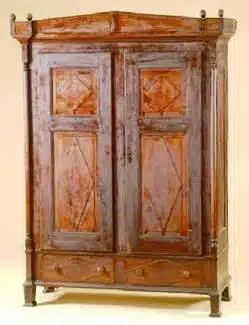
Image from Cowan’s Auctions.
“Large cupboards and schrunken (a cabinet or a tall wardrobe-like German chest with double doors, often used as hope chests, constructed so as to partially dismantle for easy transport) often include classical peaked pediments as well as raised diamond panels similar to those incorporated into the furniture of other Midwestern German settlements, such as Zoar, Ohio. Sidelights frequently adorn glazed-door cupboards, and the hinges on most doors are the lift-off type made of wrought iron or brass. Like most early cabinetmakers, those in Oldenburg mixed woods on pieces intended to be painted or finished with a colored wash, but they also mixed woods, such as walnut and maple, that received only a varnish finish.”
Cowen admits, “The [Oldenburg] cabinetmakers who made these pieces are presently unknown but their work survives as a testimony to their skill and their desire to retain their German heritage.”
In order to share with you what Oldenburg and suspected Oldenburg furniture looks like, I suggest you visit Cowan’s Auction House website: https://www.cowanauctions.com. A few years back, that auction house sold numerous pieces of Oldenburg furniture from the J. John Auraden collection, which included, among other things, cupboards, tables, and blanket chests
In a March 1894 Batesville Democrat Herald, it notes, “George Holtel is employed in the Oldenburg furniture factory. Nothing else detailed about the business could be found except in the book Oldenburg 1837-1937, which gives just an ever-so-brief account of this industry in their town. “George Holtel sawed lumber first at the foot of Main St., but when the furniture factory went broke, he bought out the owner and established the Holtel and Ortmann Sawing and Planing Mills. They had as high as twenty-five men on the job…..George Holtel conducted his factory until his death in 1933, which proved a great loss to the community….”
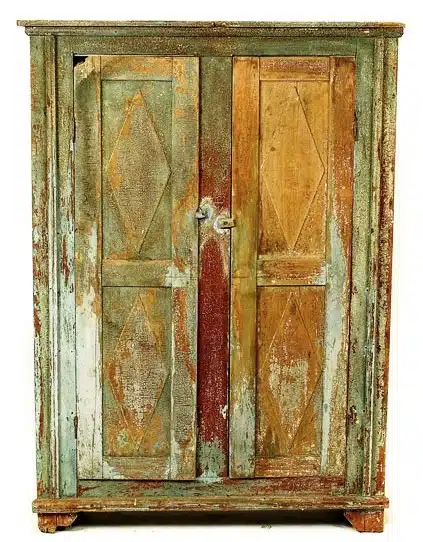
In that same book, under the specific heading of “Furniture,” it said, “Phil Dickman came after Mr. Brinck. The former had his shop in Joe Gering’s paint shop. Ed Waechter was a rare old craftsman when it came to grain cradles and spinning wheels. And Mr. Blank used to turn out a fine type of furniture where the Blank family now lives.”
Well, that’s all fine and good, but VERY vague in the details we need regarding dates and exact locations. I did find, in the Oldenburg business directory of the 1867 county atlas, Ed Waechter listed, so that gives us an estimated time frame for him, and Reifel’s county history of 1915 provides only one more clue to “Mr. Blank.” Reifel mentions it was R.M. Blank who was the Oldenburg furniture maker.
The entire history, consisting of primary paper documentation and accredited pieces, of Oldenburg furniture making and makers is an untouched topic and desperately needs to be investigated further. If you are in a quandary and want a subject for a Master’s thesis or a Doctoral dissertation, why not investigate our local history more and help fill in the gaps.
What, you say! That’s nuts. Who would want to use Franklin County as a subject for anything other than a local newspaper article or a few local history books?
You’d be surprised where our local history has ended up. Find out more in the coming weeks.