By Julie Schlesselman, Local History & Genealogy Department Manager, FCPLD
This article ran in the November 20, 2019, edition of the Brookville American and in Volume 1 of Forgotten Franklin County.
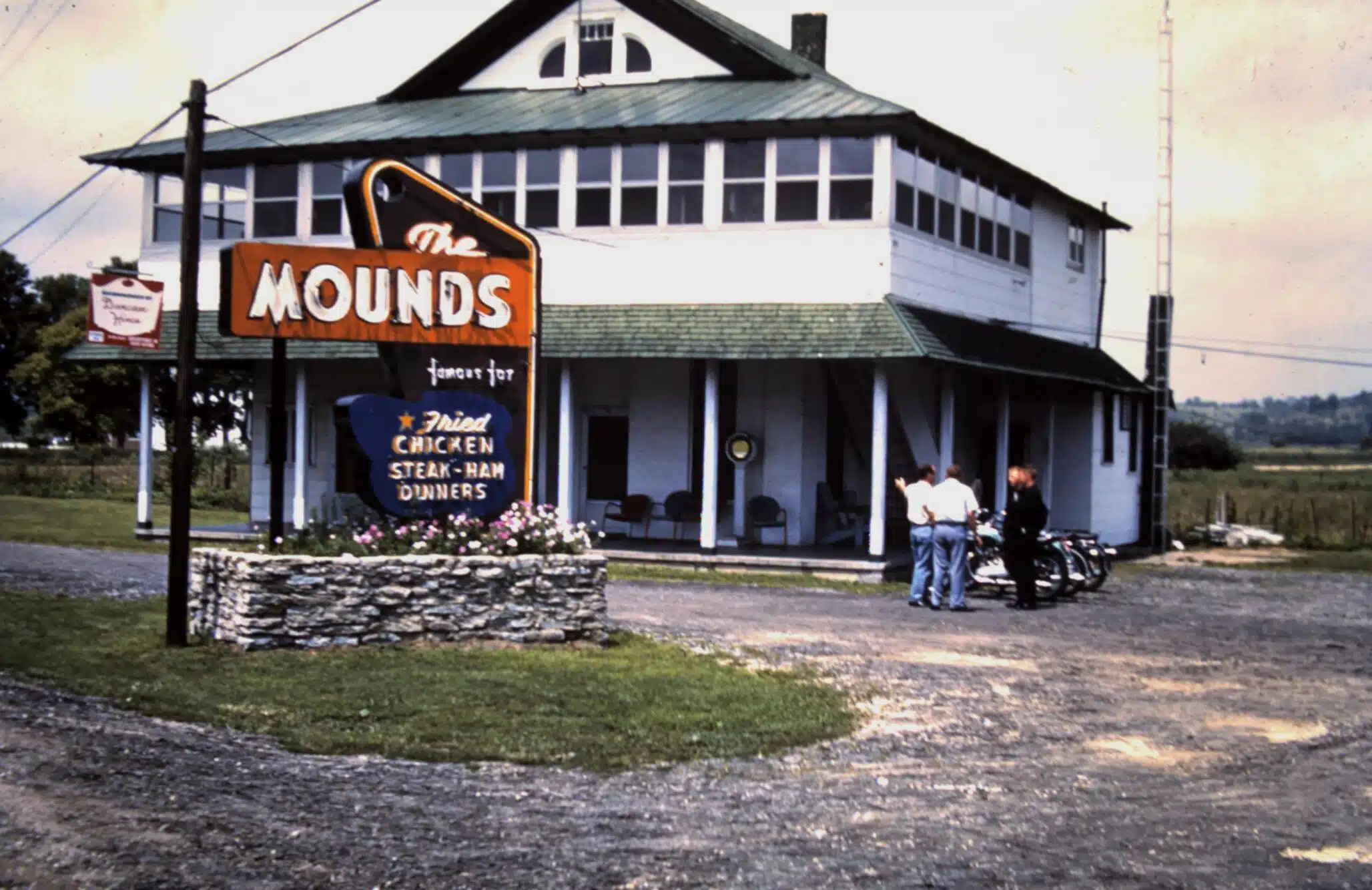
U.S. Highway 52 is the main thoroughfare in and out of Franklin County, unless, of course, it’s closed for what continues to seem like endless, annual repair jobs. On this road, coming from Cedar Grove, as one approaches the slight grade, about a mile before White’s Sale Barn, you see a small sign on the right-hand side of the road. It says, Mound Haven. Why? Because it was a beautiful, peaceful area, and there was a mound there.
Once you pass the small sign, you come upon the former Mounds Restaurant complex – popular far and wide, years ago – now the home of a fireworks business.
If you stop and pull in to the parking lot to appreciate the old building in detail, take note that what you see here is history incognito. The large, beige, two-story building that one sees today was originally a small, single-story red brick building. Take a good, hard look, because a small building that’s well over 130 years old remains, still slightly visible, but mostly hidden by extensive remodeling, paint, and additions. There is a wonderful painting by Bernard LePoris at the Brookville Library depicting the little building’s transformation.
The Mound Presbyterian Church, built in 1883, was the original structure on this site. Only twenty-seven years after it was built, it was bought by private investors to be used as a fishing camp and summer resort.
To summarize why this happened: the church was a mission church of the Brookville Presbyterian congregation, and the ministers of the mother church conducted its services. The Mound Church was never an independent congregation since those who attended there were enrolled as members of the Brookville church. Prior to building this small church, the Presbyterians conducted services in the Little Cedar Grove Baptist Church, located approximately one mile north. It seems that there was some disagreement between the Presbyterians and the Baptists concerning the use of the Baptists’ church, which resulted in the Presbyterians building the Mound Church. Services were held there on Sunday afternoons at irregular intervals, and by 1904, there were so few members living in the area that services were discontinued. The little church sat idle until 1910, when Charles Samoniel bought it from the church trustees for $300.
After the sale, Charles Samoniel in turn sold interests to both W. J. Zacharias and Louis Jonas, at which time the three men began to convert the old church into a summer resort. (If you don’t know who Charles Samoniel and the Samoniel family were, you will in a few weeks. The Samoniels will be a Forgotten Franklin County topic as they were one of the most prominent business families in Brookville, and the library has unique historic photos to share.)
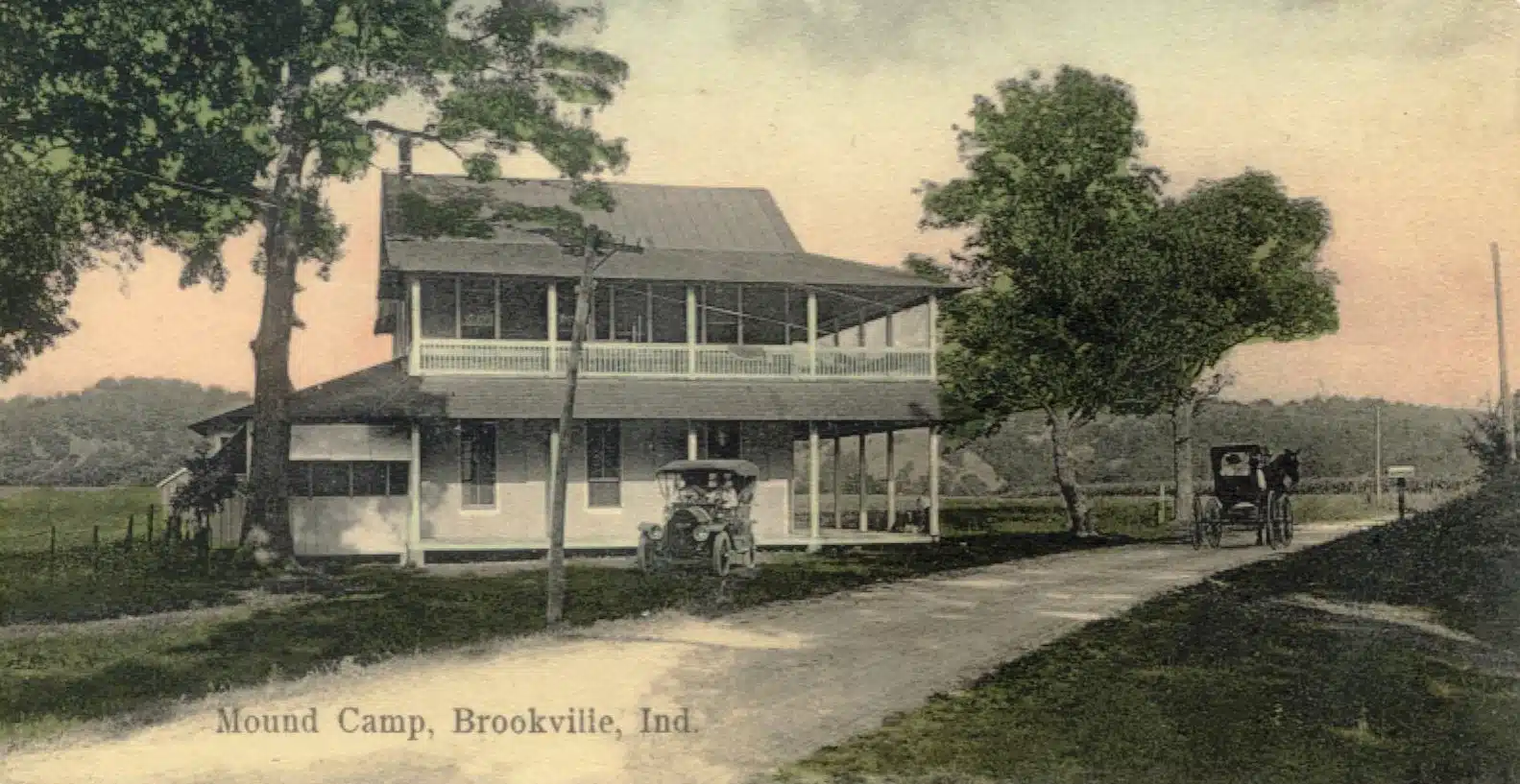
One hundred fifty invitations for the grand dedication of the new Mound Camp were sent out by the owners, and in spite of the excruciating heat of that particular summer, it was formally dedicated in July of 1911. The main building, which was once the church, now has two stories with double porches extending on three sides. It had a dining room, kitchen, and pantry, and had 2,400 square feet of veranda space. There were seven finely furnished sleeping rooms, which were screened to keep out the troublesome flies and insects.
Notice that in the early 1900s photo, when it was still used as the Mound Church, the dirt road passed in front of the church and curved to the right around an Indian mound. That mound was destroyed when the road was improved and paved.
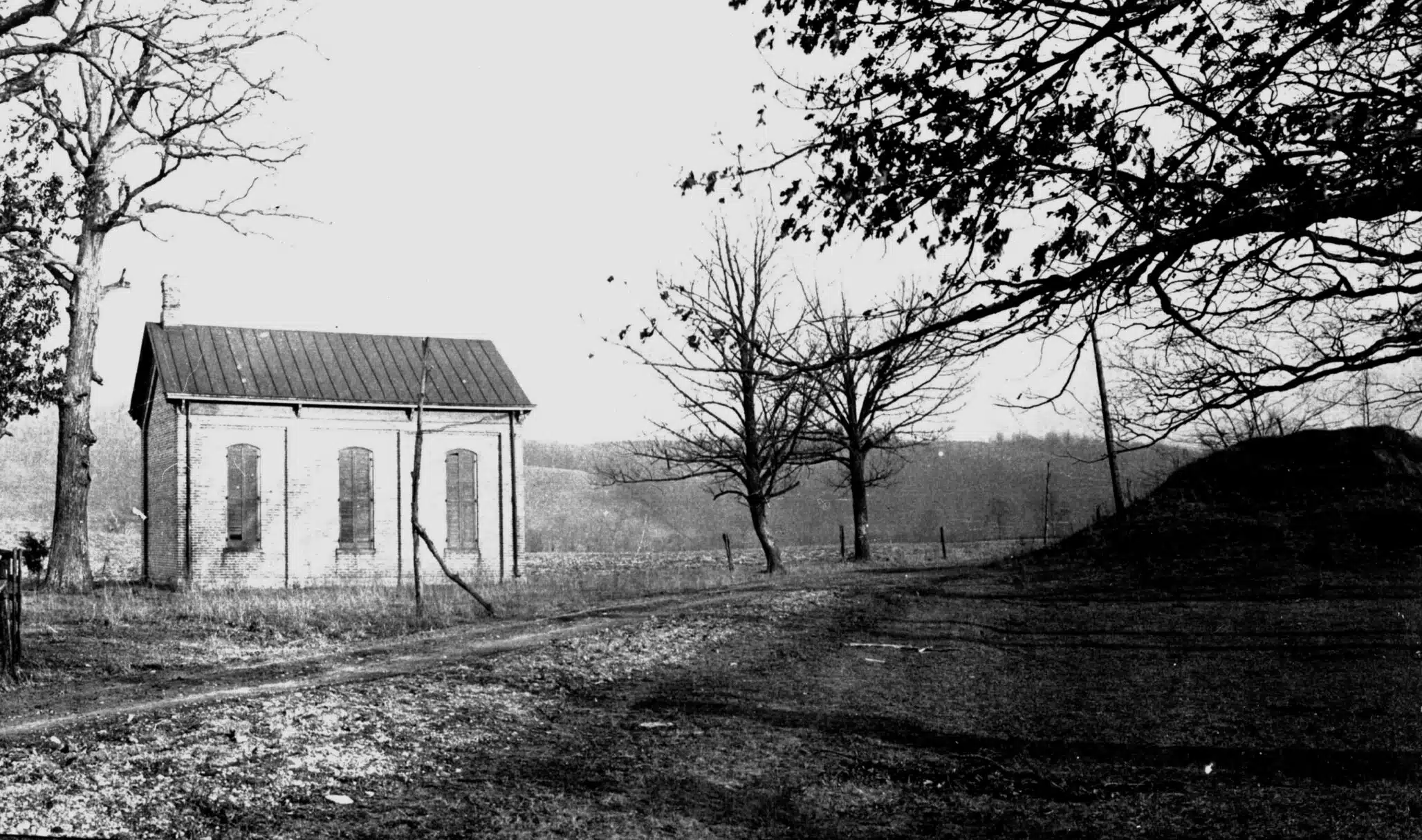
Chicago University scientist and archaeologist, Frank M. Setzler, under the auspices of the Indiana Historical Society, surveyed and excavated several Indian sites in the Whitewater River Valley in the late 1920s. His excavations were some of the first modern archaeological investigations in Indiana. He excavated three mounds in Franklin County, and the mound at Mound Haven was one of them. Setzler excavated this particular one because a new paved road was about to be constructed, which would totally destroy the mound. According to documentation made by locals in 1884, this mound originally measured 83 feet in diameter and over 12 feet in height. Eventual erosion of the riverbank, the building of the railroad, and traffic along the then dirt, Brookville-Harrison Road, had destroyed much of the mound before actual excavation started.
When construction of the new road began, steam shovels had scraped over what later proved to be the actual floor of the mound, revealing numerous pottery fragments, and Setzler noted that he had found two broken gorgets that he presumed to have been broken before they were placed in the mound. In addition, the local newspaper reported that parts of three skeletons (the bones having been scattered), several post holes, numerous shell beads drilled for stringing, pieces of pottery, traces of red ochre, a few lumps of graphite, bone awls, and several pieces of slate fragments were also discovered. However, at the time, Setzler was unable to determine with certainty the culture of the people who built the mound.
It is unclear when and why Samoniel and his partners closed the Mound Camp, but it was opened as a chicken dinner place in May 1921 by Dora Dawdy and Emmett Prifogle. The dance hall was built in the 1920s, sometime between 1921 and 1928. At some point in time, small tourist cabins were also constructed on site, which makes it one of Franklin County’s earliest “motels,” a concept that developed nationally with the popularization of automobiles, the new notion of weekend get-a-ways, and most importantly, with the onset of the once primitive auto trails being converted into standardized, paved, state roads and state highways.
As with all history, clandestine events went down behind closed doors, even in the best of establishments and families. In February 1924, under the proprietorship of, shall we just say “Bumpus,” the Mound Camp was raided by Sheriff Jolliff. The proprietor was arrested for having a still and 12 barrels of mash in the basement, and 40 gallons of moonshine in 5 kegs, found in a vault of an outhouse. All items were confiscated.
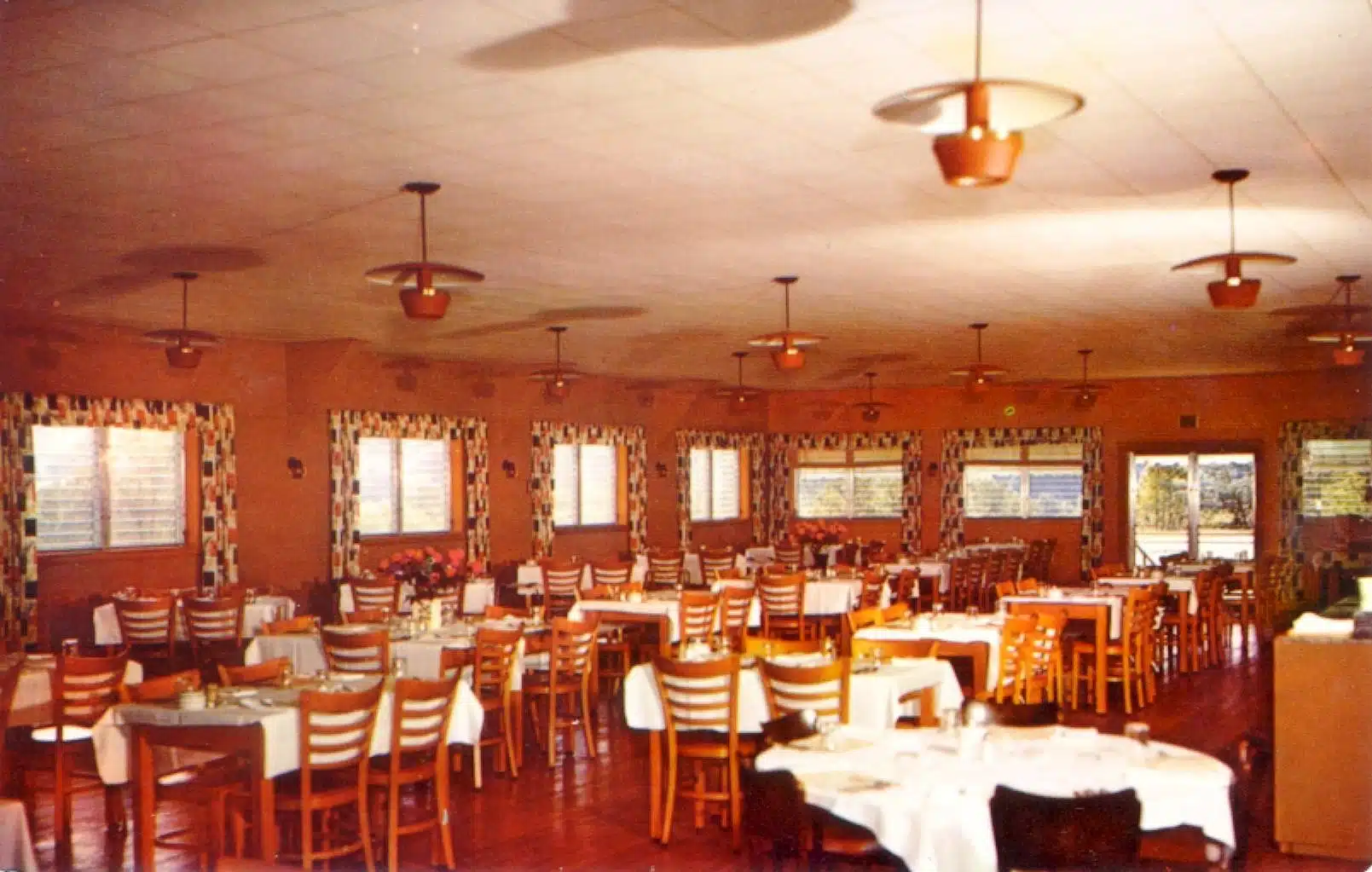
The owners who took over in 1941, Dick and Gail Watts, appear to be the ones who had the dance hall remodeled and converted into a modern dining room. The modification gave the restaurant a new seating capacity of 250 people. When the Watts owned it, they lived on the second floor of the original building and maintained the old dining room for overflow crowds and special events. It was known regionally, if not throughout the Midwest, for its fried chicken dinners, and became one of the biggest draws and weekend destinations for tourists for decades. When the Watts owned The Mounds, they boasted that they had numerous guest books that people signed – people from all over the world, who made Franklin County, and that restaurant, their destination.
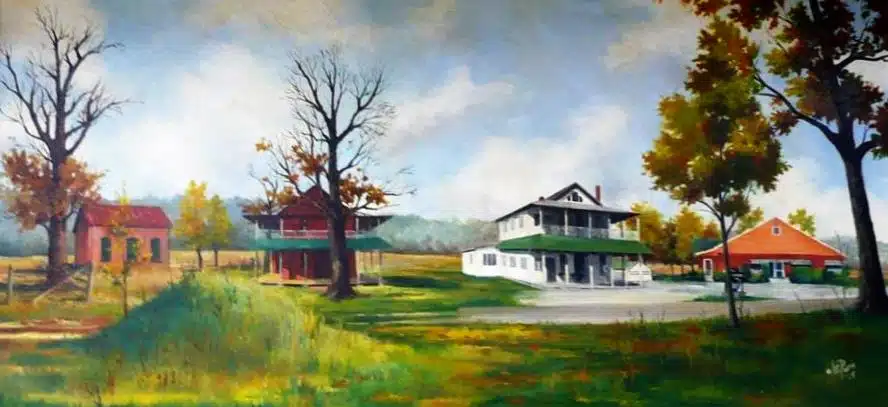
As I understand it, the LePoris painting of the Mounds came to the library via one of the former owners, Shirley and Scott May. Today, it proudly hangs in the Local History Department at the Brookville Library and catches the attention of everyone who walks through the door. It was painted in 1975 and was displayed in the restaurant for years. Many of you may remember LePoris. He was a Cincinnati native who discovered Franklin County and fell in love with it. In 1961, LePoris bought a farm near Metamora and moved his family there. He soon became enamored with the beauty and charm of Metamora and bought a small building in the town. In 1966, he opened the Fireside Gallery. It was one of the first specialty shops in the new town of Old Metamora.