![Photo with caption: A slate gorget found during the 1880s excavation of the Glidewell Mound. These were typically worn around the neck. From Dr. Homsher’s report The Glidwell [sic] Mound, Franklin County, Indiana.](https://fclibraries.org/wp-content/uploads/01-glidewell-mound-003-gorget.jpg.webp)
By Julie Schlesselman, Local History & Genealogy Department Manager, FCPLD
….’nuff said – that title is enough to pique almost any reader’s interest.
Locals’ fascination with the prehistory and archaeological findings of the Whitewater Valley goes back well over a century and a half. Here, the 1880s seem to be a heyday of discovery, investigation, and excavation, as well as the formation of clubs such as the Brookville Society of Natural History.
Some of our county’s most prolific local researchers, relic collectors, and self-proclaimed, or otherwise self-educated scientists and archaeologists include Dr. Rufus Haymond (1805-1896) and Theophilus Dickerson (1841-1920) (whom I wrote about in the April 29, 2020 Forgotten Franklin County column titled “The Relic Hunter”), Dr. George W. Homsher (1847-1926), Edgar R. Quick (1851-1917), and Dr. C.E. Case (1867-1947).
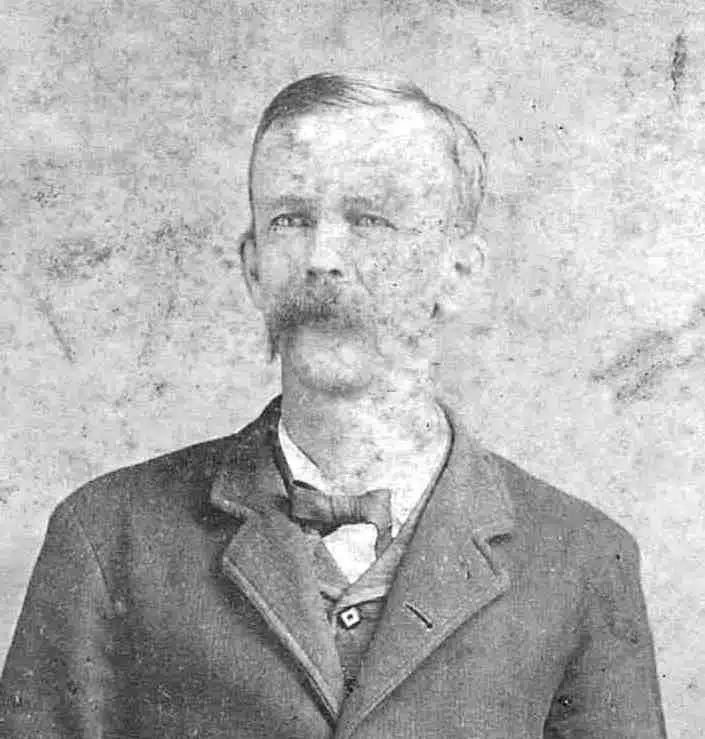
For the most part, these men became interested in archaeology and collecting because of observations and findings made in the areas in which they lived. Discovery and curiosity simply made them more inquisitive and created an insatiable desire for wanting to know all they could about the indigenous people. According to John Newman, Edgar Rollin Quick’s “primary occupation was that of a farmer and stockman in Brookville Township. He developed an interest in the study of Indians because of artifacts found on an Indian campground on his grandfather’s farm in the southeastern part of the township.” In 1882, Quick was a founding member of the Brookville Society of Natural History, and as publisher and editor of the Franklin Democrat, published reports on its meetings and papers presented at its meetings. According to John Newman, “This Society served as the forerunner of the Indiana Academy of Science, Indianapolis.” Quick collected over 2,500 Indian artifacts and published many of his studies of Indian Mounds in Franklin County. A number of his articles appeared in The Annual Report of the Smithsonian and The Indiana Academy of Science.
In most cases, local archaeology as a written topic seems to be skirted. Not for lack of materials or findings, but for exposing where mounds, village sites, workshops, burial grounds, and sacred grounds are located. Basically, the premise has grown that the less people know, the safer the prehistoric artifacts and native people’s burials will be. Before regulations such as the Indiana Archaeology Law, it was common for novices and “pothunters” to look for and excavate – for the want of a better term – Indian sites. In the 1882 Atlas of Franklin County, Edgar Quick noted that “A somewhat remarkable and possibly unique specimen of aboriginal handicraft has been recently exhumed by some curiosity seeking boys, near Cedar Grove, Indiana….on the 10th of October 1880, they discovered a human skeleton, and with it, instead of the earthen pot so often found with such remains, was a cup or bowl, made from a child’s skull.” Quick concluded by saying the location of the find was “on the highest terrace formation, about one hundred feet above and immediately overlooking the Whitewater.” Quick noted, “the place where they were found has for many years been known to be an aboriginal cemetery.”
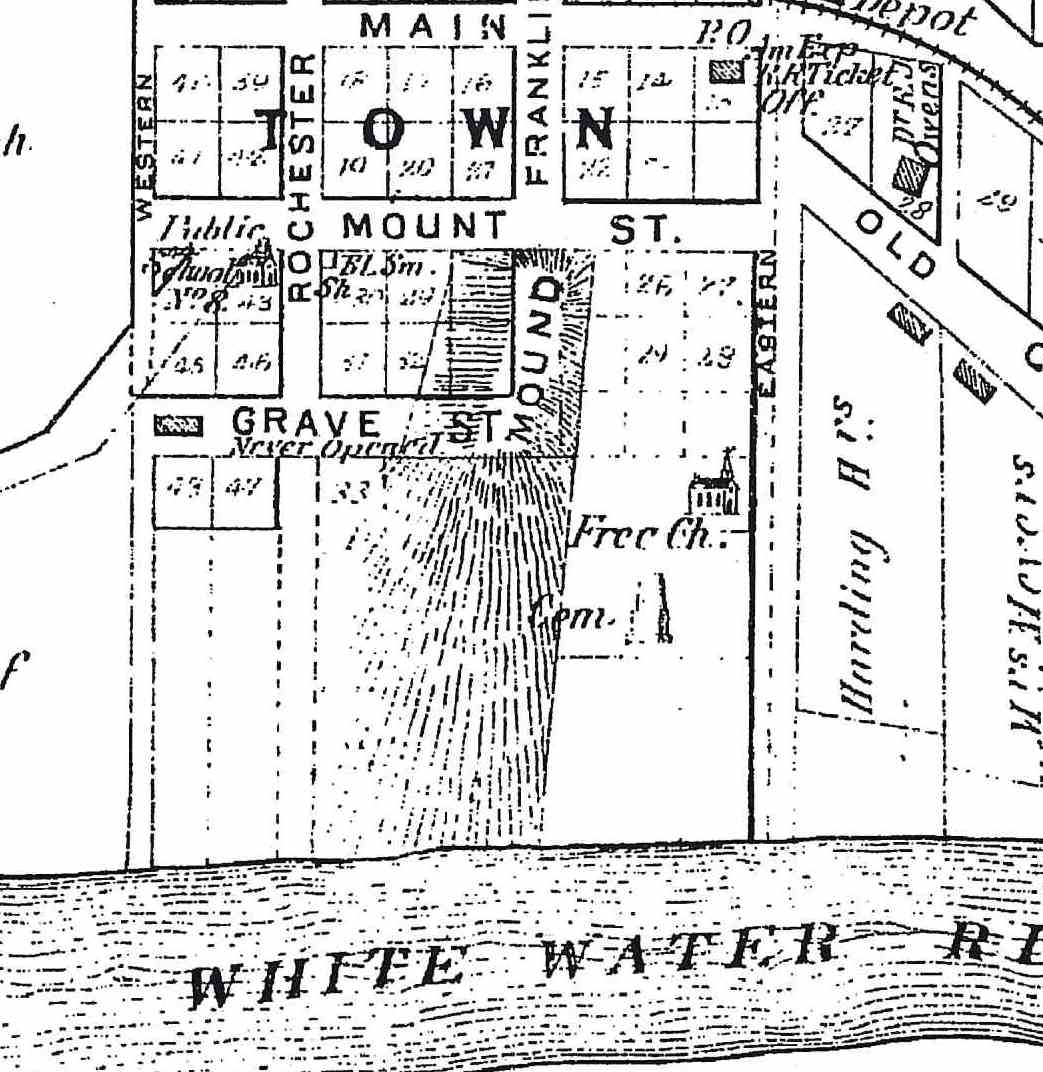
Since Quick mentioned Cedar Grove, did you know there was an Indian Mound there? The 1882 Atlas of Franklin County accounts for many of the known mounds throughout the county at that time, since the archaeology bug bit the novice and expert alike. Interesting icons for natural and man-made features appear throughout that wonderfully detailed atlas.
Possibly, the two most well-known mounds in Franklin County are the Glidewell Mound and the Laurel Mound.
Regarding the Laurel Mound, according to Frank Setzler in his 1930 report, The Archaeology of the Whitewater Valley, a bandstand was built on top of what he called “a well-preserved mound that is now in a city park.” He claimed, “Except for the leveling off of 5 feet from the top in building the superstructure, the mound is in perfect condition. It is now an artificially truncated mound with a top diameter of 26 feet. It was once a perfect circular mound which rose to a rounded cone in the center…..”
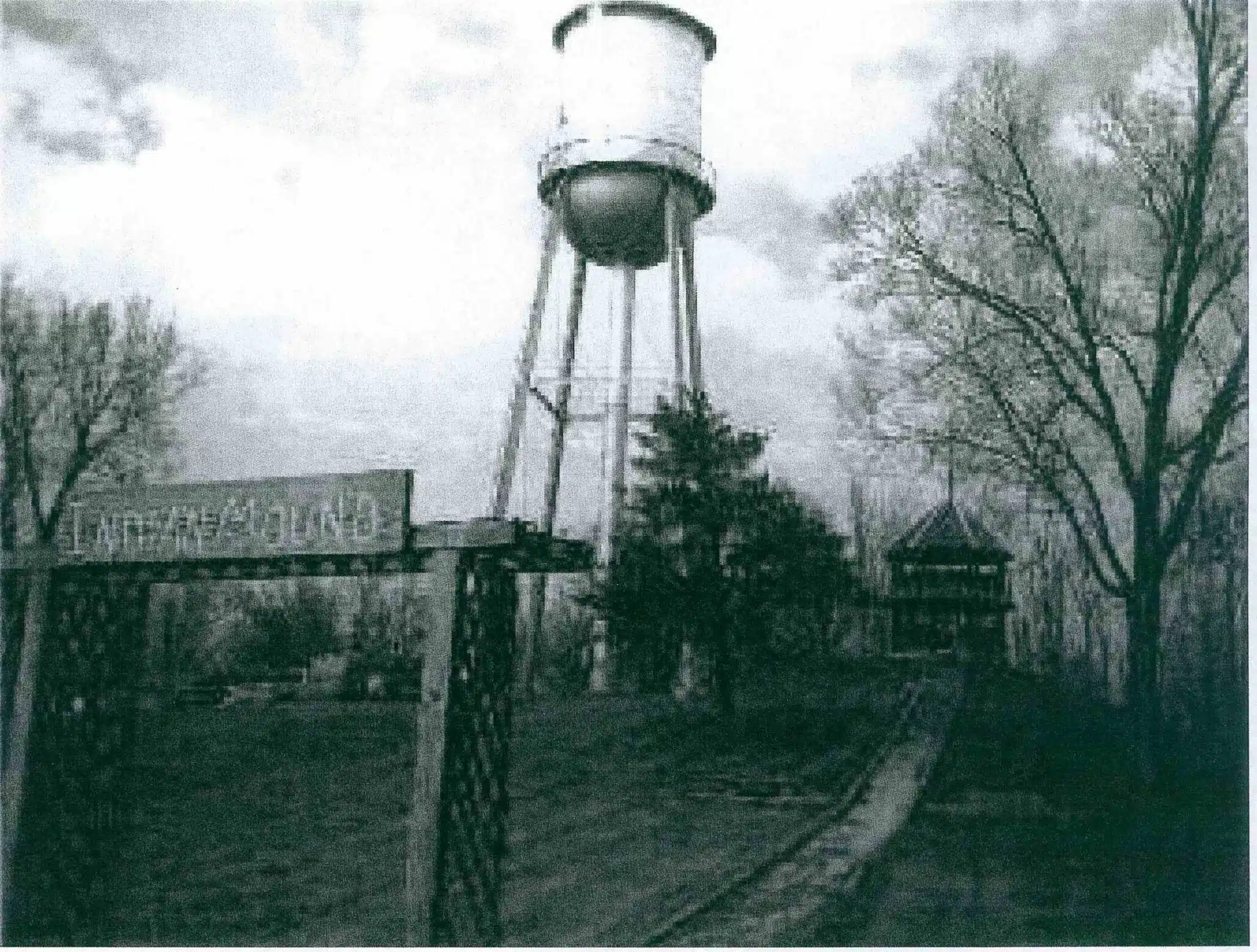
Why a bandstand was built on an Indian Mound is unclear, but probably because it’s the highest spot in Laurel and the height the city fathers felt they needed to clearly disperse their music and orators’ voices. It was a beautiful spot and a location they had to expend little energy to create, since the rise they required was already there for the taking. It appears that a bandstand was originally built on this site in 1892. The Connersville Daily News of April 1, 1892 reported, “The famous Laurel mound is being ornamented by a bandstand, and is to be converted into a pleasure resort.” People picnicked on the grounds. The bandstand was also used as a public speaking venue, and the area in general was just a popular gathering place. It was used quite heavily during the Laurel Centennial of 1936, where band concerts were held nearly every night.
The old Laurel Bandstand, in itself, is a particularly interesting historic relic since it has two levels. This makes it a very unusual structure in comparison with other bandstands throughout the state.
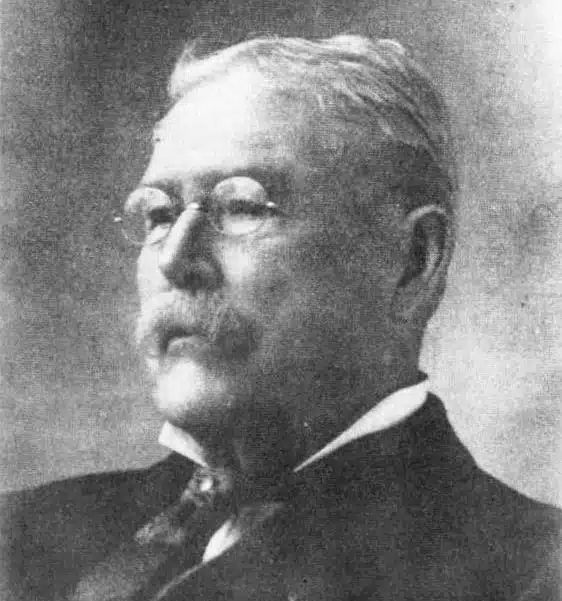
Glidewell Mound (also spelled Glidwell in historic records) is located along the Glidewell Trail at the Mounds State Recreation Area. It was first recorded around 1871 and looks nothing like it did originally; it is a mere shadow of its former self. Dr. George Homsher, then of Fairfield, along with T.L. Dickerson and Thomas Glidwell, are the ones who did the first official excavation of the mound. Additional excavations were made in the years following. A detailed and fascinating report of such, “The Glidwell Mound, Franklin County, Indiana, by Homsher, appears in a large volume titled, Index to the Miscellaneous Documents of the House of Representatives for the Second Session of the Forty-Seventh Congress 1882-83. Over the years, among items Homsher and his crew found were 25 human skeletons, copper bracelets, arrow points, pottery fragments, and a slate gorget. At one time, according to Homsher, some of these items were displayed at the “museum of the Brookville Natural Historical Society.” It is unclear where these fabulous discoveries ultimately ended up.
In his 1930’s report, Frank Setzler claimed that the majority of the Franklin County earth mounds had been excavated. In fact, by 1930, in Fairfield Township alone, out of the 24 mounds that Dr. Homsher had originally located and surveyed, only 4 were left. The rest had been destroyed or lost to cultivation and natural erosion.
![Photo with caption: Rendering of a point found during Glidewell Mound excavations. From Dr. Homsher’s report The Glidwell [sic] Mound, Franklin County, Indiana.](https://fclibraries.org/wp-content/uploads/06-glidewell-mound-001-arrow-point.jpg.webp)
If you want to discover more about the prehistory or archaeology of our area, the following items may be of interest to you: The Archaeology of the Whitewater Valley by Franklin M. Setzler, Indiana History Bulletin, Number 12, September 1930. Artisans and Artifacts of Vanished Races by Theophilus Dickerson, published in 1915 in Brookville, Indiana. 12Fr336 A Late Archaic and Late Woodland Settlement along the Lower Whitewater River in Franklin County, published by the Indiana Department of Natural Resources DHPA in Indiana Archaeology Volume 5 Number 2 in 2010/2011. Data Recovery Excavations at Site 12Fr377 A Multi-Component Prehistoric Site in the Whitewater River Valley, published by the Indiana Department of Natural Resources DHPA in Indiana Archaeology Volume 6 Number 1 in 2011. The Glidwell Mound, Franklin County, Indiana by Dr. G.W. Homsher, 1882 (available online through Google Books). Early Peoples of Indiana by James R. Jones III and Amy L. Johnson, published by the Indiana Department of Natural Resources (DHPA) in 2008.
Did you know that the Franklin County Historical Society owns an Indian mound on Dehner Road? Did you even know there was a local historical society? If not, and you want to learn more about that organization and become a member, contact me for more information.