By Julie Schlesselman, Local History & Genealogy Department Manager, FCPLD
This article ran in the December 16, 2020, edition of the Brookville American, and is in Forgotten Franklin County V. 2.
…three simple words stated by Josephine Kraus in New Trenton 1816-1976.
What would we do without local historians? They are the dedicated researchers who take an extreme interest in their communities and the people and places within them. They are the ones who spend countless hours collecting and compiling what they can to preserve our past for our future. They are the ones who interview the older generation, document precious memories and oral traditions, and copy as many images as possible before they are dispersed through estates and disappear from the community to which they belong.
Local historians typically have their works published independently and mass-copied, but in relatively moderate quantities because, for the most part, they finance their own projects and spend their own money to help educate, share the resources they have discovered, and make sure we all “learn from yesterday.” Their works are just as valuable as any professionally paid author working with a big-name publisher, yet are rarely seen in that light. Had it not been for the dedication, fortitude, and determination of local historians, many books about rural areas, small communities, and the people who lived in them would never have been produced, and so much regarding our common past would have been lost. Simply put, the local historian’s objective is to preserve history and get the information out there the best way they can.
Some of you may recall a few years ago, Josie Kraus, author of New Trenton 1816-1976, gave the library district permission to reproduce her publication. It’s been almost 45 years since she first sold her history, which has always been in high demand, but out of print for most of that time. It was originally a two-volume set. When the library district reproduced it, we combined it into one volume, and library staff created an all-inclusive surname index. Therefore, if you didn’t know, the New Trenton history book is once again available!
In addition, over the years, Josie Kraus also compiled booklets about specific New Trenton topics, including the fire department and the Methodist church; she reproduced a series of postcards, and she wrote the New Trenton community columns for the local newspapers for many years. She was tireless in her efforts performed as New Trenton’s local historian. Her knowledge and dedication to preserving New Trenton’s past are invaluable, and her works are still the primary go-to resources decades later.
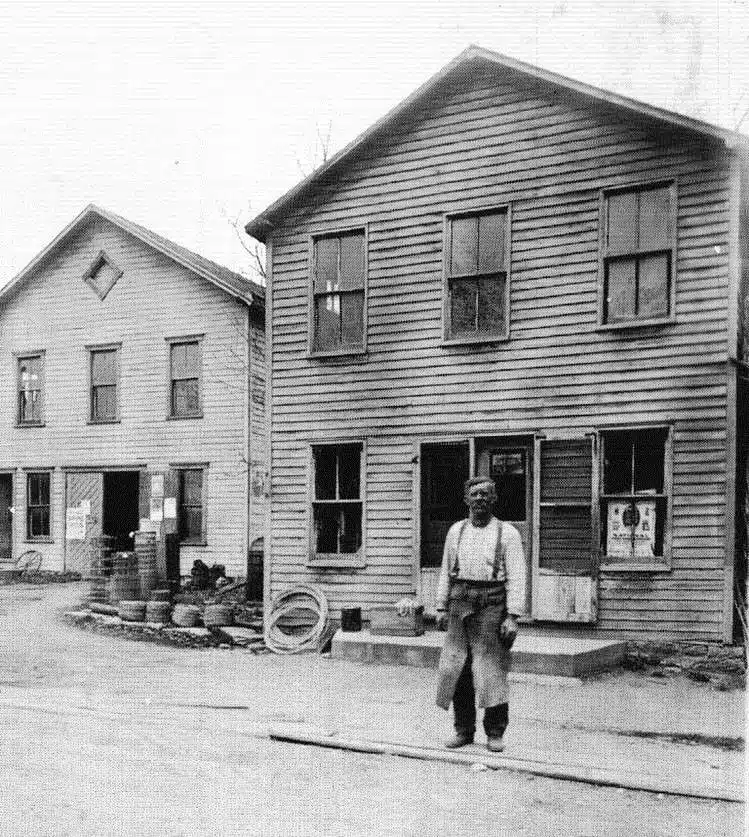
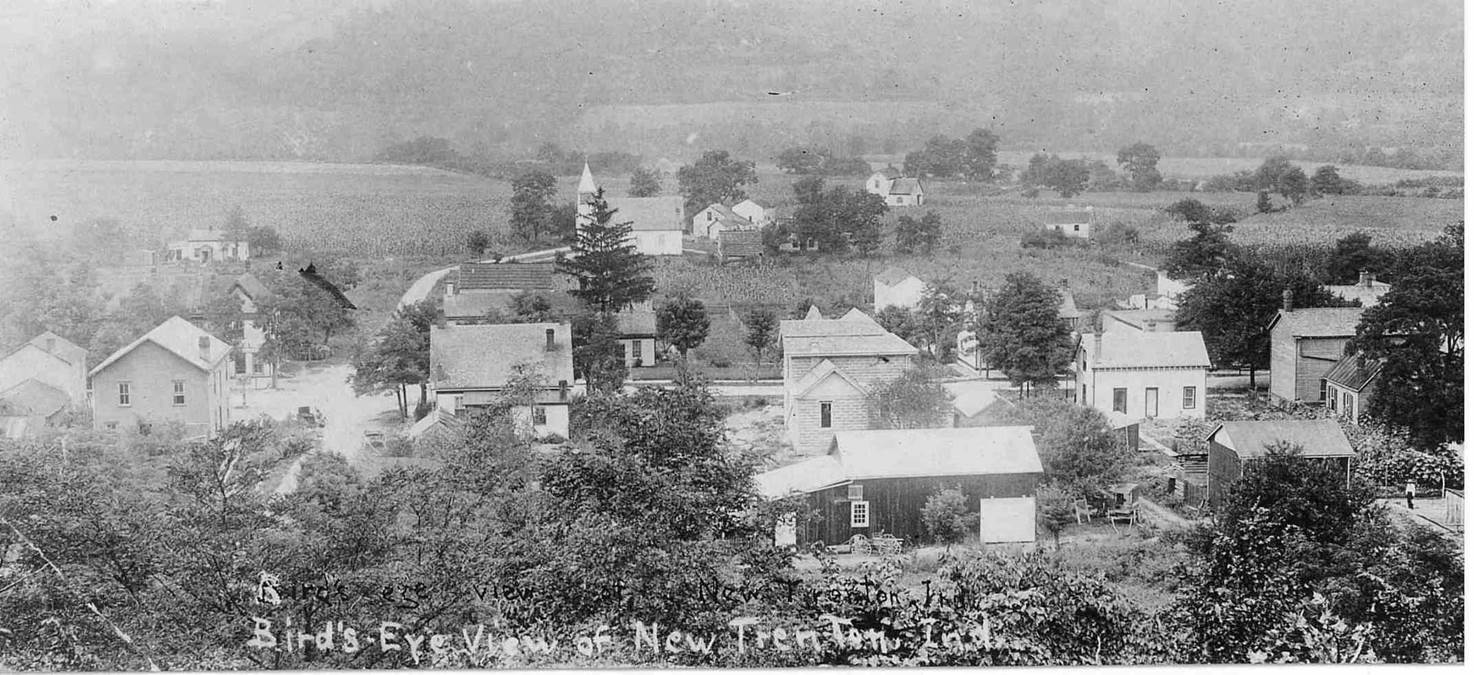
Everyone who drives US 52 heading south towards Harrison, Ohio passes through the town of New Trenton. Most rush through, simply focused only on their destination, and have no idea it was once a self-sufficient little community with a long history. The town was platted in December 1816, but non-indigenous people were in the general area as early as 1800. It once had a variety of enterprises including hardware stores, butcher shops, a tin shop, grocery stores, blacksmith shops, a cooper shop, lumberyards, sawmills, wagon makers, doctors, a bristle brush factory, milliners and tailors, a school, a public cemetery, and the list goes on. And, up until just a few years ago, New Trenton still had its own post office. This area eventually became a mecca for tourist resorts, which, along with the Widau Hotel and the YWCA camp, will be independent topics for the upcoming Forgotten Franklin County page.
Perhaps the following tidbits will pique your interest in wanting to learn more about the New Trenton area.
One of the most notorious things to happen in the New Trenton community was the 1936 robbery and beating of retired Cincinnati fireman Harry Miller. Miller moved to Franklin County and lived in a small camp along the Whitewater River. Following a botched robbery, the bleeding and unconscious body of Miller was placed in a car by the robbers, then taken to Kentucky for disposal. As Miller awoke in the backseat, somewhere outside of New Trenton and before Madison, Indiana, fatal gunshots were fired upon him. Just a few miles outside of Carrollton, Kentucky, the perpetrators cut off Miller’s head and hands so the body, which was dumped in a ravine, could not be identified. The head and hands were then placed in concrete and dumped in a lake. Historically, the story is referred to as the “Head and Hands Murder.” The trial occurred locally, and versions of this horrible incident even made headlines in numerous true crime detective magazines of the time.
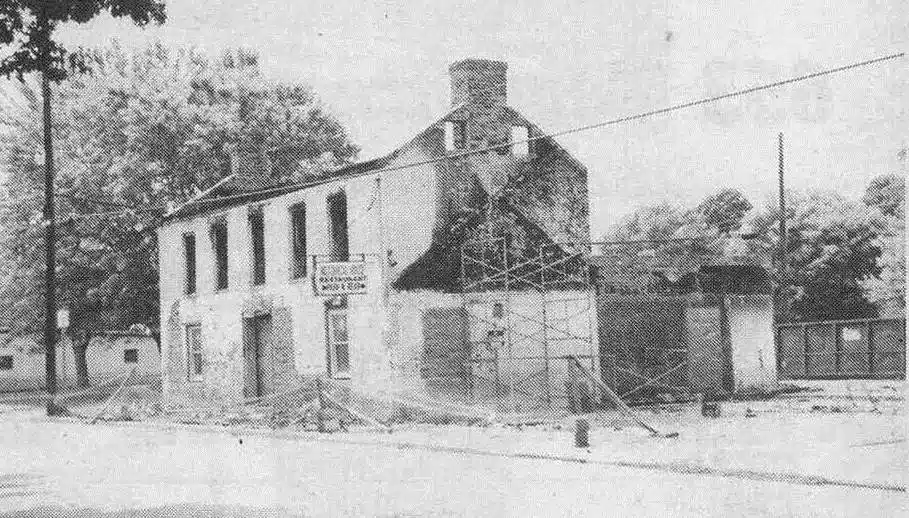
One of the oldest standing structures in Franklin County is in New Trenton. It was built about 1810 and is the former Manwarring Tavern, now once again an antique store. The historic building was ravaged by a devastating fire in the early 1990s but was salvaged and rebuilt despite the extensive damage. Solomon Manwarring, a Methodist preacher, was the first proprietor of the tavern. He sold liquor in the building six days and nights a week, but on Sundays, he closed the bar and used it as a pulpit from which to preach the gospel.
Roads across the county were very poor in the early years, so taverns and lodging of varying types sprung up every few miles – as legitimate businesses or simply as a way for people to earn a little extra money from the use of their private homes. Slightly north of, and on the opposite side of the road from Manwarring’s, Samuel Rockafeller also operated a tavern and provided overnight accommodations. He built a five-room brick home and added a large frame room that was used as a kitchen and a dining room. There were two bedrooms above it that were available for travelers and drovers taking their hogs, cattle, and turkeys to market.
For many years, the town well was the hub of activity in the little village. Residents got all their water from two hand-operated pumps. The water from these wells refreshed not only the residents but also the drovers and the animals they were moving through town.
The Whitewater Canal once passed along the western side of New Trenton. For a variety of reasons, including the fact that destructive floodwaters caused costly and time-consuming repairs and better roads were being established, canal travel became less practical, and in the 1860s, with the arrival of the railroad, the era of canal transportation ended.
The Indianapolis and Cincinnati Railroad Company secured the right to use parts of the old towpath along the defunct canal as a base for its rail bed, and “The Big Four,” the Cleveland, Chicago, Cincinnati and St. Louis Railroad, established itself in Franklin County.
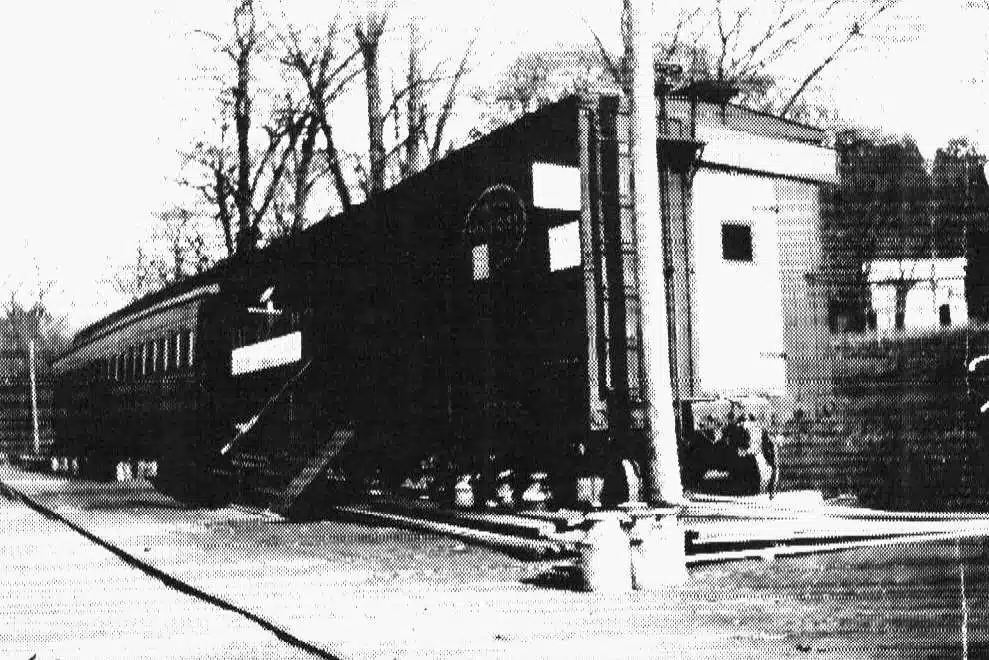
Unfortunately, the devastating 1913 flood destroyed many local train depots, and it was almost two months before trains on that line could once again travel through our county. After the New Trenton station was wiped out, a temporary makeshift depot was created with two old train cars. A boxcar was used for freight, and a coach car was used for people waiting for trains.
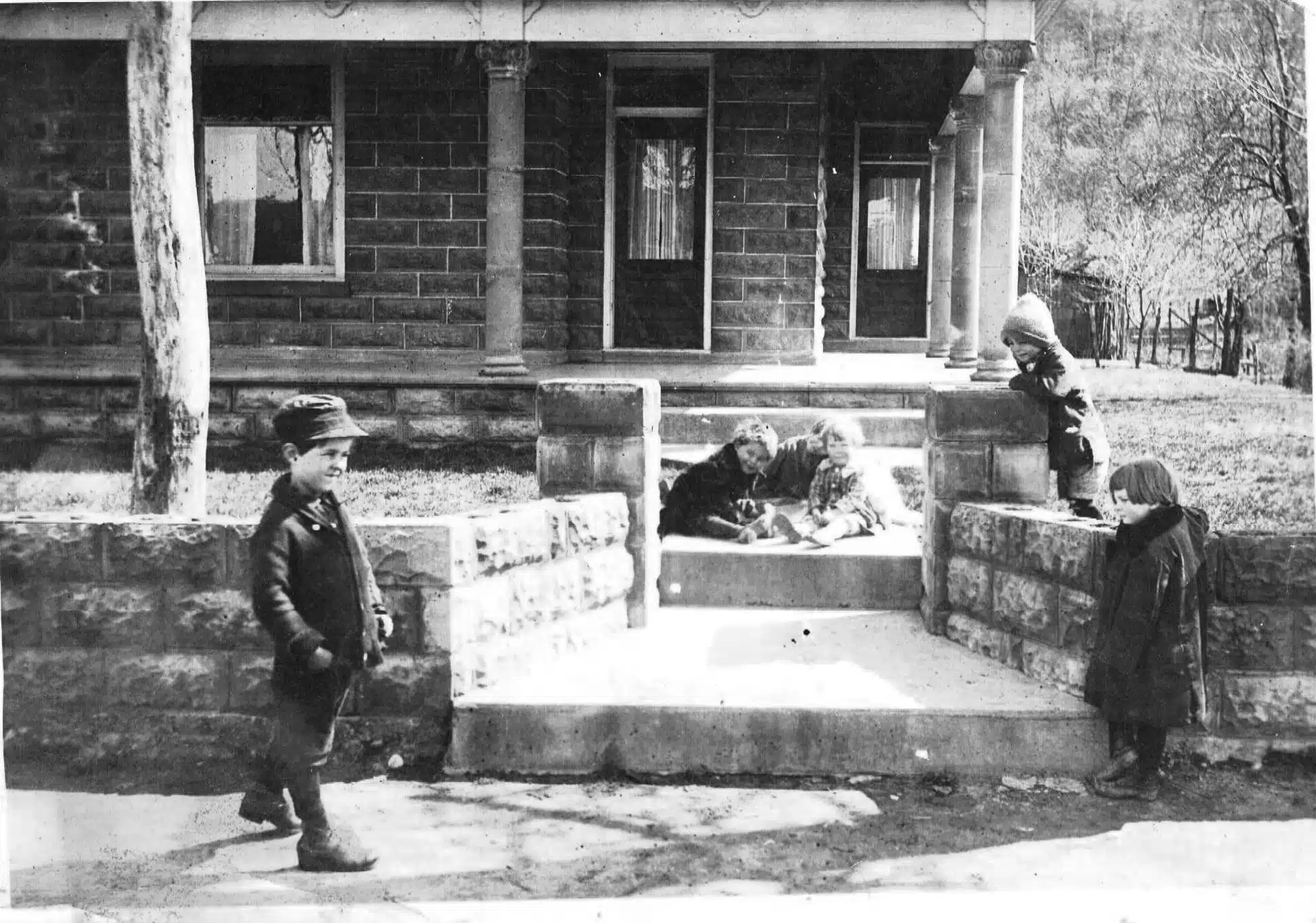
The former William and Catherine Lake home still stands along the main thoroughfare and is a unique structure in town as it is the only concrete block house left in the area and was built in the early part of the 20th century from blocks made right there in town.
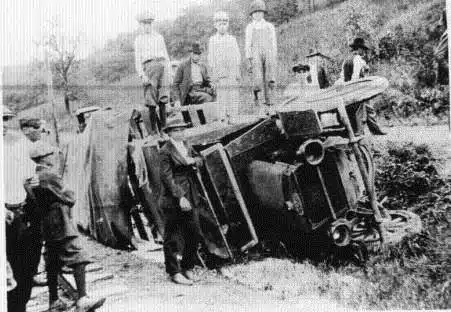
Around 1927, the main road through town, now US 52, was paved. The new smooth surface encouraged people to drive faster, and as a result, automobile accidents increased. Josie’s book even addresses a few auto mishaps, and surprisingly, or not, numerous autos ran into buildings as they rounded the curve in New Trenton, or took off at higher speeds on “the Narrows” just north of town.
Looking for a gift to celebrate a birthday or Christmas, or perhaps a thank you gift for someone who has helped you through difficult times? Then give the gift of knowledge. Many local history books, in addition to Josie’s, have been compiled over the years, and some are still available. The library’s History Department can help you obtain such titles as Josie’s New Trenton 1816-1976, or Fairfield: The Town Under the Lake; The Life of Lester Lake; and Brookville Houses and the People Who Lived in Them. Virgil Davis’ 1958 booklets, Through Our Years and Historical Almanac, can be had as copies, and machine copies of Don Dunaway’s Springfield Township and Bath Township histories (reproduced with his permission) can be requested as a copy on a demand basis. Mary-Alice Helms has a collective book of her stories that appeared in the Brookville newspapers starting in 2017, and of course, the standard county references like Reifel’s History of Franklin County and the county atlases are available from the Franklin County Historical Society, as well as the Winans’ photography book and the Brookville postcard book compiled by Craig Chappelow and Don Dunaway.
As with any work of non-fiction, the author always hopes to enlighten and educate the reader, regardless of age. Josie stated in her book, “My wish is that this publication will renew memories of times past and give our young people a strengthened value of their heritage.”
As Josie hoped, let’s help to enlighten our youth’s awareness and appreciation of their surroundings and community, and give them an introduction to their local history. You don’t have to be an adult to love history!