By Julie Schlesselman, Local History & Genealogy Department Manager, FCPLD
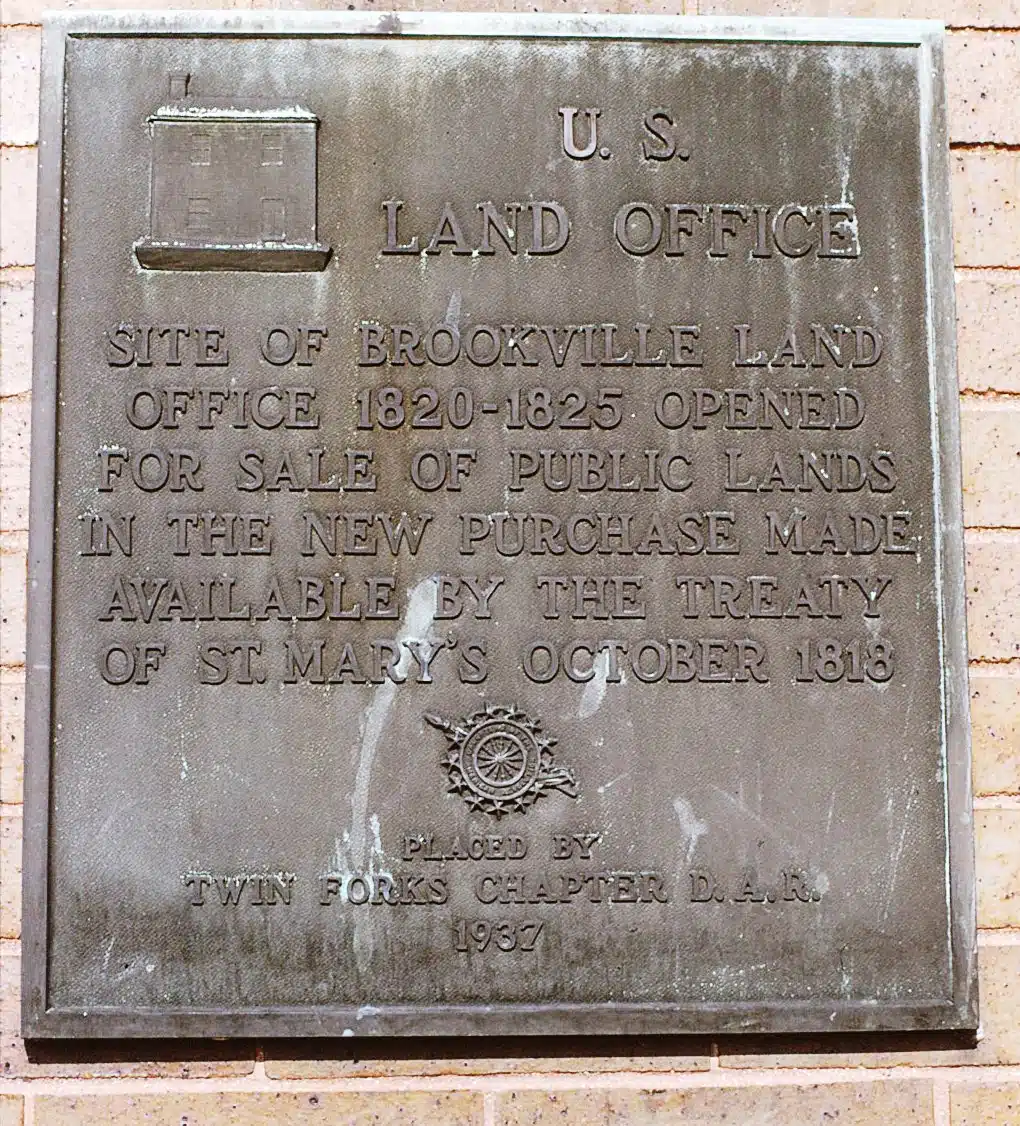
Did you ever see this plaque on the front of Knecht’s Interiors at 766 Main Street and wonder what it was all about?
A land office was a location established by the United States Government from which to sell territorial and treaty lands opened to the public. And one was established in Franklin County only nine years after it became a county. Our land office was a short-lived entity; nonetheless, it brought Franklin County and Brookville to national attention – what little there was of our nation over two hundred years ago.
Typically, it has always been acknowledged that the land office was in business in Brookville from 1820-1825. An odd entry in some of the works of historians, Chelsea Lawlis and Virgil Davis, gives 1819 as the year it was established. Upon further investigation into his claim, the reason they used this date was because an announcement was found in the March 5, 1819 Brookville Enquirer where it said “We have seen a letter from Washington, dated February 18, which states, that a bill is before the Senate for the establishment of ‘Two Land Offices in the State of Indiana,’ one to be located at Brookville, the other at Terre Haute….”
So in early 1819, the proposal for a land office in Brookville was before the Senate, but it wasn’t until 1820 that everything fell into place and it was realized. It was the first Monday in October of 1820 when land was first sold from the Brookville Land Office. Local Robert Hanna had the job as the register for the government lands.
According to the Indiana State Archives, “Indiana was part of the Northwest Territory ceded to the United States by Great Britain at the end of the Revolution. As such, the national government originally held title to all land in the state and regulated its sale and settlement. Opening the Territory was a complicated process.”
A detailed history regarding Indiana land records and the land offices can be read on the State Archives’ website.
In 1801, the United States Government started selling land in southeastern Indiana through the Cincinnati, Ohio Land Office, and by 1820, the Brookville Land Office was selling lands in central Indiana.
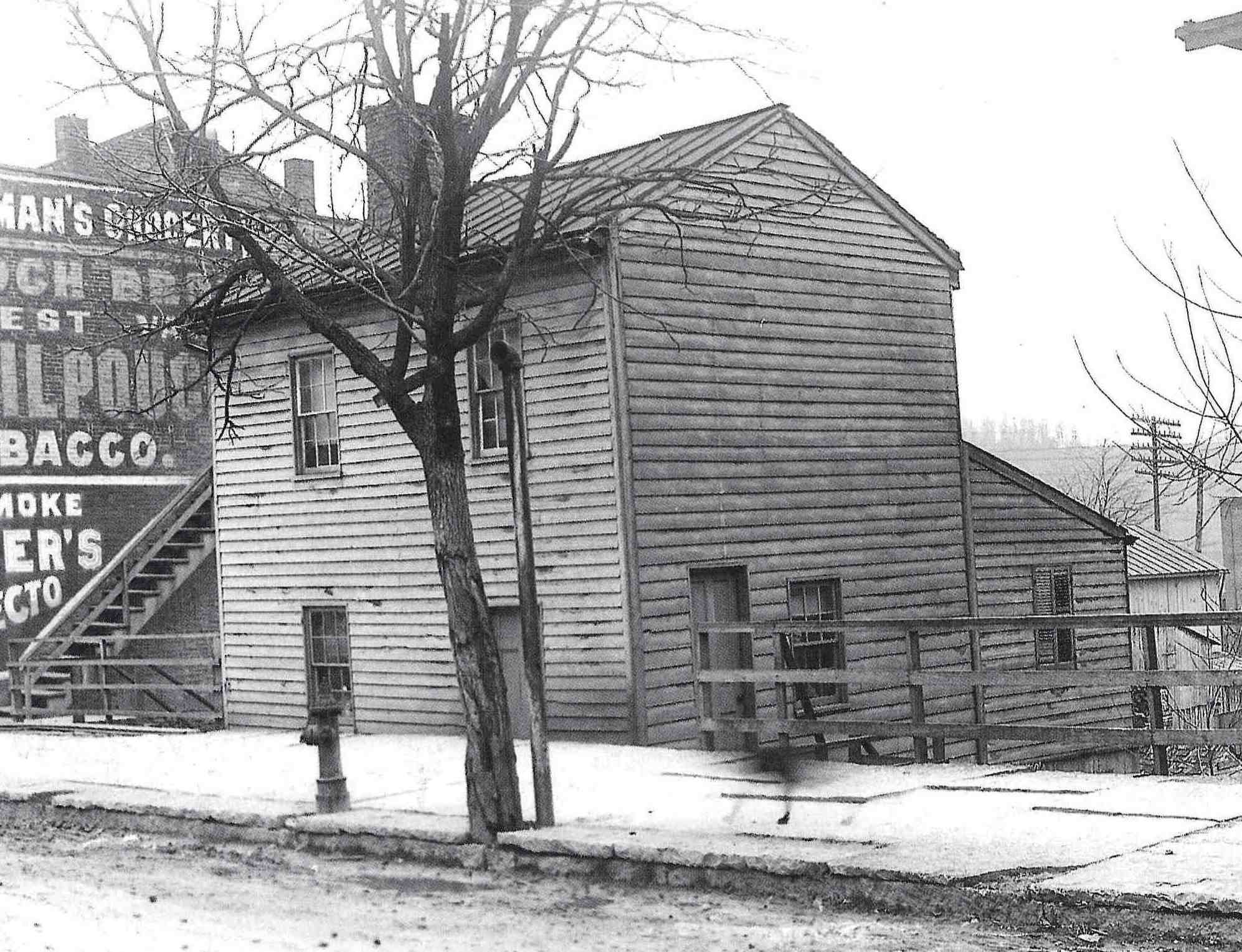
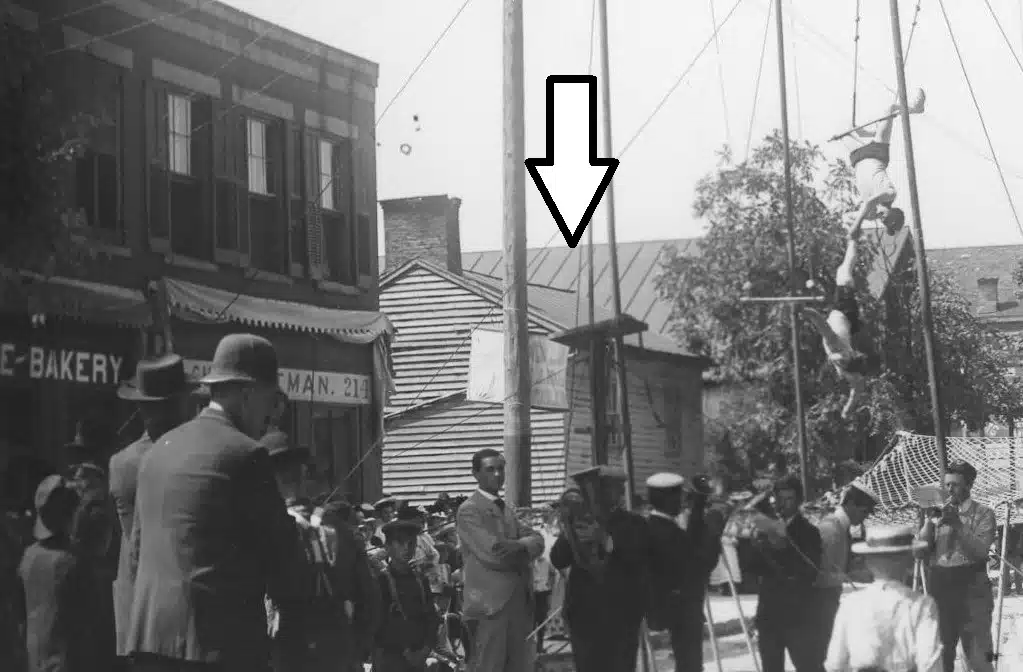
Fortunately, there exist a few photos of the Brookville Land Office – courtesy of Ben Winans, of course. Oddly, however, very little detail about the building’s history is documented in any one concise location, or anywhere for that matter. So, from scouring dozens of resources, the following is the best information about the old land office to date.
Statements from a person who actually remembered the structure, Hallie Harrell Showalter, appeared in the September 16, 1937, American. She said, “The land office was a frame structure where the building occupied by Williams & Kuntz Hardware Co. now stands.”
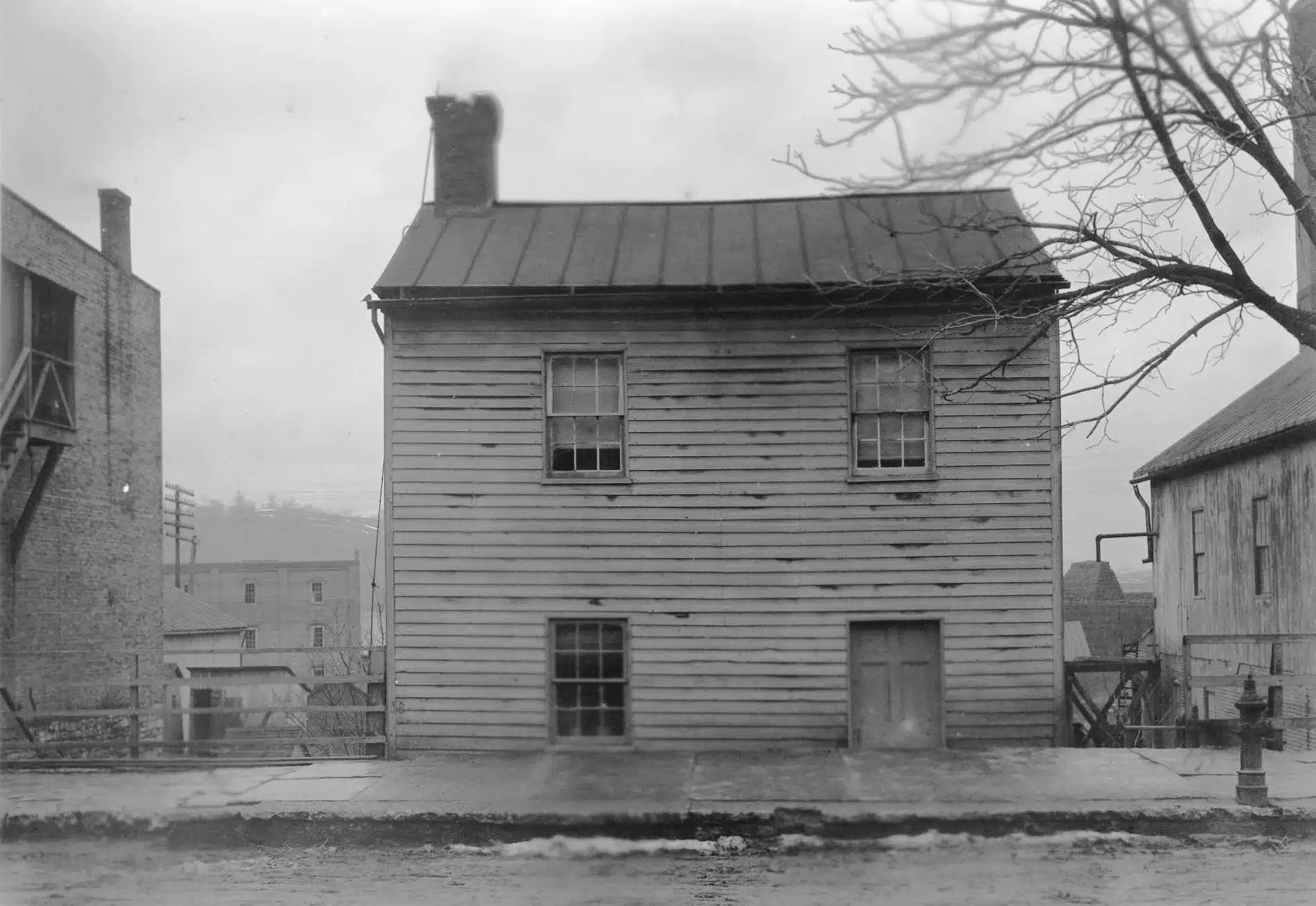
“Plain and unpretentious it had two windows in the upper story; one window and a door in the lower story facing what became Burgess or Main Street. When the building was erected the entrance was about three feet above the roadway and you entered by going up steps. Later the street was raised and for years before the building was torn down the street was on a level with the…window and [the center of the] door on the first floor; so that one descended a creaking stairway to enter.”
Hallie said the building was torn down by Frank Masters, who purchased this lot to build his new store. According to her, Mr. Masters only occupied his new building until 1922.
Hallie said the reason the land office was so short-lived was because the new State Capital of Indianapolis was seeking every way to sustain itself. At the time, Indianapolis was a village surrounded by swamps, and full of ague, and “the President of the United States was respectfully asked to direct the removal of the office from Brookville to Indianapolis.” Hallie said, “A joint resolution was introduced into the General Assembly February 3, 1825, relative to the removal of the office from Brookville to Indianapolis. The reason given was ‘much inconvenience and expense have resulted to the purchasers of public lands in consequence of the remote situation of Brookville.’”
Brookville townsmen were not happy about this request and wanted the land office to stay here. They knew its move would upset Brookville’s windfall of growth and prosperity.
Ernest Showalter, Hallie’s husband, commented about the land office about ten years after her initial public recollection. Ernest would have also have remembered the building firsthand. His comment appeared in the August 26, 1947 American. Ernest asked his readers if any of them remembered the Old Land Office. He recollected it was a two-story frame structure and “The second floor was about three feet below the street sidewalk level and you went down to enter.” Ernest noted that the wooden steps also ran down to the ground floor entrance which was some 12 or 15 feet below the sidewalk level. He claimed that “At one time a road way came up from the ford in the river past this house to Main Street. Later when Main Street was made higher, and the bridge was built, and the canal built, this road way was closed.”
The Showalter’s recollections are the only ones I found describing the building in any detail.
The June 12, 1958, Sesquicentennial edition of the local newspaper ran a huge history edition. It included photos and loads of information. While not every story is attributed to a writer, I can only assume that Portia Everett is the one who compiled most of it. She was the daughter of Ernest and Hallie Showalter. In this edition, it is stated that the Brookville Land Office was “housed temporarily in two different places before the building on Main Street was completed…The first temporary location was in a house on Court Street back of the Courthouse, the second in the brick house on Main Street now housing the Sheets Insurance agency…..This is said to be the oldest brick house in town…built in 1816.” It was also the house of Robert Hanna, the first register for the Brookville Land Office. (This house stood just north of the Wooden Apple Florist in what is now the Brookville United Methodist Church parking lt.)
Virgil Davis, in his writings from the Sesquicentennial, claims the land office was eventually built across from Hanna’s house. So from this comment, it seems the frame building was actually built in 1820 for the purpose of selling government lands.
The little building sat on the south half of lot 32 of Amos Butler’s plat of Brookville. It’s unclear who actually built the structure, but the upper level may have been used as rented living space or even an office space. Surnames associated with this piece of property were among some of the most prominent of Brookville’s earliest citizens, like Amos Butler and William Eads. Other prominents included John Pegg, who bought the lot in 1817 for $1,000, and Hervey Bates (yes, it’s Hervey, not Harvey or Henry), who bought it in 1819 for $1,400. Rarely do property transfers include anything about buildings, but in April 1820, when Hervey and his wife Sidney Bates sold the property to William Drew for $2,000, the recorded transaction included there “being the house and half lot on which John Davis now resides.” What’s most interesting about these names is that John Pegg and John Davis were in business together. They had the Brookville Manufactory where they did wool carding, weaving, and dying. This was as early as 1818.
In May 1823, Noah Noble was selling the property to Robert Hanna for $150. How Noble’s ownership transpired is a complete mystery and makes one wonder: was there a small structure on Lot 32 prior to the land office, and Robert Hanna is the one who bought the lot to build the land office building, which would push the structure’s actual construction date to 1823? If Everett stated the land office was once operated from Hanna’s house, this too is a plausible theory.
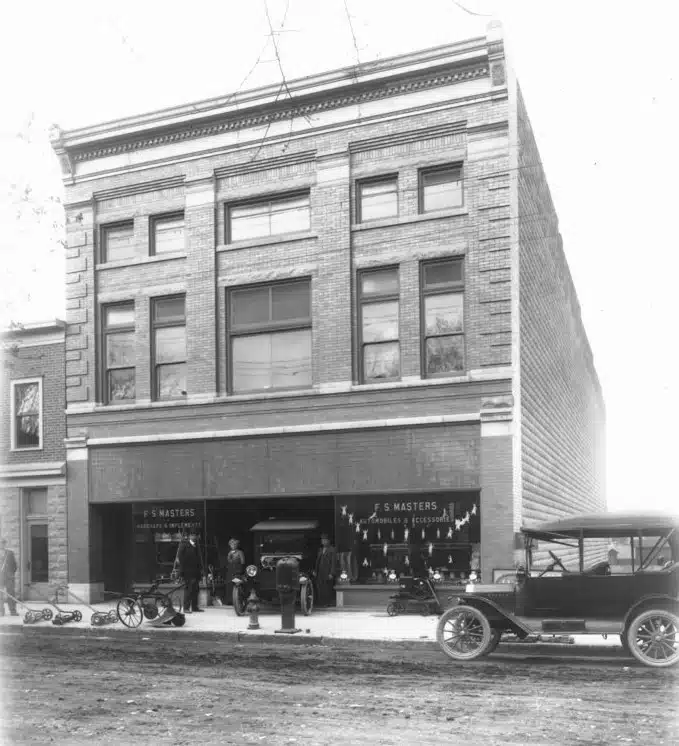
As the Masters Store was being built, the April 29, 1914 Democrat said “A copy of this issue of the Democrat and the other county papers and a number of other documents will be placed in one of the hollow concrete blocks at the northeast corner of the building being erected by Frank Masters for his hardware store on the site of the old Land Office of pioneer days.”
None of the old newspapers make mention of what purpose the frame building served after its usefulness as a land office ended. It wasn’t until the February 21, 1907, Democrat where it mentioned the old land office was still standing and in use as a “modest tenement.”
The October 15 (16), 1913, Democrat and American newspapers mentioned on the front page that the “Old Public Land Building is being Torn Down.” It said, “another landmark gives way to the onward march of progress and improvement.”
“Workmen have been busy this week tearing down what has always been called the old ‘Land Office’ building on Main Street, south of the Grimme (formerly Kimble) flour mill.”
The name Grimme is important here. Not only was he once the owner of the land office building, but the February 25, 1915 Democrat said that the old mill (which sat in the north part of lot 32) was being torn down. It was engulfed in a fire in January of that year, and the machinery was a total loss, but what was left of the structure was “being torn down and hauled to the farm of the owner, Henry Grimme, where the material will be used in building a barn.”
Did Frank Masters just tear down the land office, or since Grimme sold it to him, did Grimme dismantle the land office too and recycle it into some outbuilding on his farm? It’s possible, but the factual information just doesn’t exist to the affirmative.
In his two front-facing photos, Winans captured an exceptional example of what the earliest frame buildings of Brookville looked like – examples of which are rarely seen today, as most have been destroyed to build bigger and more modern structures.