By Julie Schlesselman, Local History & Genealogy Department Manager, FCPLD
This article ran in the April 6, 2022, edition of the Brookville American and in Volume 3 of Forgotten Franklin County.
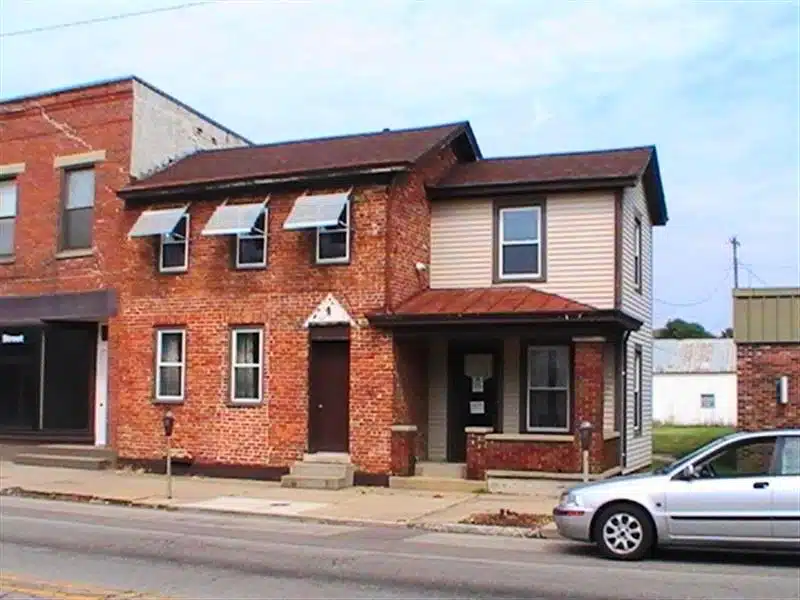
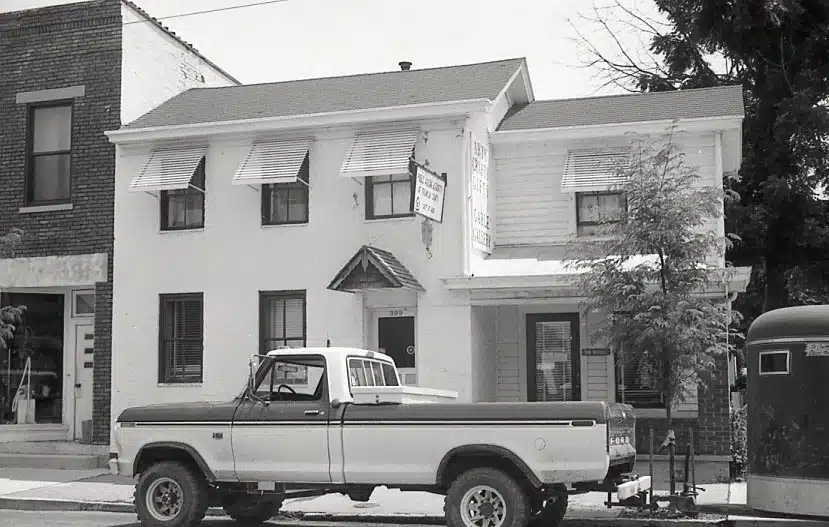
The little building at 309 Main Street always intrigued me. I knew it was old because of the brick style and the brick lintels above the windows. To my regret, I passed by it regularly with no thought of photographing it because it was one of those places that was just always there. And, why shouldn’t it be tomorrow? But as it turned out, it was one of those now commonplace occurrences where it is there one day and gone the next. And, unfortunately, I missed photographing it before it was destroyed.
When I asked around about the little building’s history, no one seemed to know much about it, and I was told it didn’t really have any significance. Some exhaustive research and assistance provided to me by Brookville Library staff member Judy Leary, unfortunately, seemed to corroborate that fact. Besides it having been a house and a location for a few businesses, she could not find anything extremely important to our historic record. Unless we can pinpoint a builder, its only significance was the fact that it was probably at least 170 years old when it was torn down in 2015.
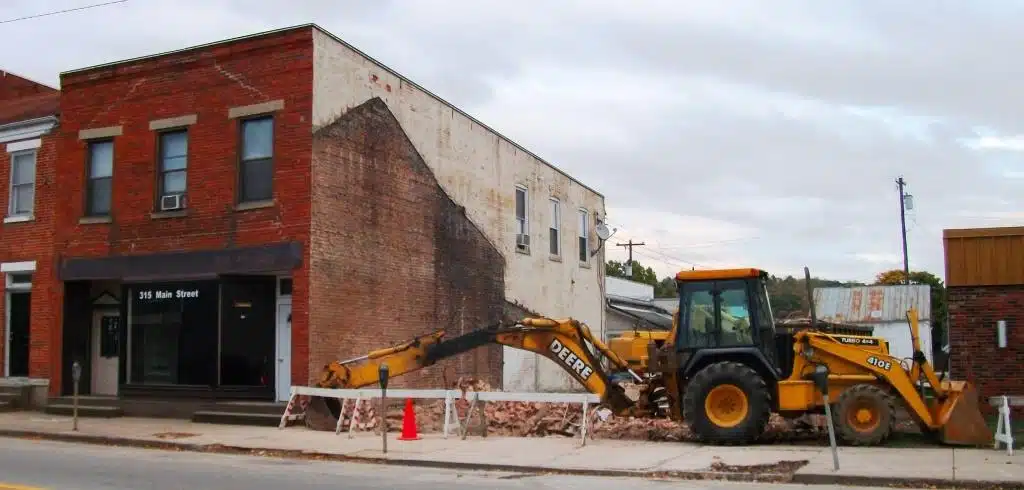
So from our research, here’s what we know about the little brick building, whose ghostly outline on the neighboring structure is the only thing that remains to prove it ever existed.
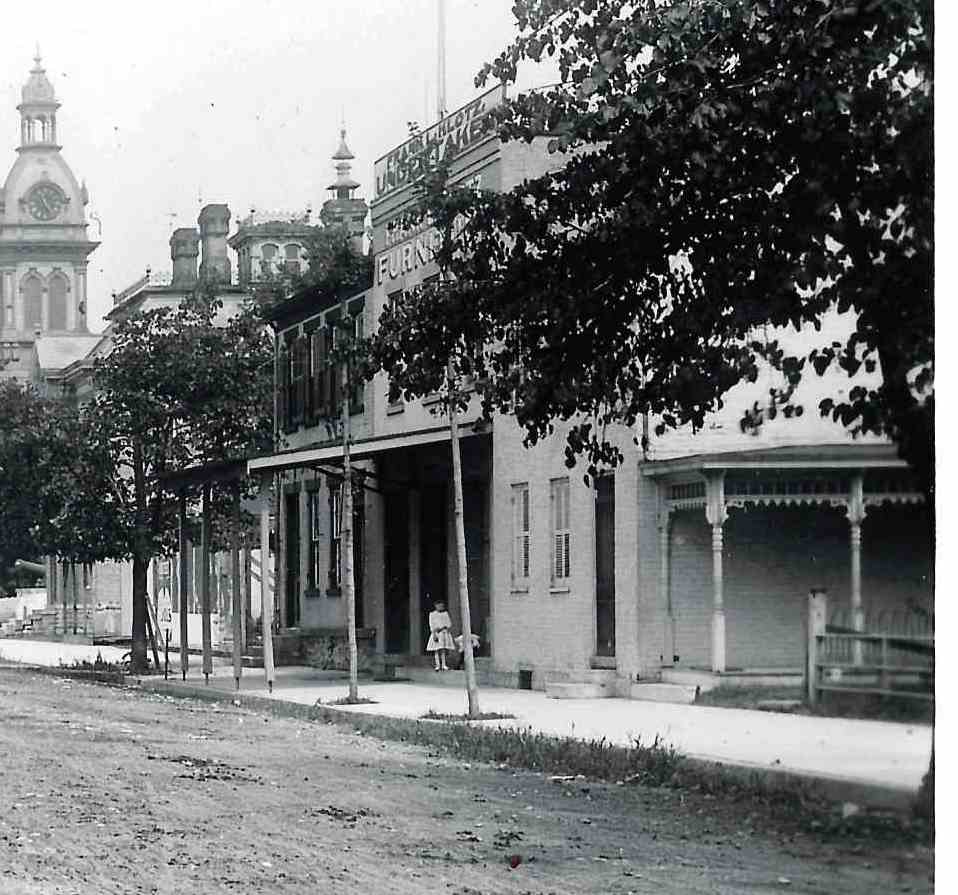
We have no historic photos of the house looking at it straight on. The only historic image comes from a Ben Winans photograph taken on September 2, 1906, looking north through town from near the intersection of 3rd and Main streets. When the Winans’ image was cropped and enlarged, it shows nothing more than a small portion of the brick house with a small wooden porch.
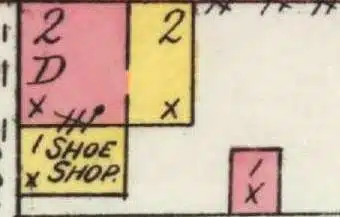
The earliest Brookville-related Sanborn Fire Insurance Company map from 1883 shows that this building had frame additions attached to it on the rear and to the south. From the notation on this map, which says the southern wooden addition was “vacant,” it implies that, though attached to the brick structure, it was occupied separately, probably as a business. The size of the frame structure on this map implies that it was not the same frame structure on the house when it was torn down. The brick structure located on the maps for 1883-1925 was always labeled as a “dwelling.”
The 1887 Sanborn map shows that the southern frame addition is no longer vacant, but being used as a “shoe shop.” This was also the case on the next Sanborn map of 1892. So, it is assumed that part of this old building served as a shoe store for at least five or six years. Probably not only were shoes sold here, but made here as well. Yes, there was a time in our history when it was common for shoes to be tailor-made to order.
After examining all of the Sanborn maps for that section of Brookville, it appears that between 1900 and early 1906 is when significant exterior modifications and additions were made to the brick house, reflecting the look we all remember.
The only thing I ever knew the building as was the HUD Office – Housing and Urban Development. But from the 1978 image which accompanies this article, it appears that the Gable Gallery, Arts, Crafts, and Gifts was at this location once also. Since the sign on the building does not appear to be an advertising sign giving another address, that’s my assumption.
The various images we have of the building show that it was painted. Removal of the exterior paint probably occurred sometime between the 1980s and early 2000s. With the removal of the paint, one can see that the original doorway was centrally located between the two windows. The original configuration of this little building implies that it looked very similar to “Nixie’s” at 563 Main Street – a building also dating from the same time.
It is unclear who operated the shoe store at this location in the late 1800s – possibly just someone who rented the space, since ownership seemed to change hands a few times during these years. Since no exact address or house number was ever given as a location in the early newspapers, it is assumed from vague descriptions that this property was also used as a saloon, and once had a blacksmith shop on it, which was operated by Simon Zahn.
A sampling of surnames associated with this location over the years includes Wade, Rudisell, Felz, Knoth, Miller, and McKibben.
C. Russell McKibben bought this property at auction in September of 1945 from the Fred Miller estate. It was one of three of Miller’s parcels being sold off at the time, and was advertised as having a brick and frame dwelling house, with four rooms downstairs and two rooms upstairs, a bath, two toilets and sinks, a garage, and a coal shed.
After McKibben took possession, in February of 1946, he was advertising two of the property’s outbuildings for sale in the Brookville Democrat – one that was 12×14 for $50, and one that was 12×18 for $250. McKibben stated they were “good enough for living quarters” – and if bought, they must be moved.
In its final years, this little brick house served as an office for the Public Housing Authority, and had a small apartment on the second floor. From all accounts, the last few people who were ever in the house said it was in poor condition. It’s been gone six years now, and the site is currently a graveled parking lot.
Perhaps more about this little building and its occupants will be found in future records as they become available.
If you purchase a place that has fallen into disrepair or inherited one that you just can’t care for and it must be demolished, don’t forget to take photographs inside and out, and send them by the way of the FCPLD’s Local History & Genealogy Department so we can preserve them for posterity. Even a few photos, regardless of their quality, are better than having no documentation of the cultural creations made by those who came before.
While on the subject of historic buildings, do you have an old property abstract that you kept as a family souvenir, inherited, or found at an auction – and now you’re not sure what to do with it? Donate it to the library’s Local History Department, as we already have a small collection of those documents in our Archives. They can be invaluable to researchers and really need to be preserved.