By Julie Schlesselman, Local History & Genealogy Department Manager, FCPLD
This article ran in the January 15, 2020, edition of the Brookville American.
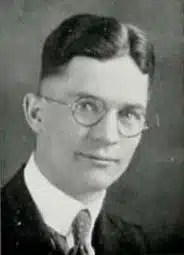
Glenn English died in California in 1951. He was born in Midland, Ohio, in 1898, but called Franklin County his home for many years and spent the majority of his formative years in Brookville. After he graduated from Brookville High School in 1916, he attended Indiana State University and received his Doctor of Medicine degree from that institution in 1922.
His childhood years must have been difficult, as it appears through public records that his mother and father divorced when he was only eight years old. The cycle seemed to follow his own adult years, as Glenn also ended up divorced; however, he had no children. When Glenn died, his obituary in the Brookville Democrat said that he was survived only by his mother, Mrs. Nellie Magley, and her husband, both of Brookville, his brother Rawn, who at that time lived in Webster, Missouri, and his aunt Maud Robeson of Cincinnati, Ohio.
Glenn Greer English, who was of tall build, with dark hair and blue eyes, was only 53 years old when he passed away at the Rural San Fernando Veterans Administration Hospital in California. He had suffered from a lingering illness for the last four years of his life and died of Pulmonary Tuberculosis. The disease appeared to have been treated once, then reinfection occurred, which was noted on his death certificate, as active and far advanced. The certificate also noted that Glenn had spent over the last year and a half of his life in this hospital.
Glenn’s mother was Nellie West, daughter of William and Mary West of Brookville, and his father was William C. English. In 1896, the local paper referred to W.C. English as the popular B & O Southwestern Railroad operator when it announced that a hefty 10-pound baby boy, who was Glenn’s brother, Rawn, arrived at the family home.
For unknown reasons, his mother, Nellie, filed for divorce in 1906. For a time, Glenn and his brother Rawn lived with their maternal grandparents, William and Mary West, on Second St. in Brookville. William was a brick mason, and their neighbors were the Lafforge and Deutsch families.
Glenn did his medical intern work at city hospitals in Indianapolis and Louisville, Kentucky, and in July 1923, the local papers announced, “Dr. Glenn English met the Ford Motor Company officials by appointment…last Monday as to accepting a position in their hospital at Detroit.”
On July 15, 1924, Glenn married Kathleen Young of Detroit, Michigan, and a local newspaper article of the 24th installment said, “They will reside in Hollywood, California, where he has fitted up an office and will practice his profession.” This event and move were just one year after he accepted the Detroit job.
So why did Glenn leave the Ford Motor Company and move to California? Was it because the climate was better? Did he foresee the need of physicians in this rapidly growing state? Did he have friends there? Did his wife influence him? The true reason eludes me. My assumption at this point would be that he had extremely high aspirations for himself as a medical practitioner and had friends who simply recommended the growing movie capital of the world. A few weeks back, in an article, we discussed local boy Guy Bogart, who moved out to California and became mayor of Beaumont. And, Brookville philanthropist and businessman, W.D. Bradt (whom we have yet to discuss in an article), had a home in Los Angeles, migrating West every winter until he took up permanent residence there. It is quite possible that Glenn knew both of these men and perhaps they had some influence on his decision to go to California.
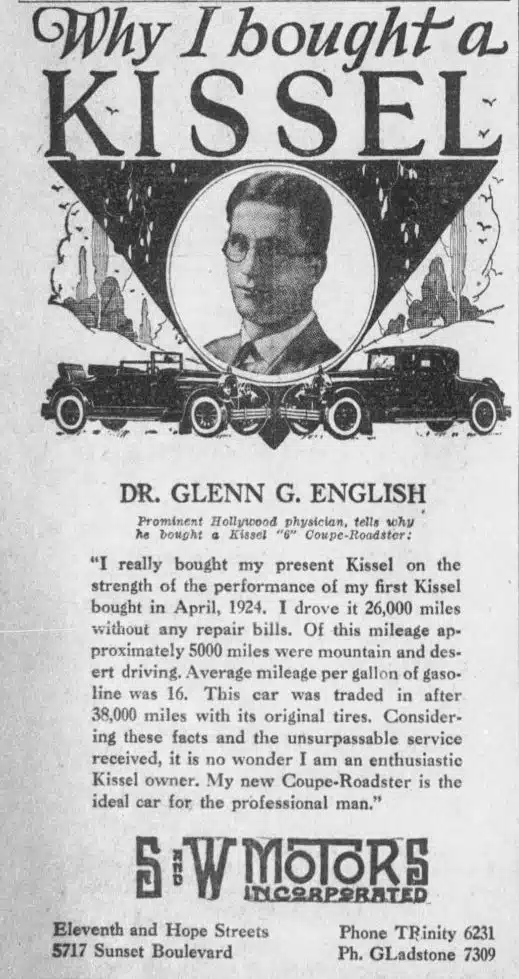
Glenn must have quickly ascended the ladder of success, for in the Los Angeles Times of August 29, 1926, he gave a testimonial for S & W Motors. He stated he bought his Kissel Coupe-Roadster because of the superior performance of his first Kissel. He said, “My new Coupe-Roadster is the ideal car for the professional man.”
Glenn’s life was not without its drama regarding what we would consider more modern-day phenomena. In 1928, he was threatened by fugitive murder suspects. Accounts vary, but the gist of it was that Dr. English returned home one evening and he found two men on his property. One threatened his life by waving a gun in his face, telling him to run for his life and get out of the car, in which they stole and absconded. In 1930, a wounded bandit, accompanied by a companion, entered the office of Dr. English and demanded treatment for a gunshot wound in the foot and another in the back. English refused, saying he would have to contact authorities and get permission from the police first. “You don’t call any police,”… the wounded man said, producing a revolver. Needless to say, Dr. English treated the bandit and then notified police. In 1932, he was called to court to testify that a former patient of his was a narcotics addict. Dr. English stated that he could find no illness or disease with his patient, but that she continued to demand a variety of pain medications. Her continued attempts, over two years, at obtaining prescription medications from Dr. English, forced him to drop her as a patient. He had a reputable practice and wanted to keep it that way; his opinion at the time was “she was an addict.”
While no military service information could be found for Glenn during WWI, according to the positive response he noted on the 1930 census, he did serve. He answered affirmatively that he was a veteran of the World War.
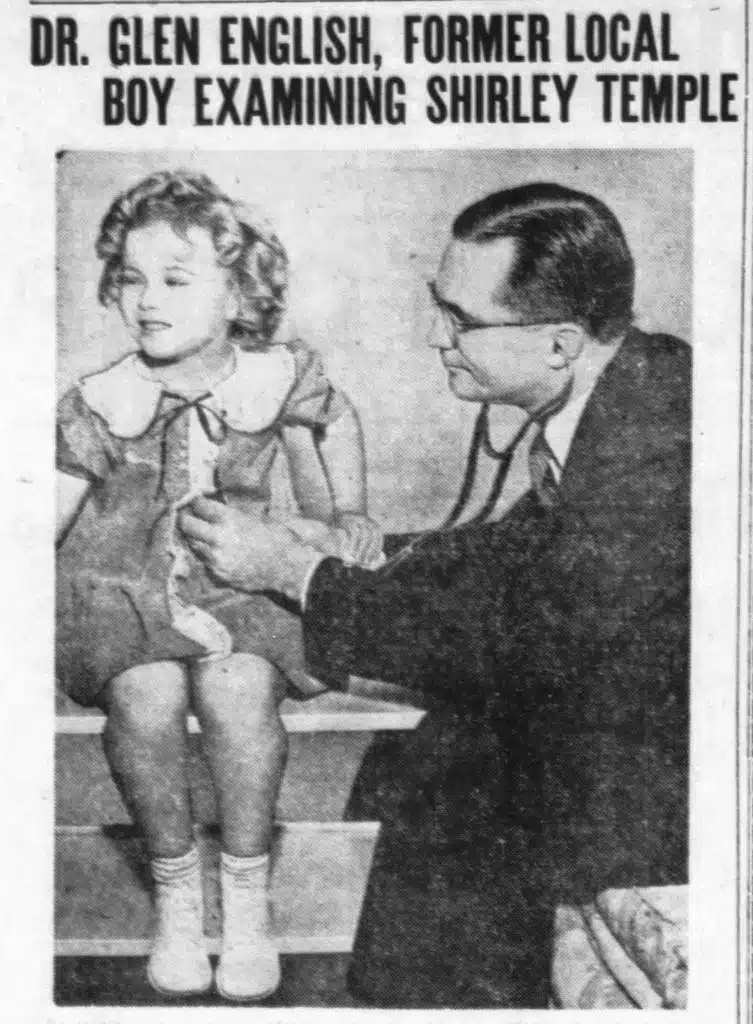
In May of 1935, the Democrat proudly displayed a photo of Dr. Glenn English examining the then superstar, Shirley Temple. The Associated Press across the county said that Dr. English conducted a thorough examination of Shirley for a life insurance company.
Glenn remarried in California in November 1935 to Maudie Schade, who was originally from Ontario, Canada. The ceremony was held at the bride’s residence. After they returned from their honeymoon, they made their matrimonial home at 5728 Cazoux Dr., in Hollywood.
When war broke out, Dr. English gave up his practice, immediately answering his call of duty, joining the Marine Corps. Newspaper accounts regarding the doctor noted, “Before entering the service, Commander English…was a Hollywood physician whose patients included Ann Sheridan, Brenda Marshall, Bill Holden, Edward Arnold, Paul Whiteman, and Marine Lt. Col. James Roosevelt, [the oldest son of President Franklin D. Roosevelt]….He was medical referee for many life insurance companies and was consulting police surgeon for Los Angeles, in which he maintained his residence and was formerly an examiner of the Los Angeles Police and Firemen’s Pension board. A fellow of the American Medical Association, Commander English served on the staffs of a number of the Los Angeles hospitals.”
On August 17, 1944, War Bulletin No. 120, released by the Franklin County Civilian War Council, was posted in the Brookville Democrat. It mentioned a snippet of information that should surely be looked into further, for it appears that another Franklin County resident was a forerunner in modern beliefs and practices in his chosen profession. The article said, “More testimonials for Blood Plasma. The publication of his definite testimonial in behalf of the magic work of blood plasma credited to a former Franklin County boy, Dr. Glenn English, of Hollywood, California, emphasizes the merit of this feature of medical treatment at a time when no local blood plasma program is in progress…The effective use of blood plasma is among the striking developments of this present war, and its use when peace returns will no doubt be enhanced, where no other supply of this life-giving treatment is available.”
The use of blood plasma as a substitute for whole blood, and for transfusion purposes, was first proposed in 1918 in British medical journals, but not implemented until WWII. Dr. English foresaw the value of this idea and wholeheartedly supported it.
Regarding plasma use, Dr. English said, “It’s to medical men, like ammunition to the artillery. It is delivered with the ammunition; medical corpsmen carry it on their backs when they land on beachheads; they are all trained so they can assemble a unit in the dark.”
It was on his 46th birthday that Dr. Glenn English was promoted from Lieutenant Commander to Commander of the Medical Corps. He was “serving as unit surgeon with the marines at a Pacific base. He has been continuously with his outfit for nearly three years serving in Iceland, Guadalcanal, Tarawa and at marine bases in the Pacific.”
Navy Commander Glenn English had been highly praised by the commander of the Sixth Marine regiment “For his intrepidity and courage in…the fight for Saipan.” Dr. English received the “Presidential Citation of the Silver Star Medal for conspicuous gallantry…in action against the enemy during the landing on Saipan, Marianas Islands on June 15, 1944. When Commander English landed [he] established a sorely needed aid station despite terrific mortar, artillery and small arms fire that was falling on the beach strewn with dead and wounded men, while others were taking cover. The gallant action of Commander English in caring for the wounded saved the lives of many wounded Marines. His conduct throughout was in keeping with the highest traditions of the United States Naval Service.”
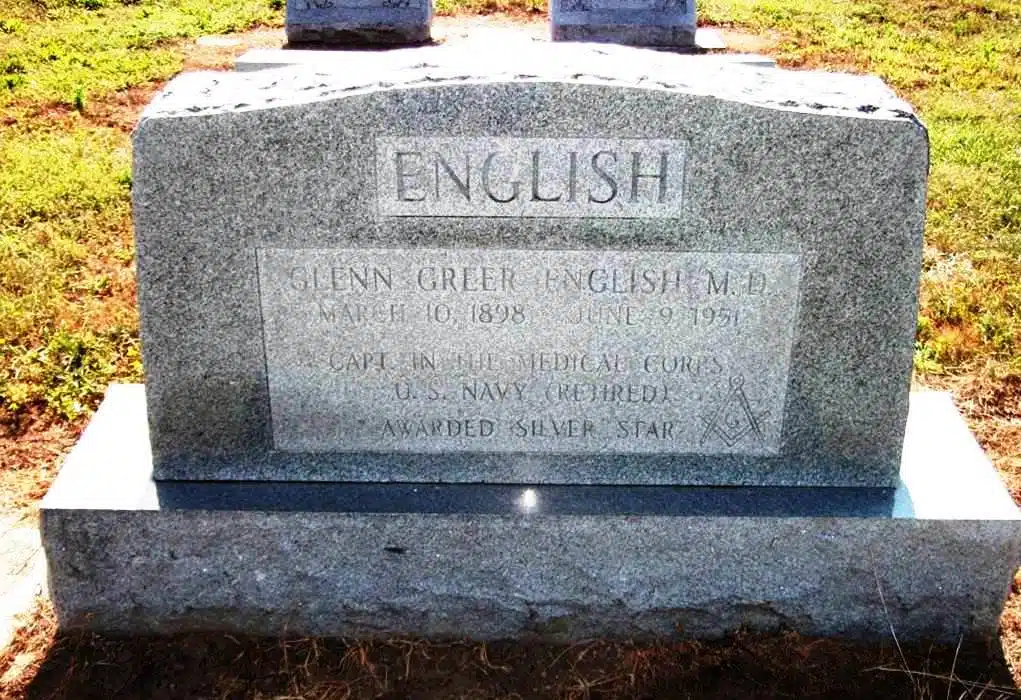
As stated previously, Dr. English practiced private medicine until the start of WWII. He spent six years overseas as a Fleet Surgeon on the hospital ship Bland. In total, for 17 years and 9 months, he was in the Active and Reserve Military Service, ultimately retiring with the rank of Naval Captain, Medical Corps, in May 1949.
Only two years after his retirement from military service, he died. Glenn’s funeral was held at Steens Chapel in North Hollywood, California, on June 12, 1951. His body was brought back to Brookville, attended by the Clevenger Funeral Home, and interred at Maple Grove Cemetery on June 14. The local Harmony Masonic Lodge, of which Glenn was a long-time member, was in charge of the burial ceremonies.