By Julie Schlesselman, Local History & Genealogy Department Manager, FCPLD
This article ran in the February 5, 2025, edition of the Brookville American, and will appear in Forgotten Franklin County V. 7 which is slated to be ready in November of this year.
In the Forgotten Franklin County column of September 11, 2019, I briefly discussed one of my favorite mid-20th-century modern homes, the Lustron house. They were a prefabricated home, metal in construction, and similar in design to the old porcelain-paneled gas stations of the 1940s and 50s. Lustrons were scattered across the United States and were very unique. They were recognizable in an instant. There was actually one, and only one, Lustron house ever built in Franklin County on SR 229 near the Ripley County line. Unfortunately, this one-of-a-kind Franklin County house was taken down sometime around 2006.
Prefabricated homes were not, and are not, a unique concept, but there are unique designs and a variety of manufacturers. Sears & Roebuck houses and Aladdin homes are probably the most common early 20th-century manufacturers that most readers will have heard about. You could buy a house in kit form, have it shipped to just about any location in the 48 contiguous states, and add a variety of the company’s extraneous components to personalize the structure to the owners’ liking.
I would guess that most people have not heard of the Erecto Home. There were at least two built in Brookville, and probably more throughout Franklin County that are just waiting to be positively identified as such.
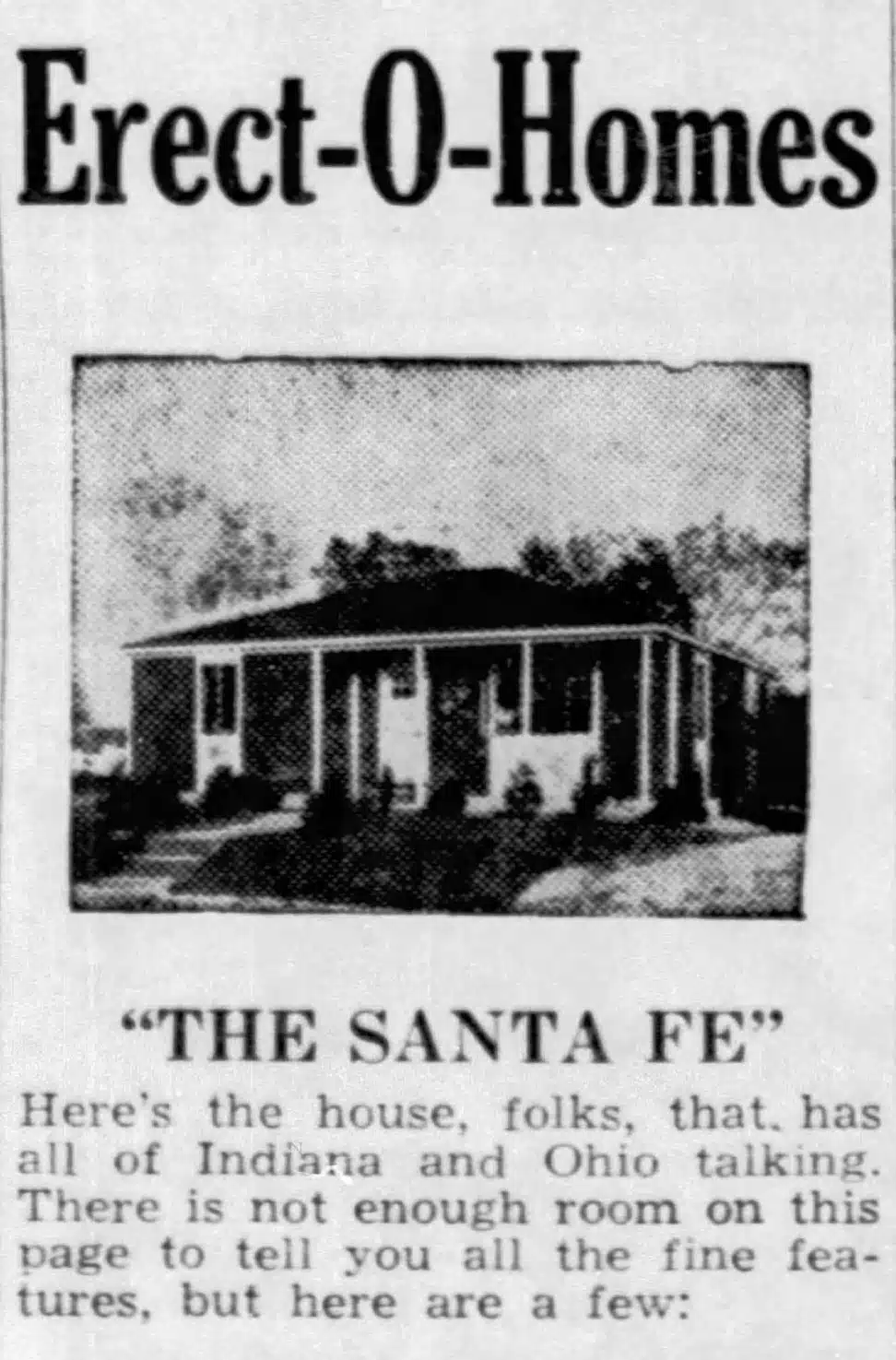
Years ago, I found an advertisement for an “Erect-O-Home” in the February 5, 1948, Brookville Democrat and was curious as to what it was all about. Through a few superficial searches, I found very little information but figured there had to be much more to this house that had all of Indiana and Ohio talking, as the ad claimed.
Since the company was based out of Richmond, Indiana, I contacted Sue King, history librarian, at Morrisson-Reeves Library. There was nothing in their library’s collection about the Erecto Homes or the company that manufactured them. But she found a few newspaper articles and sent them my way.
I was hoping for loads of information about the company, catalogs, brochures, advertising materials, etc., but the information was just not there. So, with the help of Brookville Library employee Evan Taylor, we researched just about every possibility we could. Between what Sue, Evan, and I gathered, the following is what could be compiled regarding Erecto prefabricated homes.
Erecto Homes was produced by Richmond Builders of Richmond, Indiana. The best background information about the company found so far was compiled by Ed Kaeuper in the July 7, 1957, Richmond Palladium-Item, but his story only takes into consideration about a decade’s worth of the company’s history.
Charles F. Travers moved to Richmond in the 1940s. “Travers headed an organization known as Richmond Builders, incorporated in August of 1943, as a real estate investment company.” Until 1947, Richmond Builders bought and built packaged homes fabricated in factories elsewhere.
Travers’ “manufacturing plant,” which he started in 1947, was housed in a small contractor’s shed located on North West 13th Street. Here he began to prefabricate his own homes, which he called Erecto Homes.
It appears that Travers built his first substantial-sized manufacturing plant in 1949 at 425 North West K Street. In 1953, the name of the firm changed to Richmond Homes, and in 1954 a larger manufacturing plant was built near the intersection of Sheridan and North West L Street. Richmond Homes also had a second site, “Plant No. 2,” where other components of the homes were built, such as doors. Plant No. 2 utilized the old structure that was commonly known as the Richmond Furniture building on North West J Street.
When production first began in the original plant, the company produced on average 2 houses per week. Ten years later, in 1957, when Kaeuper’s newspaper article ran, the company claimed it was producing 6 homes per week and had 200 employees. At this time, Richmond Homes, on a national scale, was ranked in the top 10 of its field.
Kaeuper describes various aspects of the plant and some manufacturing processes throughout his article. He said, “Sections of homes are built separately, moved to loading spots by overhead trolleys, and loaded on a truck. A prefabricated home consists of about 10 exterior sections and 15 interior sections.”
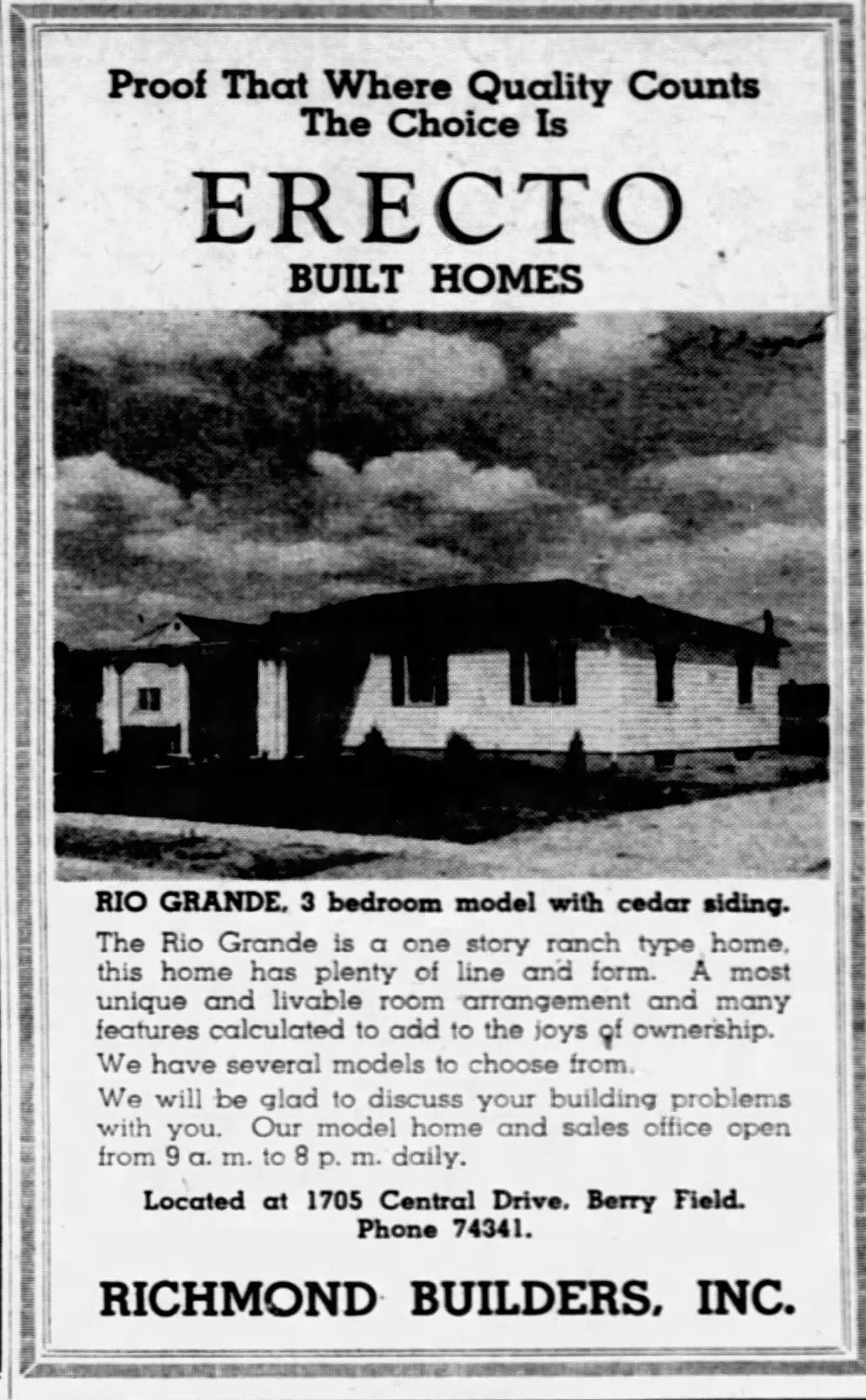
Details regarding the Erecto Homes designs were few and far between, but some information was gleaned from their advertisements. A November 1947 Palladium-Item ad boasted they were “Built to meet all standard building codes. Will pass building and loan and G.I. regulations. Comes complete with all interior partitions, flooring, exterior doors and windows, porch, roofing, etc. You do not have to be a carpenter to erect a home of this type.”
In advertisements running in the 1948 Palladium-Item, Erecto Homes were touted as “Completely engineered and proven so that all costly building errors have been eliminated. Erecto Homes are produced by assembly-line methods, thereby saving you the waste of materials commonly had in the old way of building a home.”
In advertisements for the company’s Lakeside model, this one was noted as being the ideal small home, with 4 rooms, a bath, and a large porch. It was designed for either a cement slab or block foundation. These ads ended by stating, “Now you can put up your own home for less than $4,000 complete.”
In 1957, Richmond Homes claimed to have 16 basic models and boasted they were being shipped to subdivisions in Champaign, Illinois; Dayton, Ohio; Wichita, Kansas; and Indianapolis, Indiana…to name just a few locations. It appeared their business was booming.
It seems that Richmond Builders began advertising their homes for sale outside their immediate area within a year of starting business. An advertisement in the April 3, 1948 Rushville Republican claimed: “…the good news about ERECTO HOMES has traveled so fast and so far that popular demand compels making these beautiful homes available to the entire country. To satisfy this ever-increasing demand, qualified contractors everywhere are now offered the opportunity of building the homes that the American public wants and can afford.”
So what was the main purpose of economical prefabricated homes during the late 1940s? This was the post WWII-era and the budding new company saw an opportunity to help fill the housing shortage caused by returning soldiers ready to start their own families.
So why was there such a housing deficiency at this time? In short, many soldiers were young when they went to war. When drafted or enlisting, many men were still living at home with their parents or often times in cramped city conditions, such as in apartments. Being in such dire straits and not knowing what their futures held, many men wanted something positive to return home to and married shortly before they were shipped off to fight; often times when they returned, they came home to an instant family – a wife and child. Some men chose to wait until they came back home to marry; sometimes this may have been only days after they returned. Often times within less than twelve months, they then had to find larger living quarters for a quickly growing family. The days of living with parents and extended family members had passed. It was now becoming common practice, “the American Dream,” for every new young family to have their own home. You’ve heard the term Baby Boomers. This era is where that phenomenon originated. Once men returned home from war to their sweethearts, babies were being born in record numbers across the United States, and new modern homes were needed to accommodate the population boom.
So why am I concentrating so heavily on a company based in Richmond, Indiana, when this is a column about Franklin County? Because there are at least two known Erecto homes in Brookville (one’s gone now, but surely there has to be more Erectos throughout Franklin County) and because there is so little compiled and readily available information about this company, which is very surprising. I wanted to bring this little remembered, practically forgotten, prefabricated house to your attention because the company’s history, along with catalogs, brochures, and advertising materials, has to be out there somewhere. Maybe you can help us locate the items we seek.
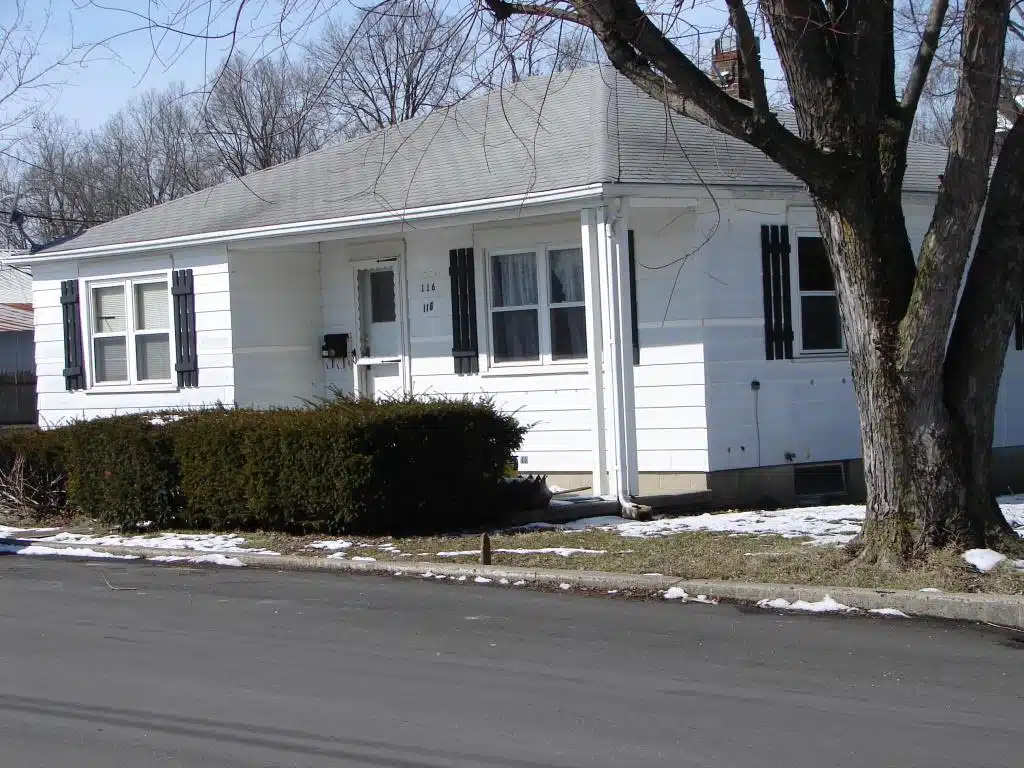
One of Brookville’s Erecto homes was located at 116 1st Street. The February 5, 1948, Brookville Democrat claimed Carl Kreutzer and Elmer Mergenthal were the local distributors for the Erecto. Apparently, this little house was their model home, and starting February 8 of that year, it was going to be open to the public. The Santa Fe was the style they chose to build. The specifics given were that it was constructed of West Coast fir siding, had aluminum casement windows, and an asphalt shingle roof. The house was comprised of 4 large rooms and 1 bathroom and had 5 large clothes closets. This model home also had a matching garage, and it can only be assumed that Richmond Homes manufactured the garage as well. The garage with this house was 21’x23’ in size and had a service door and 2 waterproof plywood overhead doors fixed with hardware.
Another ad from Kreutzer and Merganthal in the May 20, 1948 edition of the Democrat claimed another “Erect-O” they completed was “located on North Fairfield Avenue.” By doing a drive-by, it looks as though the little house still stands at 1341 Fairfield Avenue and is also the “Santa Fe” model.
Advertisements in the local Franklin County newspapers were few and far between. Was the Erecto Home not a big seller here? Or was it such a big seller that only a few advertisements were enough to spread the word sufficiently?
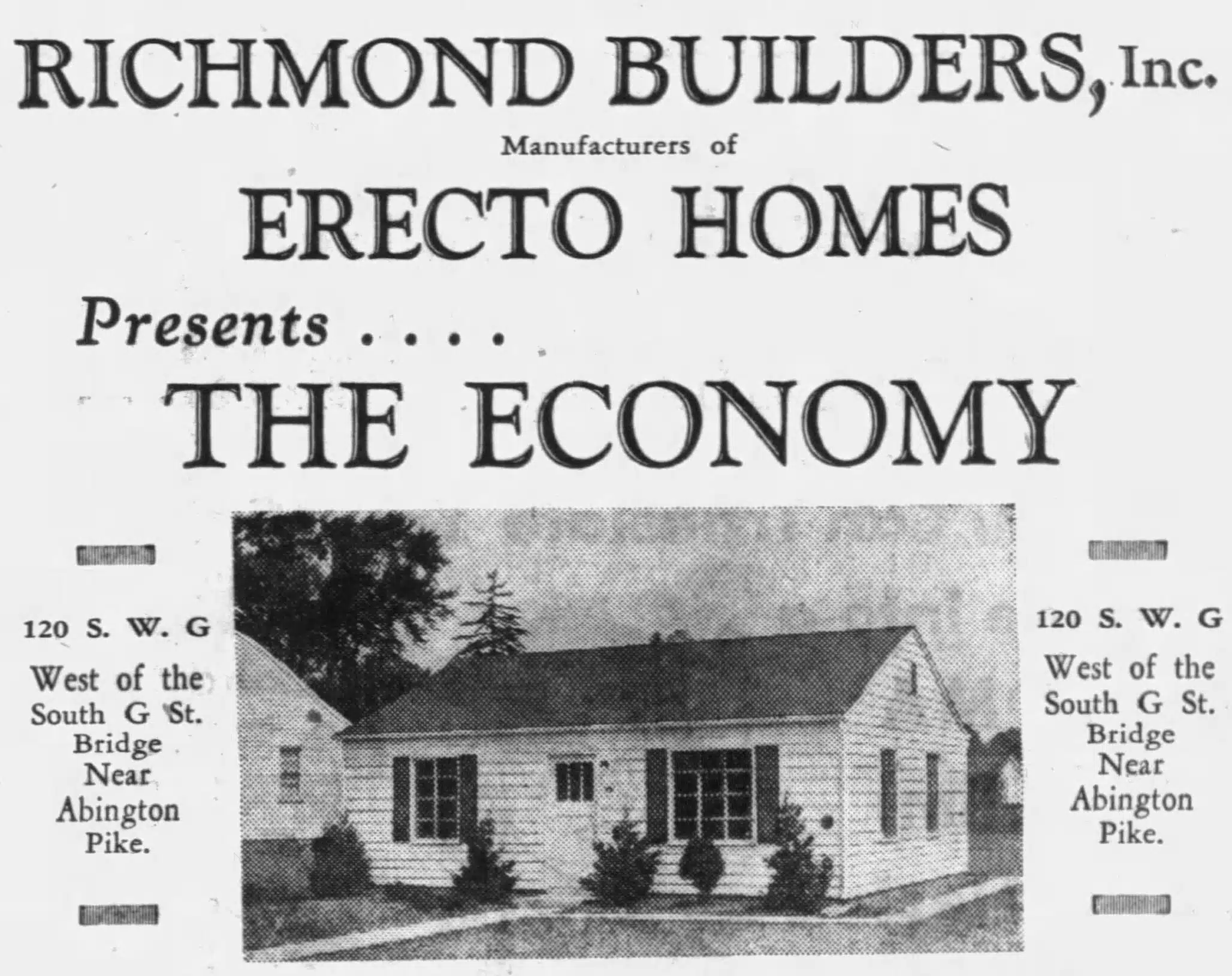
Over a dozen Erecto Home styles were supposed to exist, but so far we could only find acknowledgements of five model types: The Santa Fe (1947); The Rio Grande (1948); The Lakeside (1948); The Wayne (1949); and The Economy (1949).
Charles Fred Travers, who founded Richmond Builders, Inc., died in 1998. According to his obituary, he was 90 years old, had been born in New York, and died in Naples, Florida. He retired from his company in 1963 and moved south at that time.
Travers’ obituary claimed his “Richmond, Indiana company was a pioneer in the prefabrication of housing.”
If that were the case, there had to be company brochures or booklets that people could look at for buying options and choices. I figured the Morrisson-Reeves Library’s archives would have had one, but as of now, they do not. If you have an Erecto Homes catalog – or live in Erecto Home- please contact me at the Brookville Library to share what you might know.
NOTE: While helping me on this project, Evan Taylor did some pretty nifty investigation of the Richmond Erecto Homes. When the old Palladium-Item advertisements stated exact addresses of some of the model homes in Richmond, Evan used Google Street View images to see if the houses still stand. In many cases, they do, but recognizing them as Erecto Homes can sometimes be difficult, as many have been remodeled or heavily altered.