By Julie Schlesselman, Local History & Genealogy Department Manager, FCPLD
This article ran in the March 15, 2025, edition of the Brookville American.
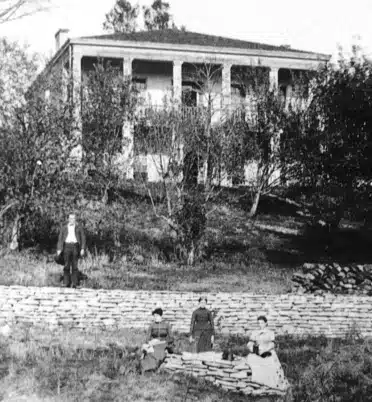
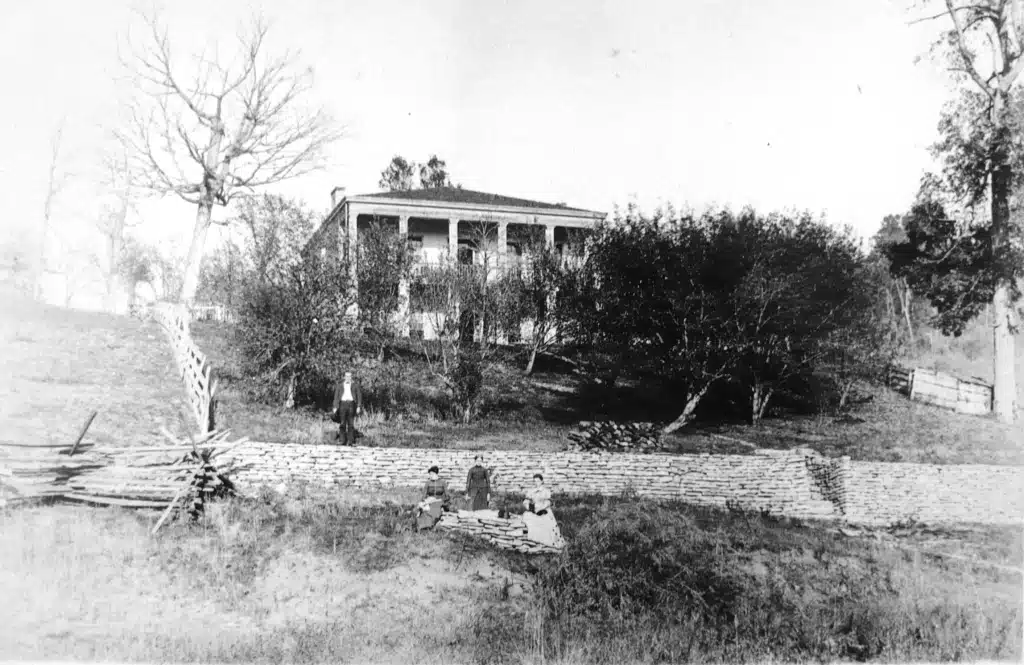
This image of Dr. Maguire’s house, cropped from a larger view, was just too intriguing to overlook.
Who was Dr. Maguire, where was this house, and what happened to it?
The image is in the Metamora Oral History Project collection, which is now in the Brookville Library’s Archives. Unfortunately, there was not much information that accompanied it. And lamentingly, there was not much information about Maguire in any of the Franklin County histories or files in the library’s collections.
The surname is consistently spelled two different ways in public records and newspapers, and used interchangeably, Maguire and McGuire.
Dr. William Maguire was well into his eighties when he died in 1911. His obituary, using that spelling of his name, appeared in the May 11 Democrat and was lengthy and flowery and gave but little biographical information of substance.
William was the son of Daniel and Marguerite Miller Maguire and was born in West Moorland County, Pennsylvania, on September 7, 1824. After he completed his medical studies, he began a medical practice in his native state. In 1845, he decided to relocate to Indiana. “September 7, 1845, he became a resident of Metamora,” and continued to practice as a physician in this community until just a few years prior to his death.
After living less than a year in town, William married Angeline Martindale on May 7, 1846. They had 6 children.
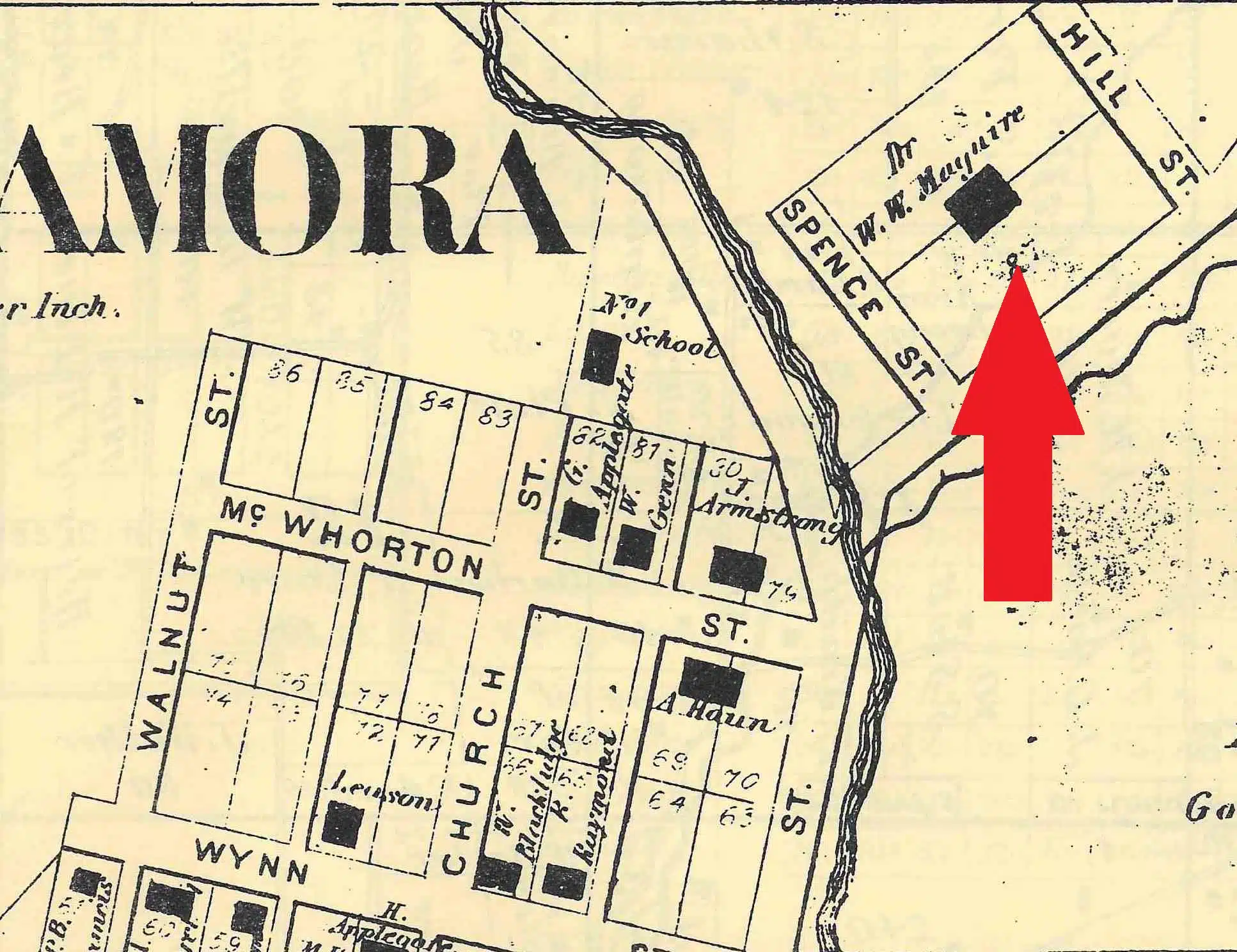
The plat of the town of Metamora in the 1867 Atlas of Franklin County shows that Dr. Maguire lived just outside of town, along the road that was eventually named for him, McGuire Ridge Road.
According to Milford Anness in his book Low Bridges and Locks Ahead…on the Whitewater Canal (c. n.d), “Another story worth telling, concerns the way in which Metamora obtained a Doctor in canal days. Russell McGuire told how his grandfather, Dr. William McGuire, graduated from a medical school in the east and came to Cincinnati, where he embarked by canal boat for Hagerstown to then travel overland up to the Wabash and Erie canal and then east to Ft. Wayne where he planned to practice. When the boat docked at Metamora, the Doctor strolled into the tavern of the Canal House, where he was engaged in conversation by a nosey proprietor, Mr. Rubottom. After ascertaining the young man’s life history, medical qualifications and future plans, Mr. Rubottom turned to his porter standing by and ordered: ‘Get this young man’s bags off the boat and bring him in here. We need a doctor in Metamora. We’ll just keep him here!’ That’s how the McGuire clan came to make Metamora their three generation home.”
According to Milford Anness in Metamora, Canal Town: A Living Memory of Yesterday, Anness notes: “Clarence McGuire also accepted, as true, the story of Chief Metamoris, for whom the town was named. I heard him say so on more than one occasion. His father, you know was one of the community’s earliest Medical Doctors, whose house was located over on the site of Sugar Loaf, near Butternut Springs. Dr. McGuire must have garnered much authentic information and passed it down to his son.”
These may not mean a lot – but they are two of the very few references we found about the doctor.
To link together the McGuires that Anness talked to: Clarence McGuire was Dr. William McGuire’s son, and Russell was Clarence’s son. I vaguely remember Ed Baker of Metamora (now deceased) mentioning Russell and the McGuires, Ed having known Russell when he was a child. Unfortunately, the questions long left unanswered will continue to be as another generation has passed, who once knew the old-timers and could have shed some light on the subject. Clarence died in 1944, Russell in 1976, and Ed Baker in 2017.
Sugar Loaf? Apparently, that was the name of the hill that the Maguire’s house sat on. Sugar Loaf or Sugarloaf is actually a common name used across the United States for hills or mounds. A sugarloaf was actually the unusual form in which refined sugar was produced and sold up until the late 19th century. The end product was a tall cone with a rounded top. Hence, a hill or Indian mound could remind people who lived prior to the 20th century of a conical mound of sugar.
Once again, not much is mentioned about Sugar Loaf. The Oral History and Folklore of Metamora, Indiana, compiled in 1986 by the Metamora Oral History Folklore Project, mentions Sugar Loaf briefly in the James Smith story. It states, “Childhood adventures and mystical folklore surround the once bald hill north of Metamora called ‘Sugar Loaf Hill’.”
Since very little could be found about Dr. Maguire, this research took a slightly different, yet lucrative turn. With the help of a variety of library staff members searching for information about McGuire, one very interesting and unsuspected resource was found. An online finding aid indicates that there is a single item of Maguire interest at the University of Kentucky’s Special Collections Research Center in Lexington. According to their website, the Maguire material “is part of the Wade Hall Collection of American Letters, which includes correspondence and diaries from all over North America covering the time period of the Civil to Korean Wars. The materials were collected by Wade Hall and document everyday men and women.”
Their Maguire collection is very small and contains one folder with one item identified as the William Maguire temperance lecture book, which documents lectures and talks given by Maguire on temperance in Indiana in the 1870s. “There are five lectures transcribed into this book, all discussing the dangers and ill effects of alcohol upon a person.”
Did Mr. Hall buy it at an estate sale, bookstore, or antique store? Was it part of a larger Metamora collection of materials that was sent to auction, which permanently left our county? Did someone donate it to the University’s collection? Wade Hall was a native of Alabama and lived in various parts of the country, teaching in universities. How this book made its way to Wade Hall is a mystery.
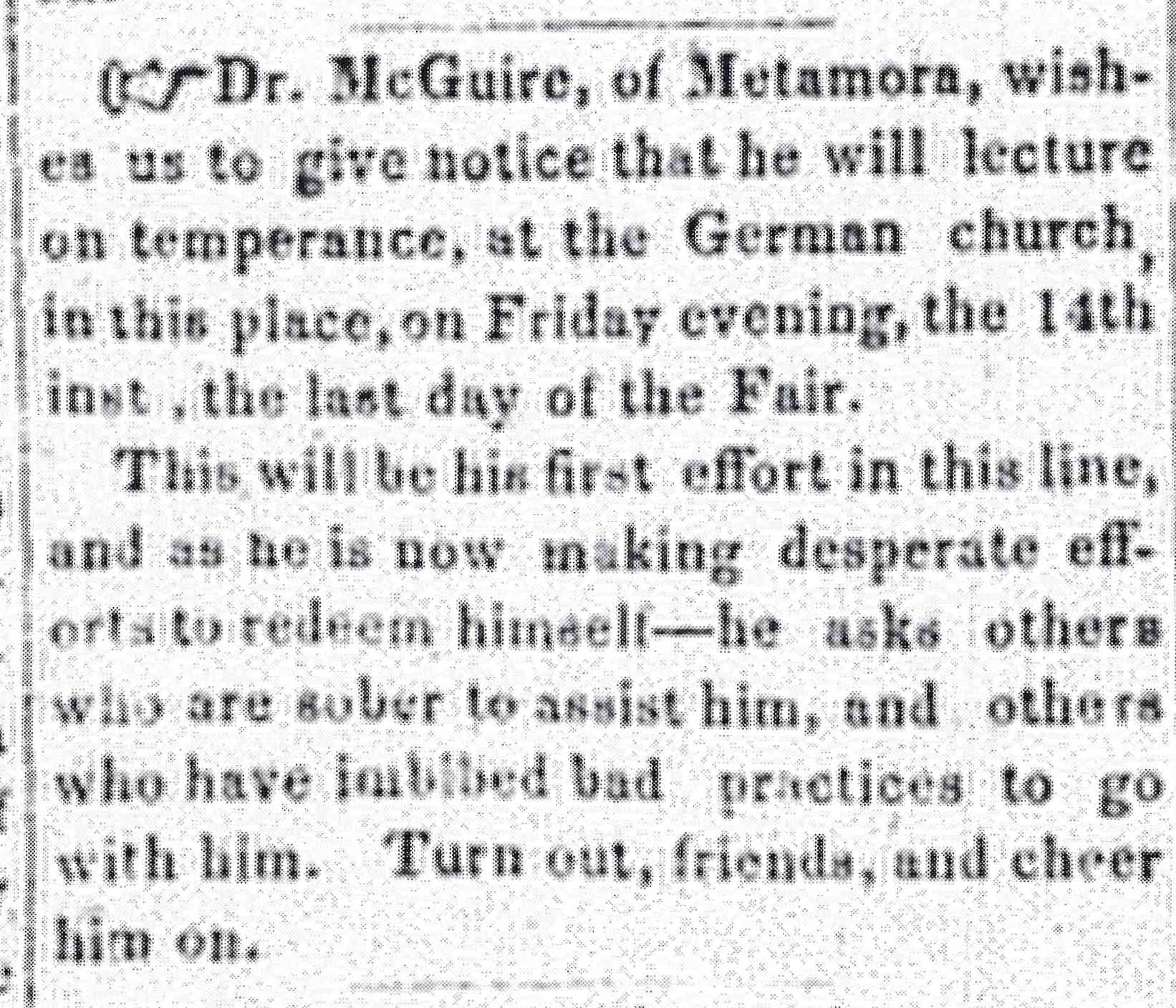
Did Dr. McGuire give lectures on temperance because he knew of the evils or because he experienced the evils? An advertisement or two suggests he may have had first-hand experience with the evils of alcohol. The October 7, 1853 American, seen here, advertised the doctor’s upcoming lecture in Brookville, and it said, “This will be his first effort in this line, and as he is now making desperate efforts to redeem himself asks others who are sober to assist him…”
Dr. Maguire must have given scores of public addresses over the years, as evident from other announcements found in the newspapers, even up through the 1880s.
The Maguire’s Metamora house needs to be shown in the photograph’s fullness for the variety of things that are going on in it. Among some observations there are a laid wooden slat fence in the left foreground, a typical wooden board fence along the left side of the house, a beautiful laid stone wall along the front of the house with a somewhat grand stone stairway entrance leading up to the house, and a different type of wood fence or animal pen to the right of the house that seems much more solid and constraining. The cut stone outcropping that the three ladies are sitting on is a mystery as to its function, if it has one. The 2-story porch extended the entire length of the house. The doctor’s house was huge, beautiful, and stately, and almost appears to have been built into the hillside. Unfortunately, I could not find where the Metamora Oral History Project noted whose photo this was originally or who loaned it to them.
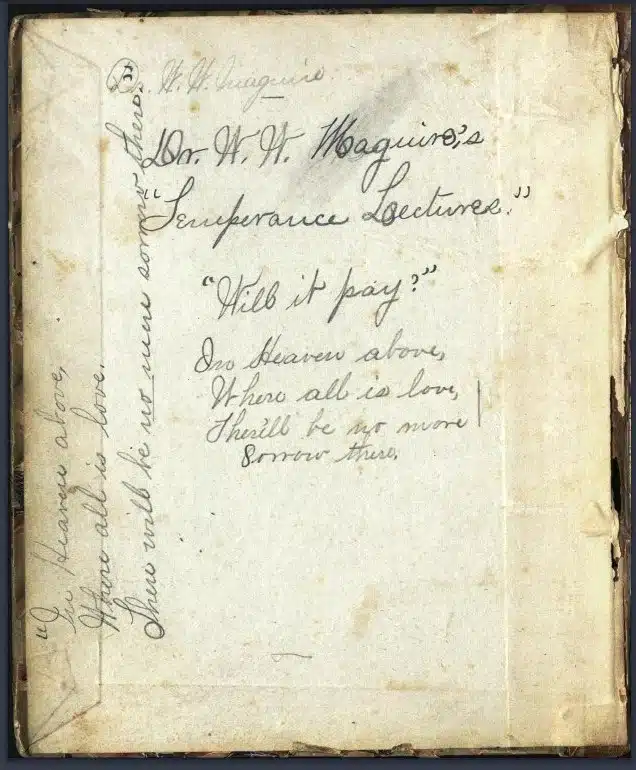
NOTE: One of the most interesting aspects and unexpected outcomes of this research was finding out that a small temperance journal written by Dr. Maguire exists at the University of Kentucky. Even better was how gracious the University’s archivist was. I told her of my research and asked how Wade Hall may have acquired this book. She replied: “Unfortunately, we do not know how Wade Hall acquired the William Maguire temperance lecture book. Generally, Wade Hall collected items through estate sales, antique/thrift stores, or buying or having it gifted to him straight from families, but he never identified how he got each collection we have from him. He traveled across the United States acquiring items, so we also do not know where he would have picked the lecture book up.”
But what was the most fabulous part of our correspondence was that the archivist offered to scan this book and send it so we would have a copy at our library to share with researchers. A big thank you goes out to Sarah Coblentz of the Special Collections Research Center, Margaret I. King Library, University of Kentucky Libraries.
If you take a look at the Indiana Historical Society’s website, you can see that in their collection, they have a 42-page booklet by W. Maguire called “A Night’s Entertainment in Familiar Conversation Between a Prohibitionist and an Anti, on the Subject of Intemperance, and Other Matters Therewith Connected.” Their catalog entry says it was printed in 1854 by the American Power Press.
I wonder where else the doctor’s lectures, journals, and correspondence ended up? Or was everything burned up in a fire that supposedly claimed the Maguire’s house?
If you know anything about the Maguires or their magnificent house, let me know so it can be shared with our readers.
You must be logged in to post a comment.