By Julie Schlesselman, Local History & Genealogy Department Manager, FCPLD
This article ran in the March 2, 2022 edition of the Brookville American, and is featured in Volume 3 of Forgotten Franklin County.
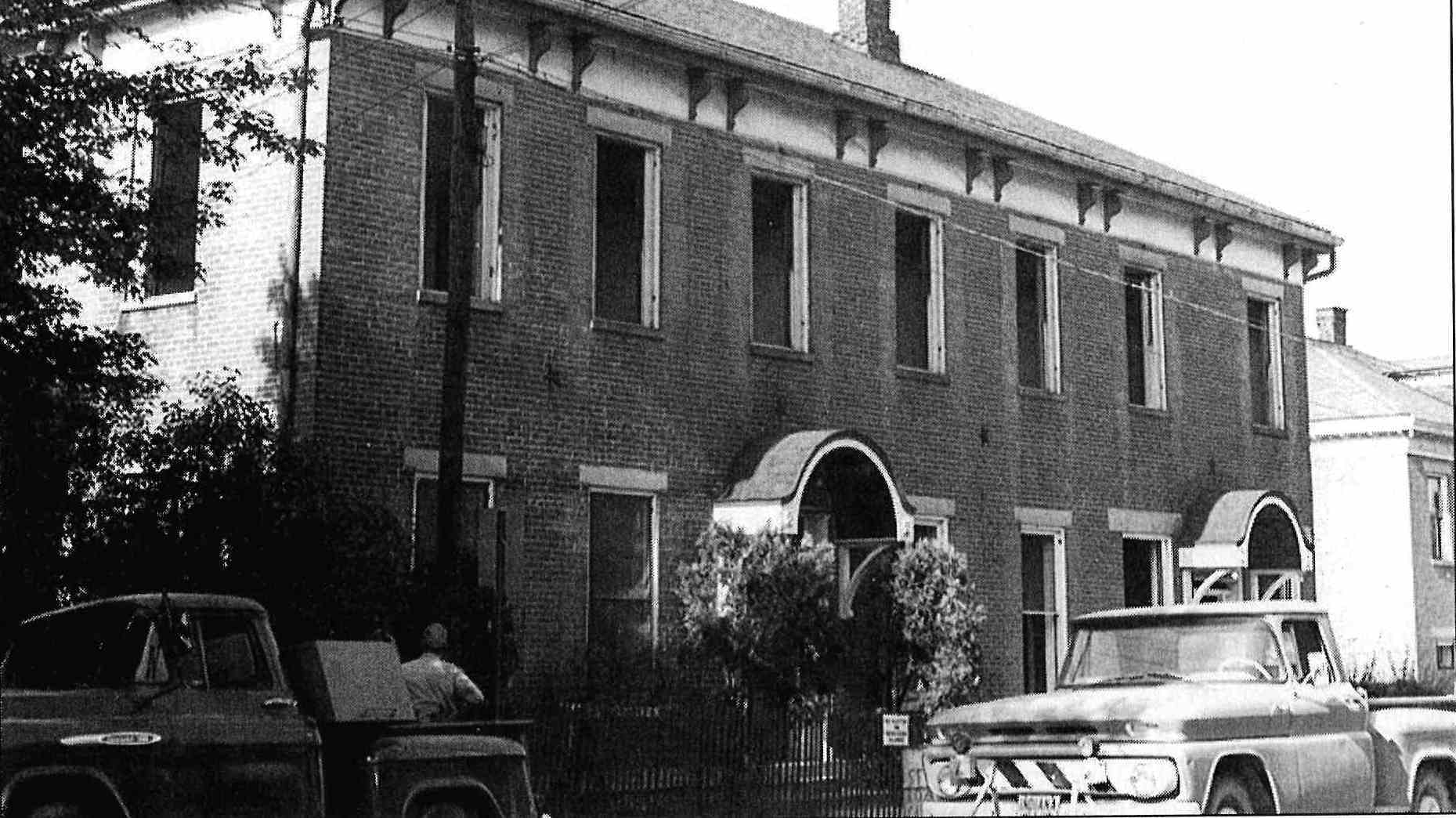
It’s been 57 years since the large 2-story brick structure graced the Main Street of Oldenburg, lot 18, to be exact, just east of the Holy Family School. It was constructed for use as a hotel and stood in that location for 97 years.
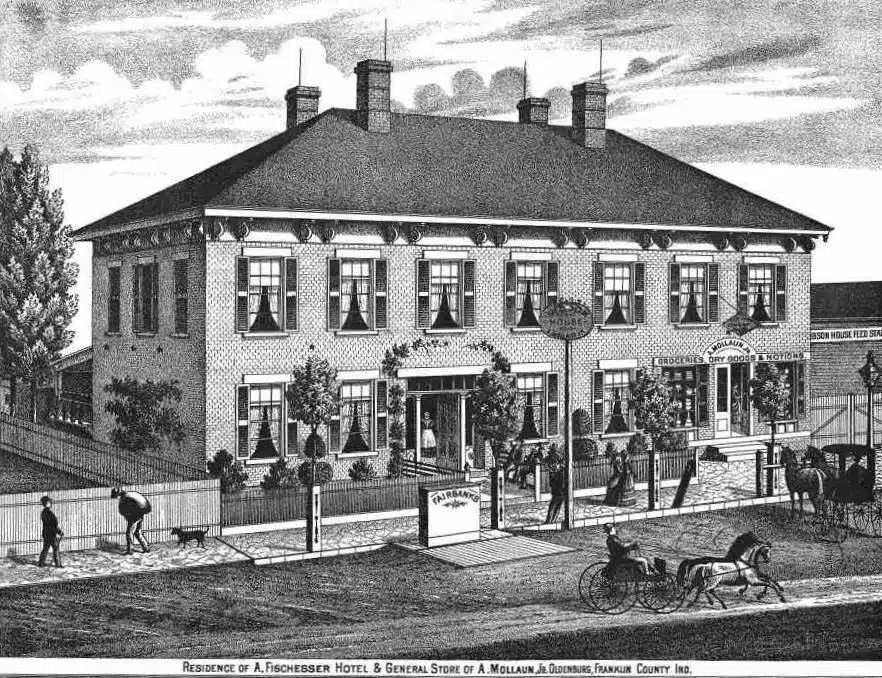
The oldest image I have of the building comes from the 1882 Atlas of Franklin County. It was only twelve years old at the time of the rendering and proudly portrayed. It was the creation of Anthony (Anton) Fischesser. No biographical information appears in our county history for Fischesser, and oddly, nothing besides the rendering appears in the 1882 Atlas.
Anthony was born in Germany in 1834. He came to America in 1853 when he was 19. By the time he reached Cincinnati, he had exhausted all of his money. He appealed to Bishop Purcell for aid to reach his journey’s end, which was Oldenburg, where his uncle, Father Franz Joseph Rudolf, was pastor of the Church of the Holy Family. The bishop not only advanced him aid but found a man to take Anthony to his destination.
Once in Oldenburg, Anthony worked on the estate of the convent for 2 years and then married Maria, the widow of Henry Decker. Maria’s daughter, Elizabeth, was 6 years old at the time of the marriage. Anthony and his wife never had any children of their own.
After Anthony and Maria married, he purchased a farm just outside of Oldenburg, then later moved his family to town and opened a hotel. Fischesser transformed the old Hackman warehouse into a hotel, and an increased volume of business through town soon gave Fischesser the confidence to build what became known as the Gibson House. The Gibson House hotel was built in 1868 and opened to the public on June 15 of that year by Fischesser, who conducted it until 1881, when he transferred it to Anthony Mollaun. The business appears to have stayed in the family, for Anthony Mollaun was the husband of Fischesser’s stepdaughter, Elizabeth.
The hotel was a place to be proud of and provided a valuable and estimable service for Oldenburg.
In the March 24, 1898, Democrat, G. Henri Bogart “characterizes [the Gibson House] as a perfect home in a public house,” kept by Tony Mollaun and his wife.
In 1895, Maria Decker Fischesser died. Her husband, Anthony, died in 1905.
In 1906, just a year after his father-in-law died, Anthony Mollaun retired from the Gibson House after 25 years of managing the place. It was a somber event for the Mollauns, but the choice was necessary because Mr. Mollaun’s health was declining and he could no longer manage the hotel.
At that time, it was announced that E.W. Drewes of Cincinnati took charge of its management on July 1, 1906.
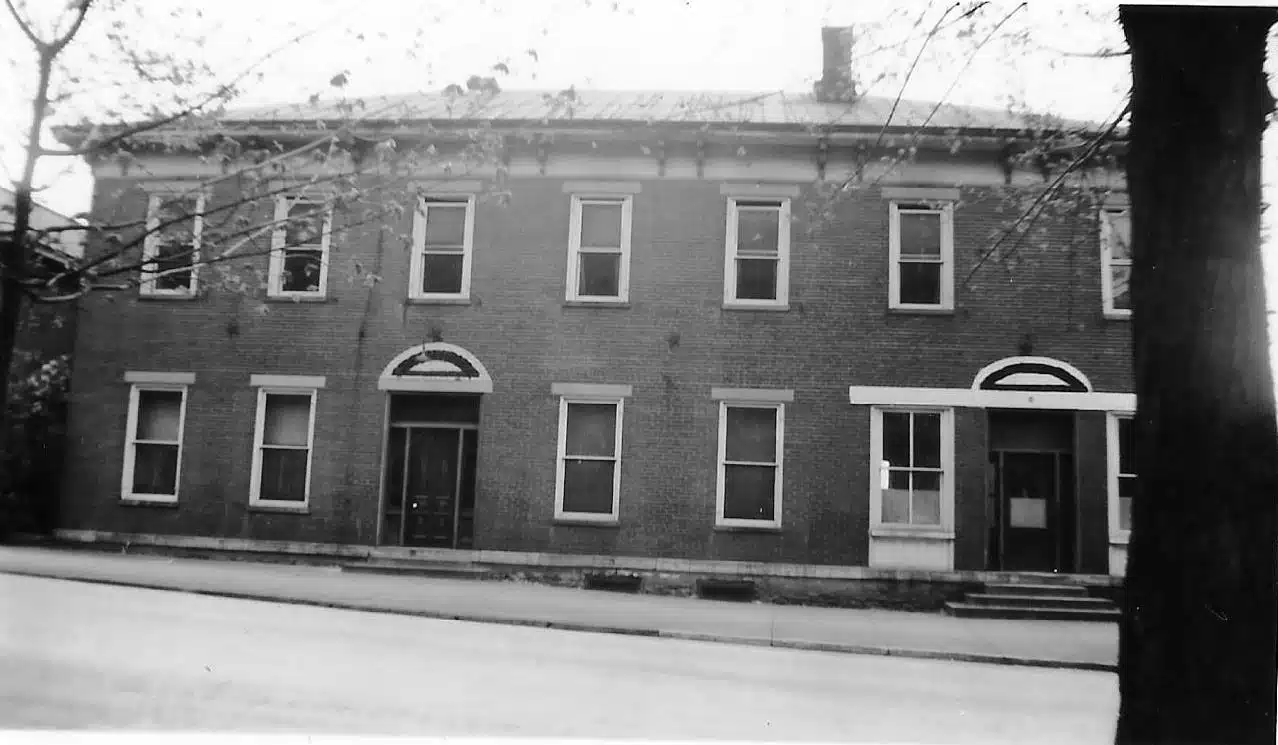
While the sad news of the Mollauns retiring made the newspapers, so did the fact that there was also another longtime, original resident of the hotel, Mrs. M. Schlosser. She was the first cook of the hotel and was still in that position in 1906. Mrs. Schlosser estimated she cooked 41,682 meals during the 38 years she was at the helm.
Unfortunately, shortly after Anthony Mollaun retired, he died in August of 1906.
A few months later, in October of 1906, Elizabeth Mollaun and her daughter, Anna, left for a new home at Harrison, Ohio.
Eight months after her husband’s death, in April 1907, Elizabeth Mollaun returned to Oldenburg and the Gibson House. The May 2, 1907, Batesville Tribune announced, “The Gibson House has again changed hands, Mrs. A. Mollaun having repurchased same from Ed Drewes.”
It’s unclear what happened after Mrs. Mollaun returned – if she simply owned the place or was the proprietor as well- but by 1910, Joseph Merchen was applying for a liquor license on the spot. According to the license application, the bar was in the northwest room on the ground floor, being twenty-three feet long and twenty feet wide, fronting Main Street.
Elizabeth Mollaun died in 1917.
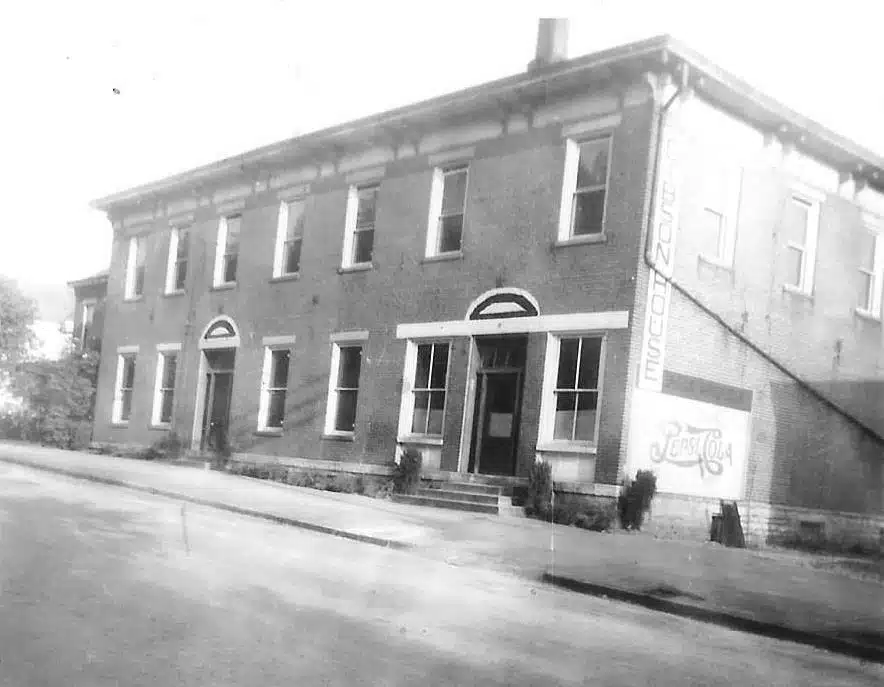
Not much appears about the Gibson House in any local newspapers until the June 9, 1938, Brookville Democrat. At that time, it was stated, Joe Merchen and his son, “Blackie,” were remodeling their Gibson House Hotel and Café by “installing an addition to the rear, which was to include a shower and tub baths, modern toilets and a spacious hall.”
While I was able to figure out the early background of the Gibson House, I was not able to determine what happened to it in its final years or why it was lastly called La Claire (Le Claire) Guest House – that is, until I contacted Sr. Lorraine Geis, OSF, Oldenburg, who forwarded my request along to their archives.
Sr. Rose Marie Weckenmann of the Archives of the Sisters of St. Francis provided me with more information about the latter years of the Gibson House than I could have ever hoped for.
Years ago, Sr. Wilhelmina Burkemper and Sr. Francis Assisi Kennedy, Sisters of St. Francis, Oldenburg, compiled a brief history about the Gibson House for their publication, Convent Chronicle. Why? Because the Sisters eventually owned the building.
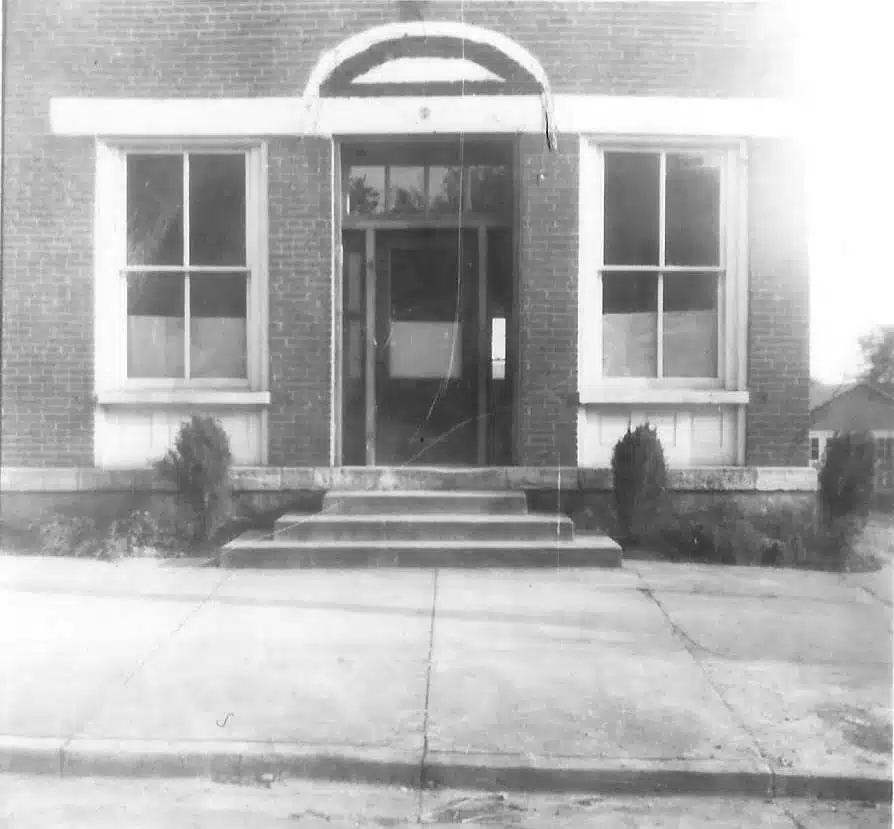
According to With the Poverello, by Mother Clarissa Dillhoff and Sister Mary Olivia Frietsch, “With the consent of the Ordinary of the diocese, Bishop Joseph E. Ritter, and her religious Council, Mother Leonida Borchelt purchased a building situated on the main street of Oldenburg opposite the Convent and known as the Gibson House. The purpose was to prevent the conversion of the property into a roadside tavern by new owners, and likewise to provide hospitality to relatives and friends of the Sisters and Academy students when they visited at Oldenburg.” The Sisters changed the name of the building and it was called La Claire Guest House and Tea Room. This happened in 1944.
The following information is what appeared in the November 2006 Convent Chronicle, v. 23, no. 4.
“On February 14, 1944, Sister M. Cupertina Grundler, Sister M. Aurea Brosnan, Sister Cotilda Marie Gohmann, and Sister Mary Ruth Michaelis paid a visit to the place to examine it. That same day, the owners, Joseph C. and Mary C. Merchen, were given our written promise to purchase the place at the price designated, which was $14,250. This included personal property as well as 103 ft. frontage and a twelve-foot drive at the rear, which leads to Water Street. The cost of the drive was included in the amount.”
“On April 12, 1944, four days after the former business was closed, renovations were begun. Mr. Lawrence Fullenkamp, our carpenter, assisted Mr. Stanley Fisher, examined the roof to repair it, and found it in very bad condition. A roofer was consulted. It was decided to let it go until last and begin on the first floor. The next day the wall opening was begun in the storeroom. Now the ‘had-been’ parlor has become a part of the tea room. It is in this part that the new soda fountain, purchased April 17 and installed April 24, has been placed. Outdoors, shrubbery in the form of bridal wreath and Juniper trees have made a pleasing transformation.”
The Sisters formed a Sewing Circle for the purpose of making new covers for the old furniture, and they meticulously cleaned the mattresses and carpets, washed woodwork, and cleaned ceilings, walls, and radiators. The place was spotless.
“Old Venetian blinds had been found in the attic. The ICA girls and five local boys….were kept busy sanding the old thick varnish from them.”
“Rev. Mother Leonida declared that she wished La Claire to be a guest house for relatives and friends of the Sisters and not a hotel. Since most of the relatives of the Sisters are people of moderate means, it would defeat its purpose if prices charged were too high…..”
The La Claire Guest House was remodeled in June of 1954. Sister Mary Ruth, manager of the La Claire Guest House, and Mr. Fullenkamp, the Sisters’ carpenter, along with his crew of five men, “aimed to make the La Claire Guest House more attractive.”
As a result, a beautiful “U” shaped dining room was being made. “To add to the attractiveness of the picture-the entrance was widened by ripping out part of the wall, and replacing the unsightly stairway to the side-making the center of interest the large “U” shaped dining room on the opposite side. The walls, ceiling, floor, etc. of the dining room, breakfast room and parlor were brightened with pleasing colors of paint, wallpaper, furniture, rugs, etc.”
In a letter by Sister Clotilda Marie, Treasurer, to the Indiana Department of State Revenue, dated May 31, 1963, she states, “La Claire Guest House of this town, operated by the Sisters of St. Francis, is open each summer from about June 10 to August 15 as an accommodation and for the benefit of the relatives and friends of the Sisters. During this time, besides rooms rented, refreshments, including meals, candy, ice cream, and soft drinks are sold. The Sisters work without any pay because the cost of maintenance, taxes, and insurance takes all the money received from the above.”
By 1965, it seems that the La Claire House venture was no longer viable for the Sisters. “Since no one was available to operate La Claire, it was offered to Holy Family Parish in February 1965 with the understanding that the ground be used for school or parking purposes.”
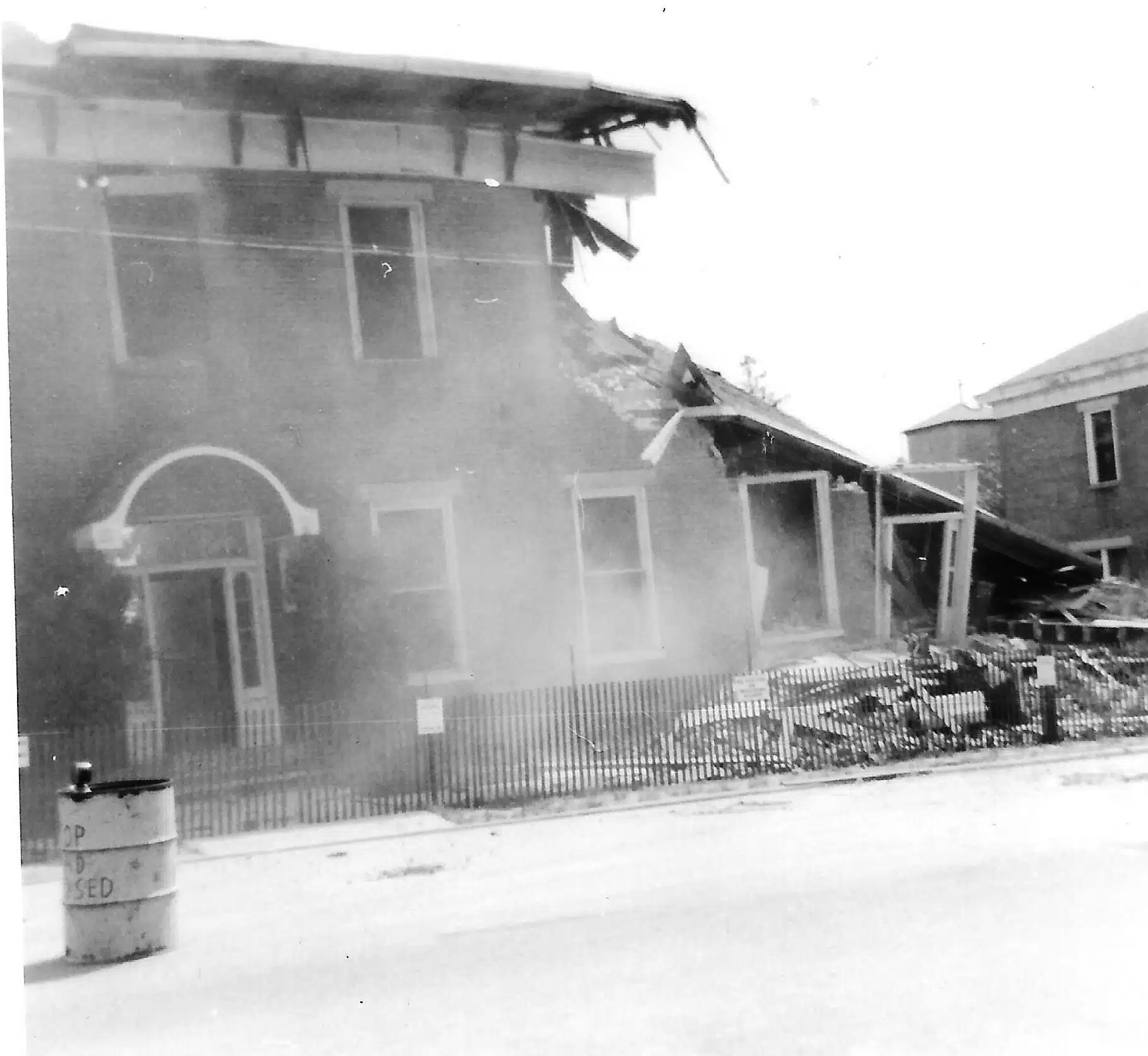
Within four months, on June 24, 1965, an article appeared in the Batesville Herald-Tribune, which announced the demise of the historic building. “An Oldenburg landmark fell to the wrecker’s hammer last week when the Roman Nobbe Company removed the La Claire House (formerly the Gibson House) from the scene. Work on removal of the building was begun on Thursday morning with the entire structure down on Friday. Only clean-up work remains.”
And that’s it…..
In addition to the wonderful information the Convent Chronicle provided, the Archives of the Sisters of St. Francis also had a few images, which have added so much to the overall story. I can’t thank them enough for sharing with all of us and providing information that could not been found anywhere else.
NOTE: You would be surprised how many people contact the Franklin County Public Library District for information regarding their ancestors – the descendants of whom now live in a variety of areas across the country as well as around the world. A few years back, a descendant of Agnes Decker Fischesser contacted me for help in figuring out family connections. In addition, a gift to the Franklin County Historical Society arrived in 2021 from a Fischesser descendant in Cincinnati, Ohio. It was a land deed for the piece of property that Anthony bought from Rudolf.