By Julie Schlesselman, Local History & Genealogy Department Manager, FCPLD
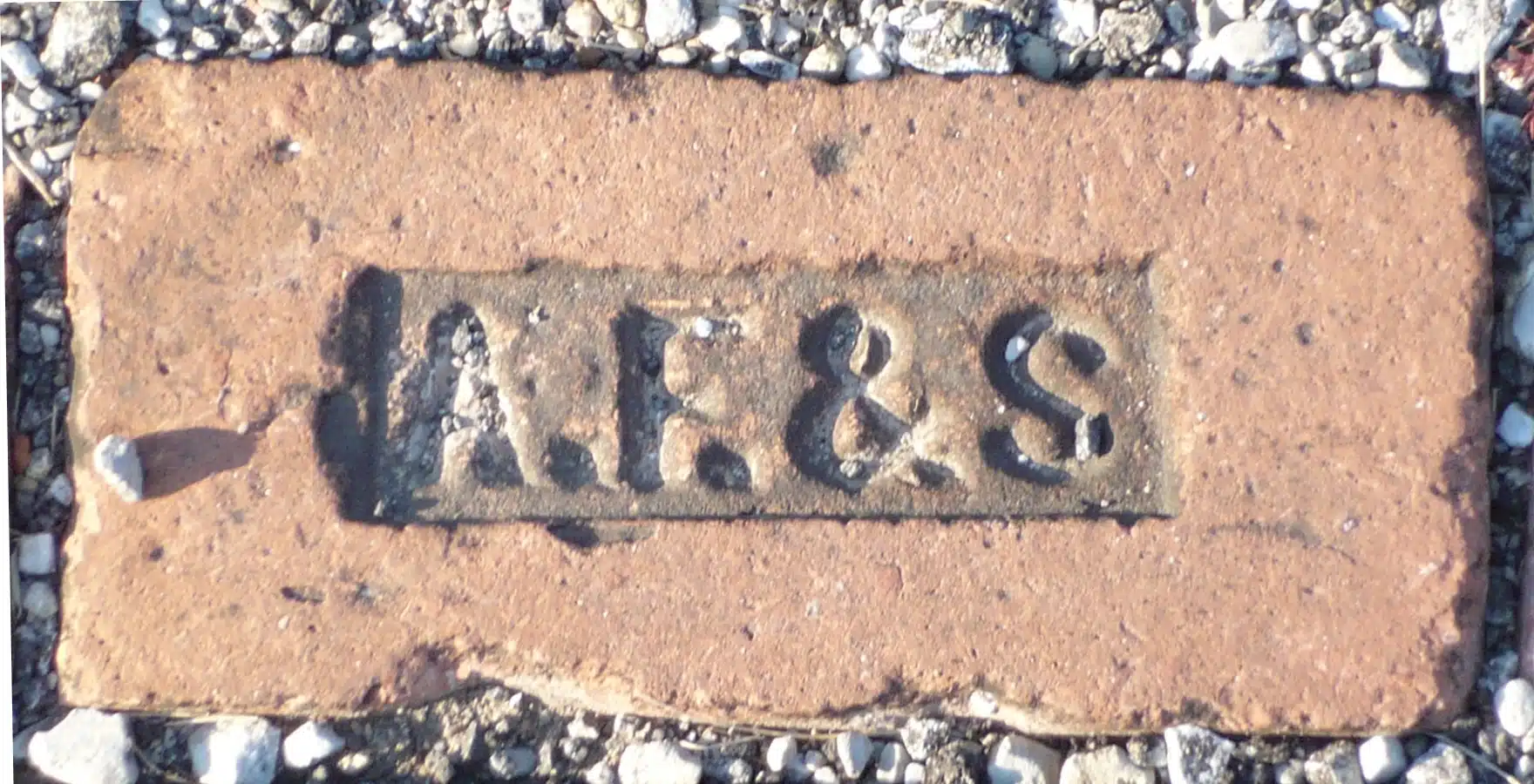
This article ran in the October 23, 2019, edition of the Brookville American.
…almost everyone in Brookville does. The “A.F.&S.” stamped in the center of the bricks stood for Anthony Fries and Sons.
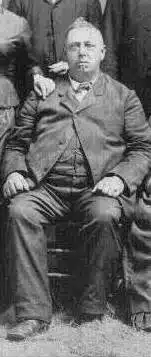
Anthony Fries was born in Germany in 1835. He came to the United States in 1853 and ended up in Franklin County by 1864. Anthony was originally a cooper, which is someone who makes barrels, and he established a huge cooperage at the south end of Brookville near the confluence of the East and West Forks of the Whitewater River. This area was known as Stavetown. Staves were the wooden parts of the barrel that comprised the main body of the container; they were bound together by wooden or metal hoops.
Wood was used for everything at that time, and as local timber became increasingly scarce, Anthony started, around the year 1882, making handmade clay bricks from the extensive clay deposits on his property. He was very innovative and, by 1888, added a horse-powered brick-making machine to his endeavor. He eventually built the first steam-powered brick-making plant in Indiana. The superior quality product of the Fries factory soon attained high demand, and was not only used locally, but sent to nearby towns, including Connersville, Indiana, and even to larger cities like Cincinnati, Ohio. The Fries’ bricks that were sent to Connersville were used in some of Fayette County’s most important buildings of the time, including numerous schools, the McFarlan Carriage Company factory, and the Connersville Furniture Company warehouse.
The oldest bricks from the Fries’ plant had the identifying mark of “A.F.” since Anthony Fries was the sole owner. In January 1892, Anthony Fries organized the A. Fries & Sons Company, in partnership with his sons, John and George. Another facility was needed to keep up with demand, so Anthony was working on finalizing his plans for the establishment of an extensive new brick manufacturing plant west of Connersville. Unfortunately, he died in February 1892. The two sons, however, went ahead with their father’s business plans and established the brick factory in Fayette County.
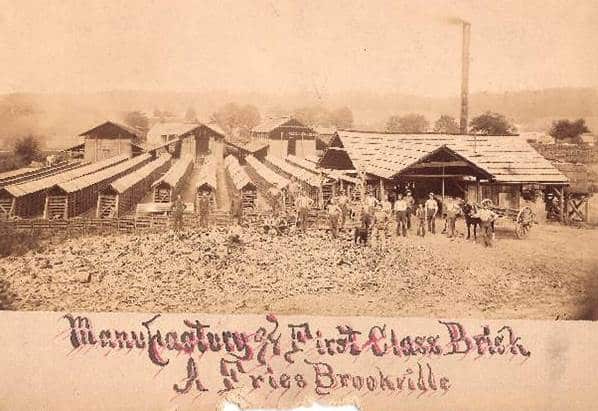
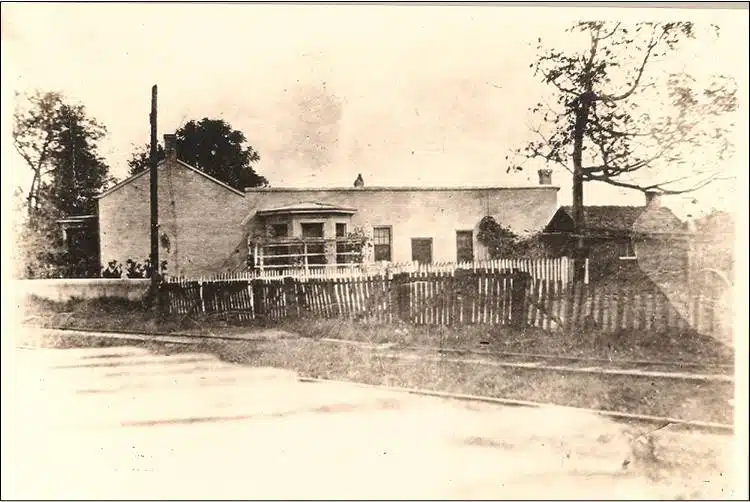
The brick manufacturing plant in Brookville was run by son John, and the one in Connersville was run by George. The Connersville plant was located between W. 12th St. and the B.&O. Railroad. Each plant produced upwards of 2.5 million bricks a year, and the facilities included processing buildings and large kilns. Shortly after the Connersville plant was established, George built his home at 1218 W. 12th St. using bricks that were made at his plant.
In 1902, the Fries’ factories discontinued the manufacturing of brick and started the manufacturing of drainage tiles as the demand for products of this type was rapidly growing. With the use of drainage tiles, large areas of wet or swampy land could be converted into productive farmland by the property owner. The Fries’ company soon attained a wide and favorable reputation for the durable quality of their tiles, and the brothers continued in business together until the devastation of the flood of 1913.
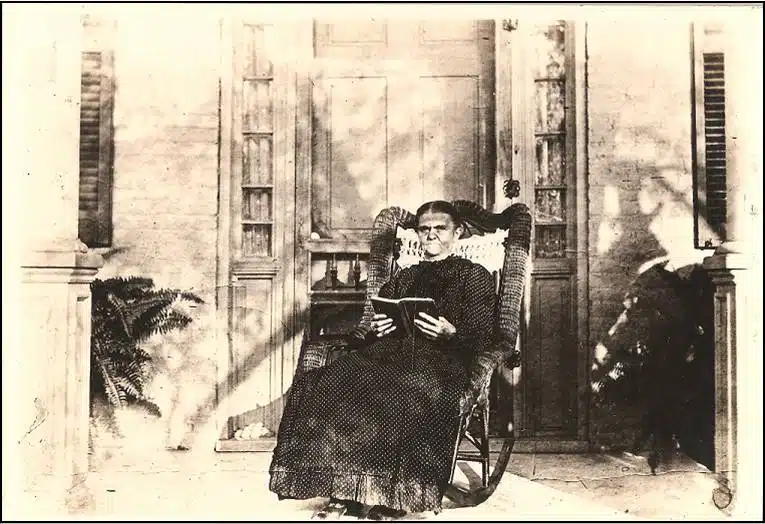
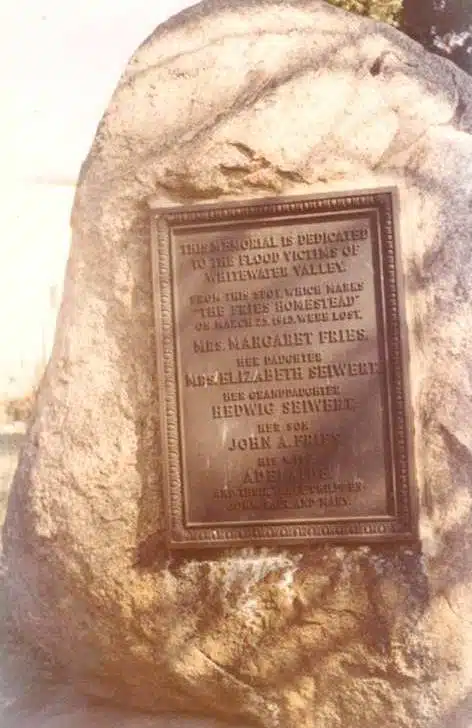
Starting on March 23rd, 1913, thirteen inches of rain fell in the course of twenty-four hours. The worst disaster in the history of Brookville followed on March 25th, when floodwaters reached 10 feet above previous levels. A dam on the East Fork of the river collapsed, and the rampaging flood waters hit the Fries’ tile plant and the two Fries’ homes at 2 o’clock in the morning, when it was pitch black. The Fries families had no warning and were asleep when the swollen river smashed their homes, leaving no evidence of them or their domiciles ever having been there. Casualties of this disaster were Margaret Fries, widow of Anthony, the founder of the company, her son John, who was the manager of the Brookville plant, and his entire family, wife Adelaide, and children John, Paul, and Mary. Also killed that night were Margaret’s daughter, Elizabeth Seiwert, and granddaughter Hedwig Seiwert. Eight members of one family perished. Elizabeth Seiwert’s body was not immediately found after the flood event, and a desk from the Fries home was found in the Ohio River several weeks later near Corn Creek, in Trimble County, Kentucky. The body of the aged grandmother, Margaret Fries, was never recovered.
Three days later, the Fries family funeral procession, the likes of which had never been seen before in Brookville, traveled solemnly along Main St. from St. Michael Church to the cemetery. There were four horse-drawn hearses that transported the bodies. This powerful and emotional scene was photographed by Ben Winans.
On a 50-foot square piece of ground in December 1921, a monument to the Fries family was erected by surviving sons, George and Anthony Fries Jr., who, at that time was living in Cincinnati and operating his own engraving and die-cutting business. This memorial was dedicated on June 11th, 1922, on the site of the Margaret Fries house. It has been said that the boulder on which the plaque was placed came from a nearby farm where Anthony and George often played during their childhood. For the sons, this boulder possessed an added sentimental value to the family memorial.
George Fries continued to operate his drainage tile manufactory in Connersville until 1932.
The next time you stop by IGA or Save-A-Lot, notice the large boulder with the bronze plaque on the grassy spot between the two grocery stores. Maybe you have noticed it before, but never knew why it was there. Now you do. As you read the plaque, reflect for a moment, and think about the brick and tile manufacturing plant that flourished in that general location over 125 years ago, and remember the family who lost everything in an instant.
In 2013, in memory of the anniversary of the Fries family tragedy, a descendant of the family, Grant Rice, presented a wonderful program at the K of C Lodge on Main St. Afterwards, a memorial and remembrance was held at the site of the devastation. Historic photos used in this article came from his presentation.
To learn more about your county and the fascinating history it holds, visit the Franklin County Public Library District and enjoy our huge collection of photos and books. Contrary to popular belief, NOT everything is online!
You must be logged in to post a comment.