By Julie Schlesselman, Local History & Genealogy Department Manager, FCPLD
This article ran in the July 19, 2023, edition of the Brookville American, and is in Forgotten Franklin County V. 5.
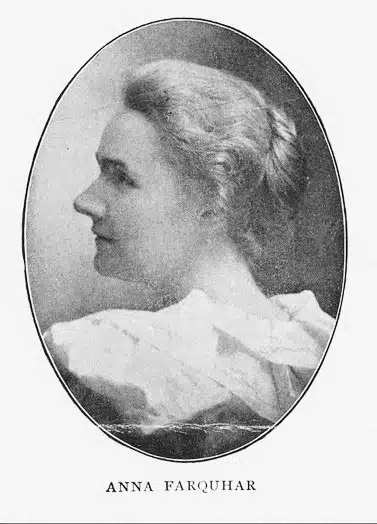
Anna Farquhar-Bergengren.
She’s not exactly a household name here, despite the fact that she was briefly famous and a native of Franklin County. She was born in Brookville in December of 1865. She, like Lew Wallace, was only here for a few short years, and her connection with the other cities where she lived, like Indianapolis and Boston, greatly overshadowed the connection she had with the place of her birth.
There’s really no biographical information remaining in Franklin County pertaining to the Farquhars. Only one written reference was found in the 1882 atlas of Franklin County, and that short paragraph was regarding her father, John Hanson [Hansen] Farquhar.
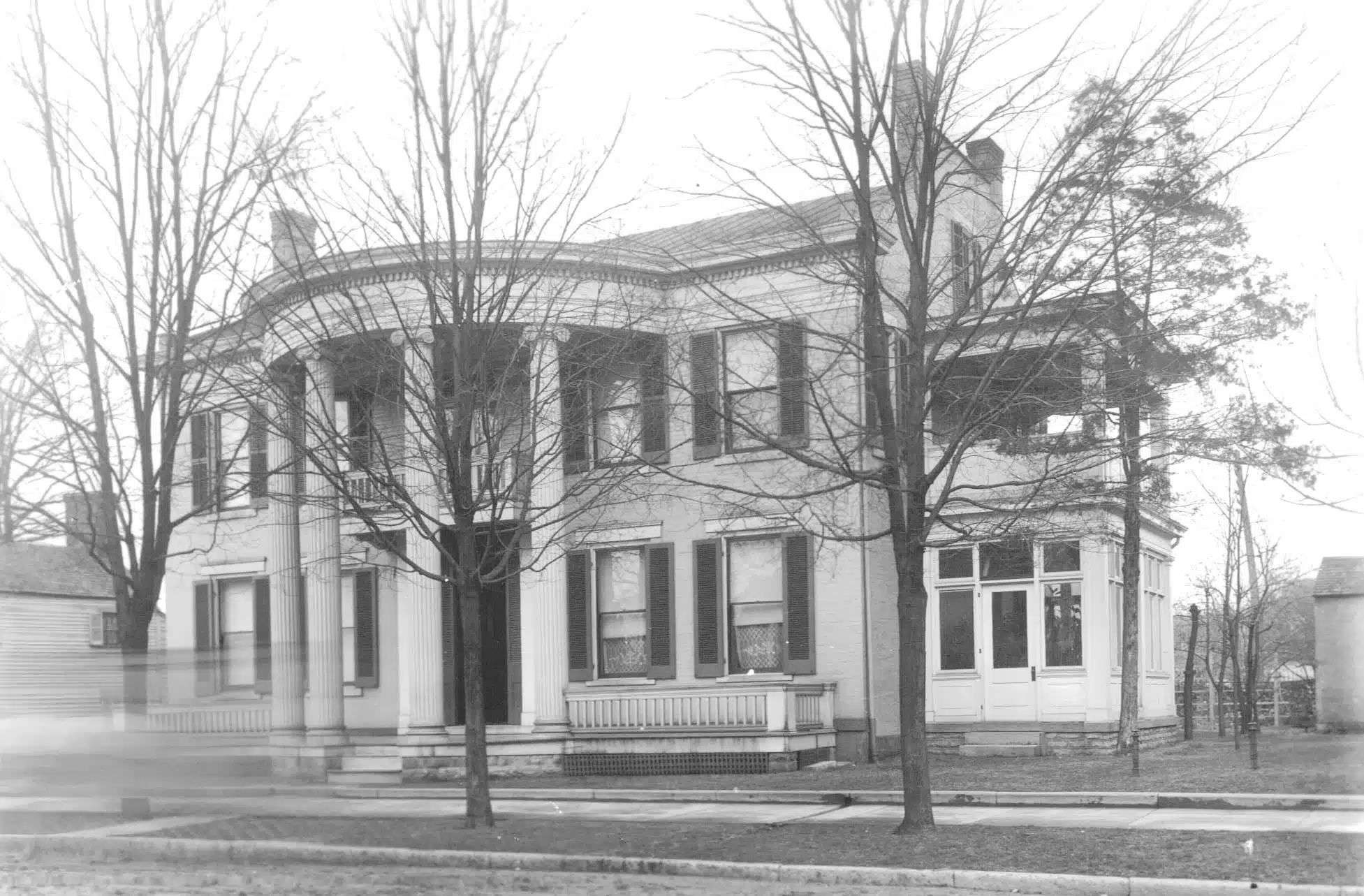
Maybe the name Farquhar sounds familiar to you. That would probably be because you read the historical marker outside of the Goodwin House at 813 Main Street, where it says that the house was built by John D. Howland circa 1856-57 and “later owned and occupied by John H. Farquhar, merchant.”
What’s interesting about the sign’s claim is, since they were accounted for in the 1860 United States census of Brookville, we can actually prove the Farquhars lived here. And how do I know this is the exact house even though no physical addresses were listed in the census at that time? Because the Farquhars’ neighbors listed on the census were Phoebe and Lucinda Meeks. You’ll remember the Meeks from a previous Forgotten Franklin County column. They were the ones who lived where El Reparo is today. Phoebe was the recluse known across the country.
I’ll get back to John Farquhar shortly.
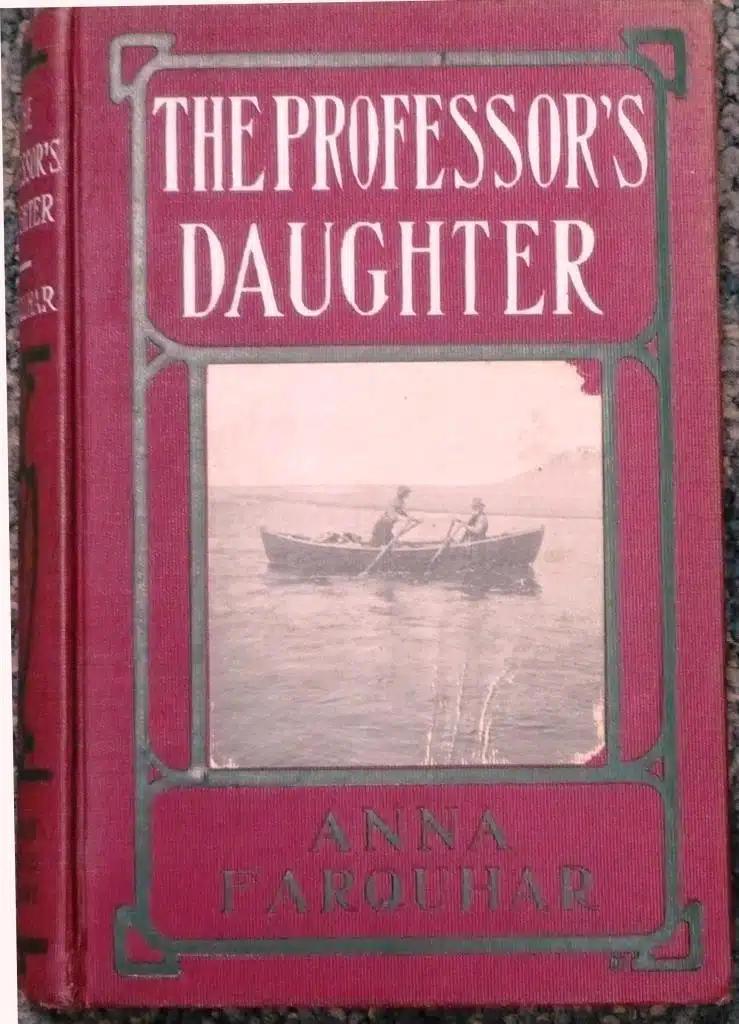
The point in bringing up Anna Farquhar is because of two separate donations we received for the Local History & Genealogy Department many, many years ago – three books. The donations came from Betty Vonderheide of Brookville and Dr. James Senefeld of Tennessee. These little books, which were written by Anna, are somewhat obscure, as very few original copies and second editions were ever made. They’ve been reproduced more recently by companies like Forgotten Books, but the new, quickly scanned reproductions pale in comparison to the originals.
Anna was a writer, and 120 years ago it was common to see the name Anna Farquhar published in newspapers and magazines from every corner of the United States. Farquhar’s titles that the library has include: The Professor’s Daughter (1899); Her Boston Experiences: A Picture of Modern Boston Society and People (1900); and An Evans of Suffolk (1904). In total, Anna is reported to have written at least six books, including: A Singer’s Heart (1897); Her Washington Experiences: Letters of a Cabinet Member’s Wife (1897); and The Devil’s Plough (1901).
Anna wrote under two names – first and foremost her maiden name of Farquhar – and it appears she also used the pen name of Margaret Allston. She wrote fiction and non-fiction.
Anna’s first love was music, and she hoped to be a professional in the field. The Farquhars were out of Brookville by the time Anna was about five. So she attended schools in Indianapolis where their new home was made as well as a private boarding school in Maryland. At the age of 21, Anna went to Boston to study music and stage performing. Her ambition was opera. The fates had other plans in mind for her, however, as the New England climate was not kind to her frail disposition and voice, which was never very robust to begin with. She left Boston and moved around and ended up back in Maryland, then New York City, and Washington, D.C., mostly working as an assistant editor or writer for magazines and newspapers.
Since Anna could not sing to please herself or anyone else, and she enjoyed working as an editor and writer, she turned her artistic talents solely to writing. It was through the book, A Singer’s Heart that she expressed the professional ambitions which she had experienced in her musical career. It was her first literary attempt, and even though it was not a super-popular book, it did receive flattering reviews, which encouraged her to continue in that profession.
In addition, her stories also appeared as installments in the popular magazines of the day, including The Saturday Evening Post and the Ladies’ Home Journal.
Anna married Ralph Bergengren in 1900. He, too, was a writer, mostly of children’s books and children’s poetry. After her marriage, Anna did not write much more. Her last book was published in 1904. Anna died in 1945 and is buried in Gloucester, Massachusetts.
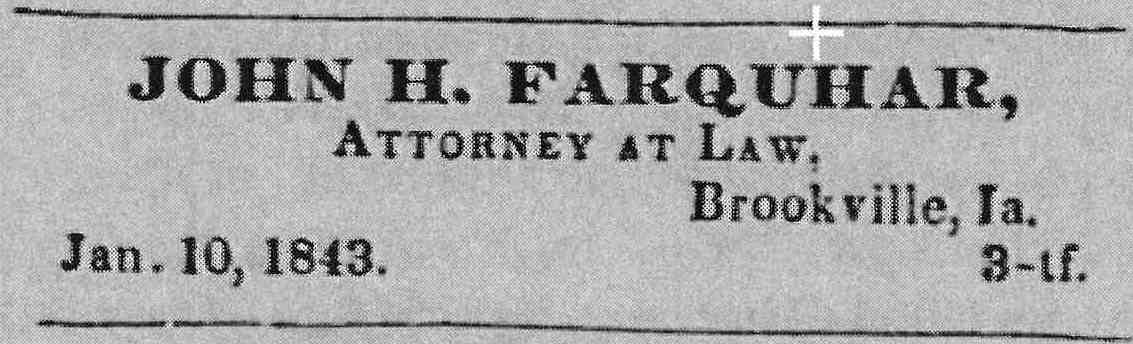
Anna’s father, John H. Farquhar, was a big deal during his day, just as his daughter was in hers.
John Farquhar was born in Maryland in 1818. He came to Indiana when he was only 15 and lived for a short time in Richmond, Indiana. He found work on the Whitewater Canal, became an assistant engineer, and worked with the canal company until 1840.
Farquhar eventually moved on and chose law as his new career path. He was admitted to the bar and practiced law in Brookville. He was making a name for himself and became active in politics and during the 1840s served as Secretary of the State Senate (1842-43) and Chief Clerk of the State House of Representatives (1844). Farquhar went on to become a U.S. Congressman (1865-66).
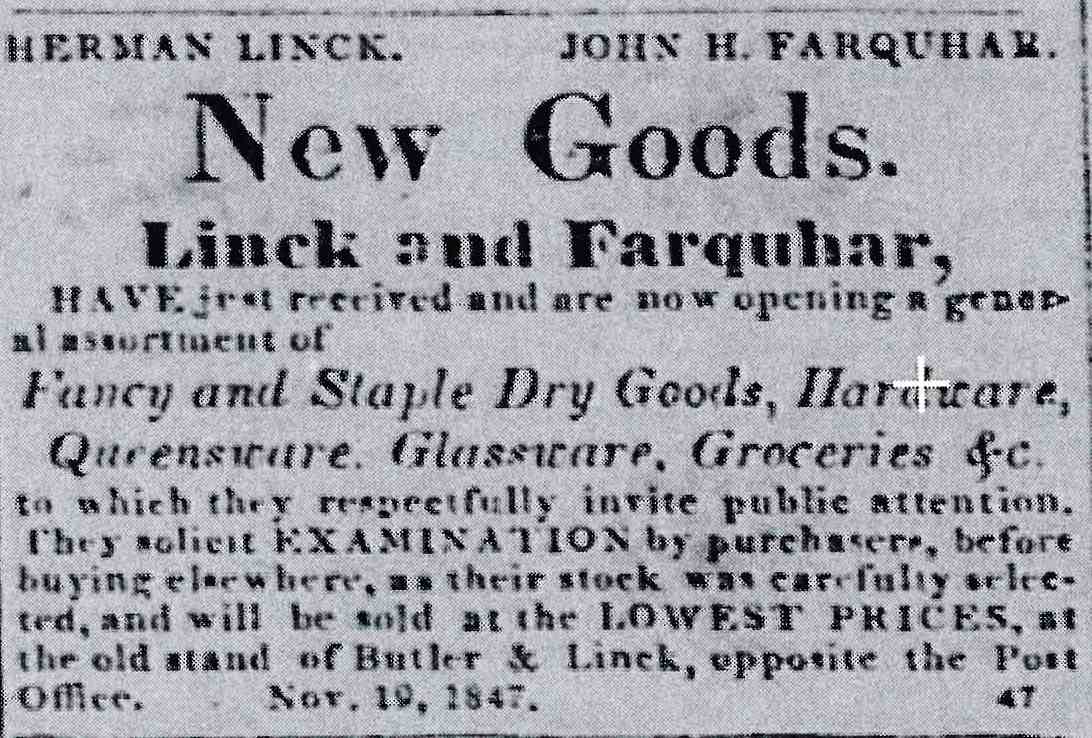
Also, during the 1840s, John Farquhar joined forces with Herman Linck (whom you will recall I have written about in a past column) and worked with him in the mercantile trade. More than likely, this partnership was just a financial one, as this entrepreneurial endeavor seemed to supplement his lawyer income and help out Linck. I doubt Farquhar, a new and well-respected attorney, was ever seen working behind the store’s counter.
When the Civil War broke out, Farquhar was appointed a Captain in the 19th regiment of the United States Regular Army Infantry in May of 1861 and held that position until 1864.
A little more biographical information about John was found through the Indiana Historical Society. Surprisingly, in their Manuscripts Department, they have one letter written by John to his wife during the war.
According to the Indiana Historical Society’s biographical information, “In 1863, Captain Farquhar was appointed Brigadier General of the State Militia, and he travelled to Evansville to protect the southern Indiana border against Confederate forces. In July of that year, Farquhar and his men responded to Morgan’s invasion of Indiana. Later, in 1863, General Farquhar received a commission to investigate riots in Brown County. Near the close of the war, Farquhar greeted the returning 9th, 10th, and 153rd Cavalry with a speech on the grounds of the Indiana State House. He resigned his commission on August 9, 1864.”
During his military service, John was detailed for duty as a chief master disbursing officer at Indianapolis. Through his military service and political positions, he became well-known to many in this city and liked the area very much. He eventually uprooted his family from Brookville and moved there. This was about 1870. At the time, he and his wife, Fannie, whom he married in 1857, had three children, Anna and her two older sisters. The next avenue of his career included banking, and he worked as a higher-up in that capacity at one of Indianapolis’s foremost banks until 1873, when he died at the age of 54. John contracted typhoid fever and, after an illness of two weeks, died on October 1, 1873.
John was about twenty years older than his wife, Fannie (Frances). She lived almost another half-century without her husband, as she died in 1922. Both are buried at Crown Hill Cemetery in the state’s capital.
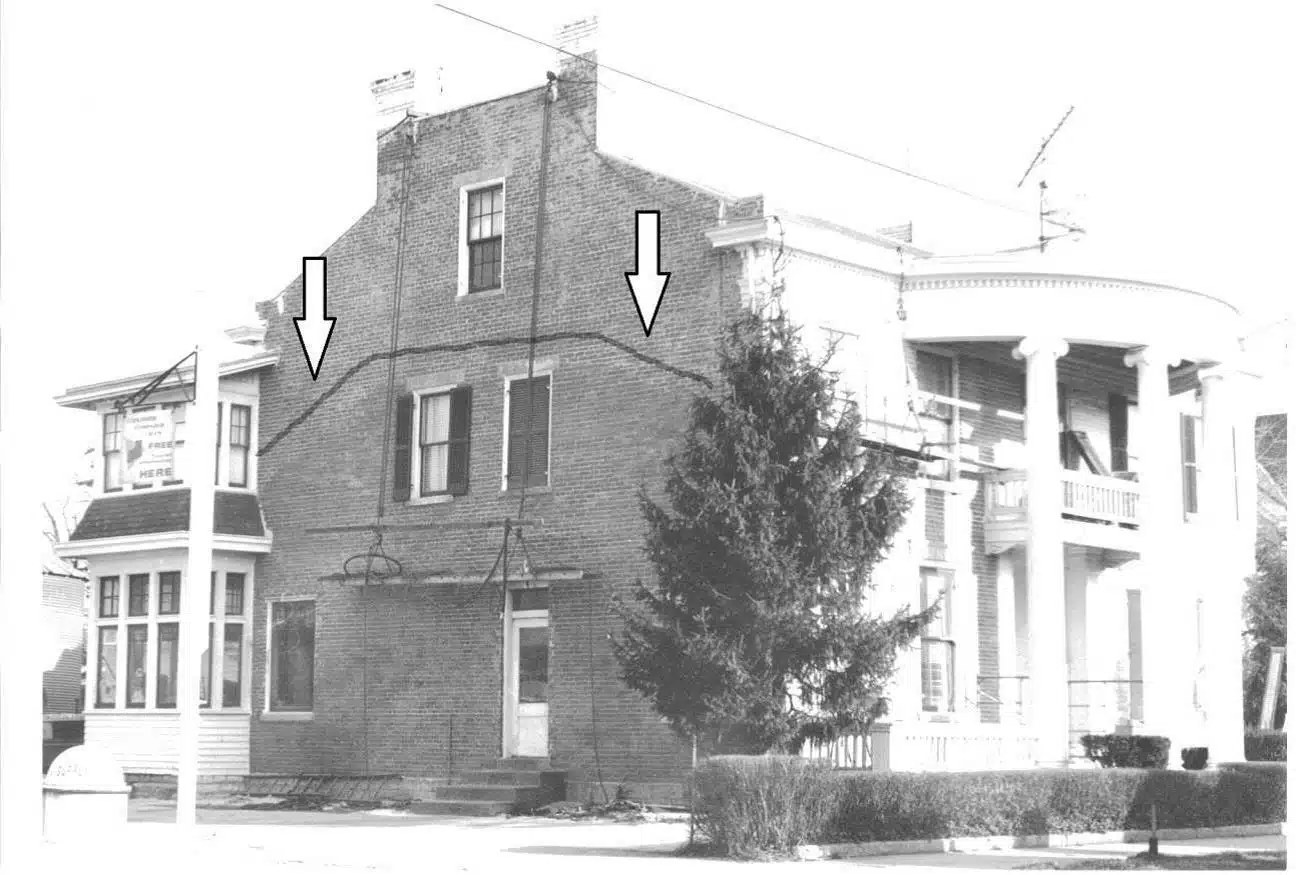
When the Farquhars lived in the house in Brookville, it probably looked much different – probably more similar in style and size to the two houses across the street from the Brookville Library. While doing research for the Houses of Brookville book, Don Dunaway and I came across the following in a July 3, 1931 Indy Star article, written by Agnes M’Culloch Hanna. Agnes mentioned that the [Goodwin-Farquhar] house had been much smaller than what one saw at that time. She said the Goodwins were the ones who enlarged the house and added the full upper levels, and that originally, it had curved stone steps leading to the front entrance.
Next time you are at El Reparo, make a visual inspection of the neighboring building, especially on the north side. One can still see a faint, ghostly outline of the original structure.
The Farquhars have been absent from Franklin County for over 150 years now and are truly a part of Franklin County’s forgotten past. At one time, for at least twenty-five years, the name Farquhar meant something in Brookville. Superficially, it represented a business, a law firm, and the entire population of Brookville and Franklin County in politics. Not to mention John’s commitment to his country and the personal sacrifices he made during the Civil War. Today, the only vestiges of anything Farquhar in Franklin County are the name on a historical marker and three books in the library’s Local History & Genealogy Department Archives… and now this article.