By Julie Schlesselman, Local History & Genealogy Department Manager, FCPLD
This article ran in the March 30, 2022, edition of the Brookville American and in Volume 3 of Forgotten Franklin County.
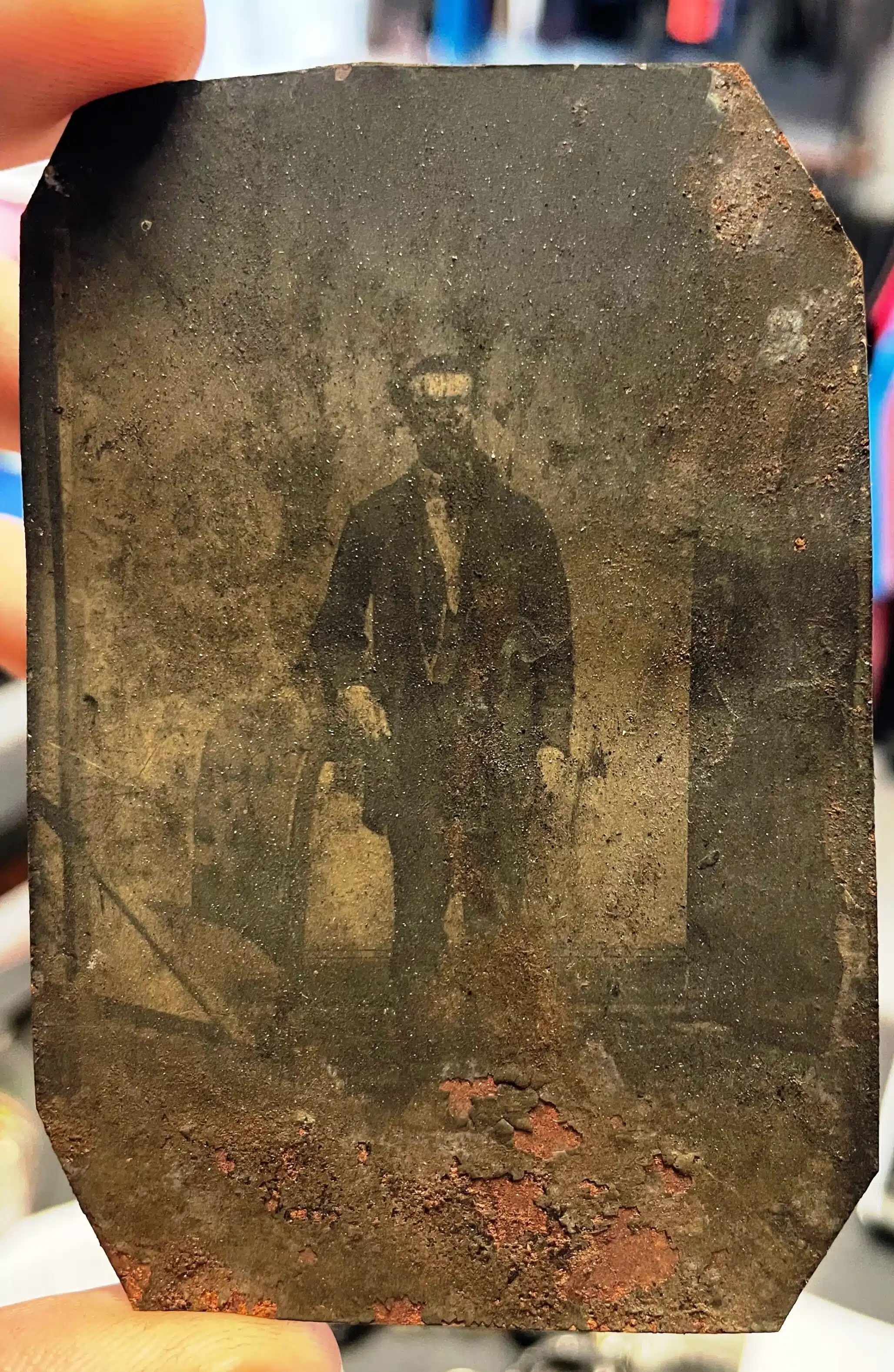
When people remodel their homes they find all kinds of interesting and unusual things – old newspapers in the walls (which were typically used for insulation), jewelry that slipped between the floor boards, “mud bricks” behind walls that were created from years of flooding events, coins & tokens, receipts, and even a small cannon ball was found in a Brookville backyard when a library staff member was having an addition put on her house. Lucky for me, people like to share their finds, and one of the most intriguing came my way in May of 2021 – an unidentified photograph.
When people contact me at the Franklin County Public Library District’s Local History Department with house history questions and object identification issues, it often takes a while to investigate. Rarely do I have exactly what one needs already researched – it takes days and often times weeks combing through our materials and unique collections to retrieve information or make comparisons to find the answers they seek.
Many times, it’s a game of chance whether or not we can materialize a correct answer or not. Sometimes only speculation or conjecture can be offered up about a building or object because the information needed just does not exist – or it just hasn’t been donated to the library’s collection yet! Many times, I have to reach out to other researchers or organizations for suggestions or assistance.
For the object that came my way in May of last year, the research and outcome was rather rewarding because I believe what we materialized was spot on.
So, here’s the story that’s too good not to share. In May 2021, Kurt Grimmeissen sent me a snapshot of a small tintype photo. Among a variety of endeavors, Kurt owns G2 Apparel at 6th and Main Streets in Brookville and has been doing an extensive amount of repair and restoration, including a little modernizing and updating, to revitalize one of the oldest buildings on Brookville’s Main Street, “Nixie’s” at number 563. While doing some interior work, he found an old photo behind the plaster in the ceiling (or if you are upstairs, the floor joists of the second floor) near the chimney.
He sent it to me as just a really cool find – but could I possibly tell him anything about it?
In 2017, then owner of Nixie’s, Steve Hounchell, better known as Smokey, had me do a little research on his building. So I was one step closer to a possible answer than normal. From my original research, I knew that early owners and occupants of the building at 563 Main Street included the surnames Adams, Price, Rudman, Shepperd, and McCready, to name just a few.
Unfortunately, the facial features of the man in Kurt’s photo were not clear at all, so I tried searching our collection by photo type and background. After nothing in the library’s archives seemed to be a similar match, I sent the image on to Jim Senefeld.
After working with former Franklin County resident Dr. James Senefeld of Tennessee on a project or two, I knew that he had many of the surnames of the building’s past occupants in his own family tree. His roots go deep in Franklin County’s history and spread far and wide. Since Jim was an only child, many generations of photos and genealogical information got passed down to him. Needless to say, he has a fabulous collection of photos and genealogy materials.
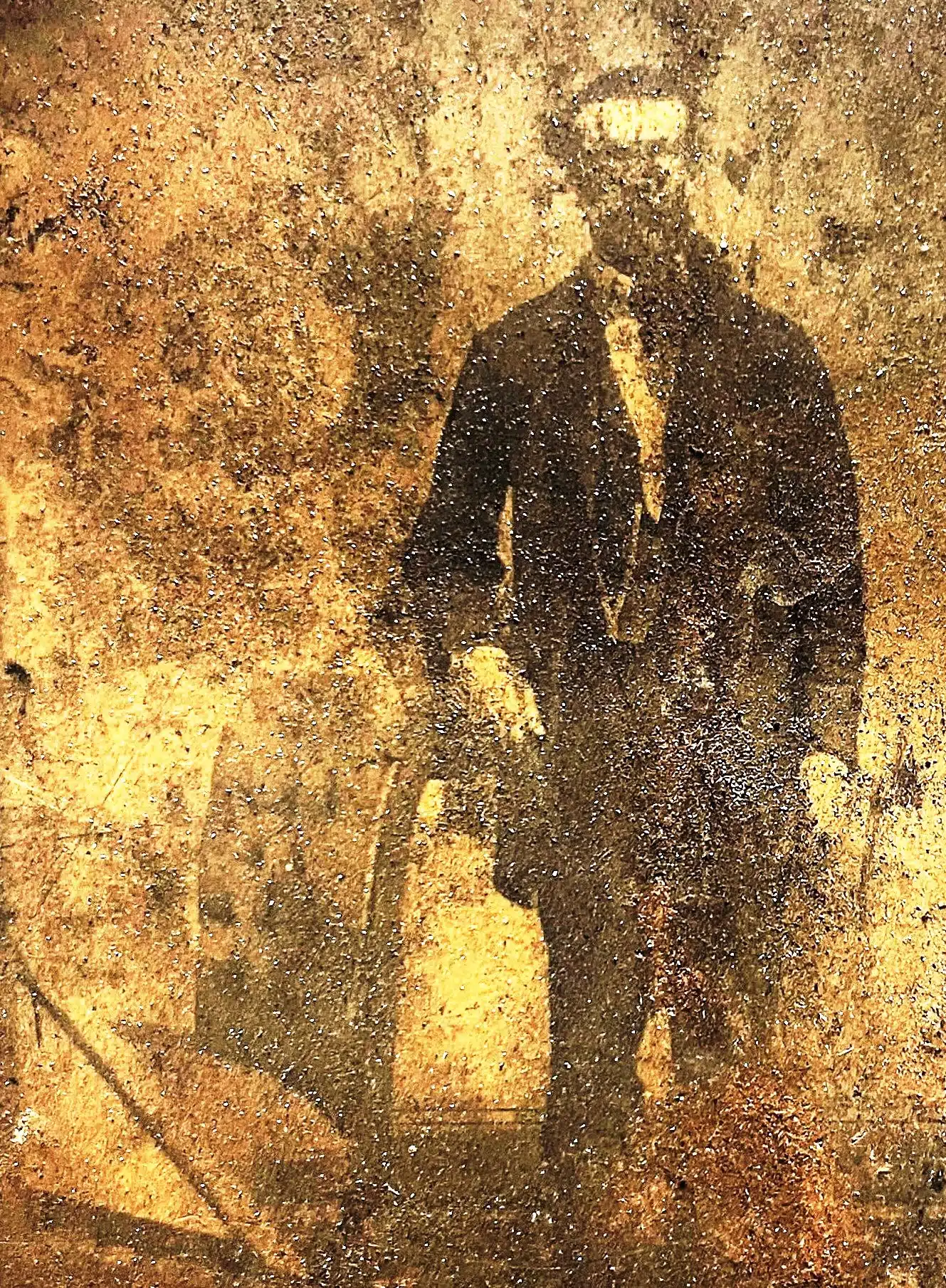
Jim tweaked the digital image Kurt sent, which enabled him to highlight a few high-profile physical features and compare the man in Grimmeissen’s image to era-appropriate images his own family collection.
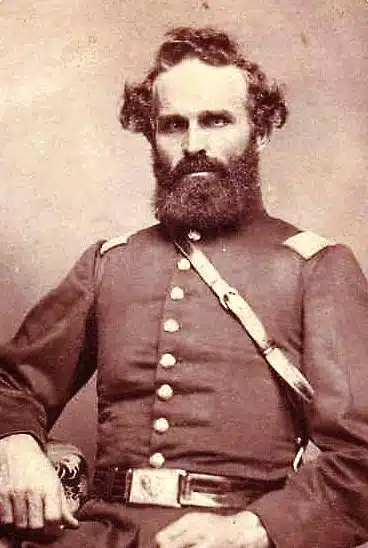
Jim came up with the reasonable conclusion that it was a tintype of one of his relatives connected to the Rudman and Shepperd families, Elias Millis. When Jim compared his image to Kurt’s, he felt that the body build and hairline were very similar, and considering the family connections, Elias Millis is an excellent assumption.
According to research done by Senefeld, Elias W. Millis was born in Franklin County, Indiana, in 1822, near Blooming Grove. Elias was married twice. His first wife, Julia Roberts, died in 1853. Since Elias had children to rear, he married Mary Elizabeth Shepperd in Brookville in 1855. Elizabeth, or “Lib,” as she was commonly known, was born in 1832, the daughter of Samuel and Martha Rudman Shepperd.
So, who was Elias Millis? First and foremost, he was a United States Army veteran.
Elias W. Millis enlisted at age 40 on August 4, 1862, with the 68th Indiana Volunteer Regiment. He was commissioned as a First Lieutenant and later was Quartermaster. The entire regiment was captured that summer at Munfordville in central Kentucky by Confederate forces under the command of General Braxton Bragg and later paroled and returned to Indianapolis. After reorganization at Camp Morton, the regiment departed on December 26 by train to Louisville, Kentucky, and remained in camp for almost two weeks. The regimental historian of the 68th Division, Edwin W. High of Metamora, narrated what happened next.
“On December 26 we went to Louisville, where we remained until January 7, when we broke camp in the early morning and marched to Portland, on the Ohio River, where we arrived at 10 a.m. and bivouacked on the wharf or landing without shelter. During the night, snow fell to the depth of several inches. On the 8th, we stood in the snow in inclement weather until 5 p.m. when we embarked on steamboats…as guards for a fleet of 26 boats laden with supplies of all kinds for the Army of the Cumberland at Murfreesboro, Tennessee. The writer has a vivid recollection of that night passed on the bank of “La Belle Rivere” with no shelter but the clouds overhead and the winds of winter storm to rock us on to sleep on piles of camp equipage, strewn around promiscuously on the landing. However, this exposure was accepted as part of the show, but taking a retrospective view, I am of the opinion that it would have been better to have gotten the boats ready before breaking camp. The exposure of that night caused much suffering and disease, resulting in the death to some and the discharge of nearly 100 of our regiment. Many of the men who camped on the river bank that night have crossed the silent river by reason of disease contracted at that time, aggravated by hardships and exposure later” (pp. 27-28).
The regiment was then at the battles of Hoover’s Gap, in Bedford County, Tennessee. Later, at Chickamauga, the regimental commander, Colonel Edward A. King, was killed on September 20, 1863. Then, the regiment was in the battle of Lookout Mountain, Chattanooga, and in February 1864, sent toward Knoxville to the relief of General Ambrose Burnside.
Due to failing health, Elias Millis resigned on March 14, 1864, and returned home to Franklin County, “his health ruined,” as was noted in his obituary. He died in Brookville on September 28, 1864. He was buried north of Brookville at the Ebenezer Cemetery.
According to Senefeld, Millis’ body was exhumed from the Ebenezer Cemetery and moved to the Old Brookville Cemetery years later, where a family plot with his second wife, Elizabeth, was established. So today, Elias has two gravestones, one marking the original grave in Blooming Grove and one at the Old Brookville Cemetery in town.
In conclusion, considering Elias Millis had the documented family connections to the Rudman and Shepperd families, former occupants of the building now known as “Nixie’s,” and Jim Senefeld’s observations and comparisons regarding physical characteristics, I would say the man in the tintype Kurt Grimmeissen found is definitely Elias Millis. More than likely, Elias and his wife and children lived elsewhere, and he never did anything more than visit this building. This photo was probably just one of many that were in Elias’s in-laws’ collection.
How very interesting that the photo Kurt Grimmeissen found in 2021 was lost for just over 150 years. And even more interesting is the fact that a man who now lives over 350 miles away from Brookville had the research and family materials to help identify it.
If you are curious as to what types of businesses were once at today’s 563 Main Street over the last 190 years they included a harness making shop, a seamstress shop, a tailor shop, a dressmaking and millinery business, numerous barbershops, a glassware and china shop, the Brookville Cigar and Novelty Shop, a combination wallpaper-tobacco-toy shop, a laundry and dry cleaners, and in 1939 it became Nixie’s Lunch and Billiard Parlor. So, this well-known spot has carried the “Nixie’s” name for over 80 years. This modest, yet very historic, little building dates from the 1830s-1840s.
You must be logged in to post a comment.