By Julie Schlesselman, Local History & Genealogy Department Manager, FCPLD
This article ran in the February 18, 2026, edition of the Brookville American.
Don’t discount the archives of your local library. You never know what fabulous research materials are tucked away in storage and maybe not yet cataloged – books, ephemera, manuscripts, three-dimensional objects. Local history departments and their archives hold unique and wonderful things – much more than just books.
Institutions striving to be the best – and that’s what your Local History Department of the Franklin County Public Library District has done over the past twenty years – have extremely diverse collections interspersed with loads of primary resource materials. Items are selectively collected, amassed, preserved, and carefully stored away, just waiting to be utilized by people who want to do real hands-on research and investigative studies.
While the Archives Room at the Brookville Library does not currently hold any examples of Franklin County quilts, such as I discussed in last week’s column, we do have an example of a Franklin County woven coverlet. Coverlets were woven in a variety of ways and were simply textiles used to keep one warm. Quilts, blankets, and coverlets all served the same purpose, but were constructed very differently, resulting in distinctly different end products, which were revered differently by each owner.
In volume 1 of Forgotten Franklin County, I have a general background story about coverlet makers in Franklin County. And just last year, for the July 30 and August 6, 2025 columns, I wrote about Cockefair coverlets. So I have covered the topic fairly sufficiently in the past.
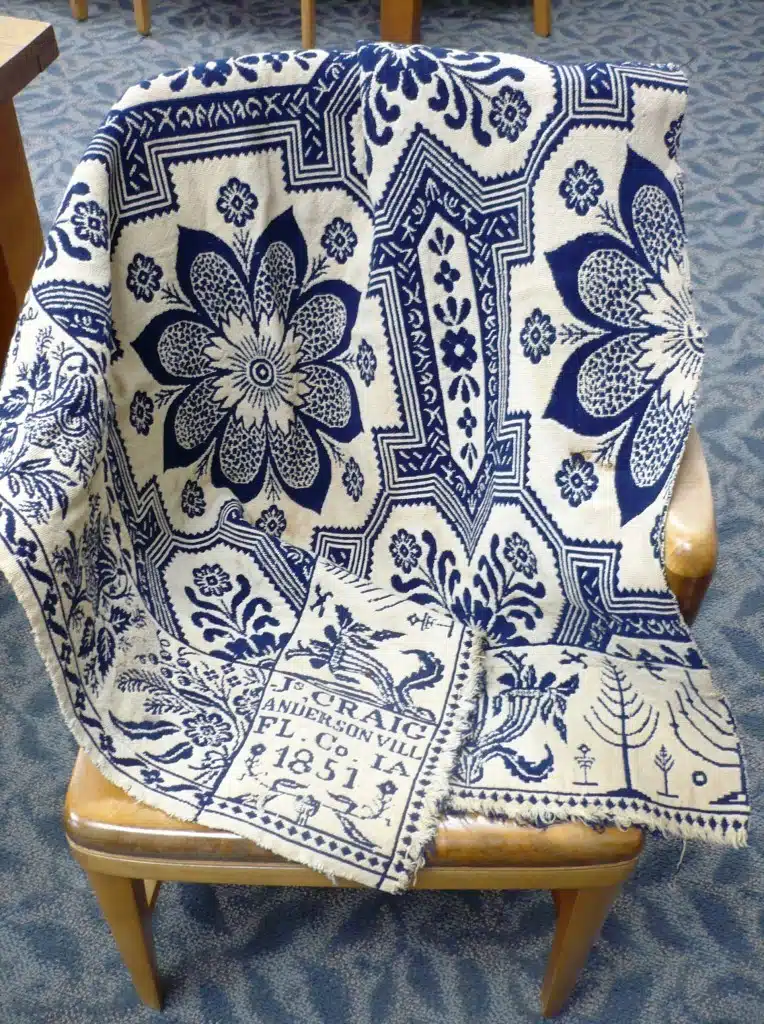
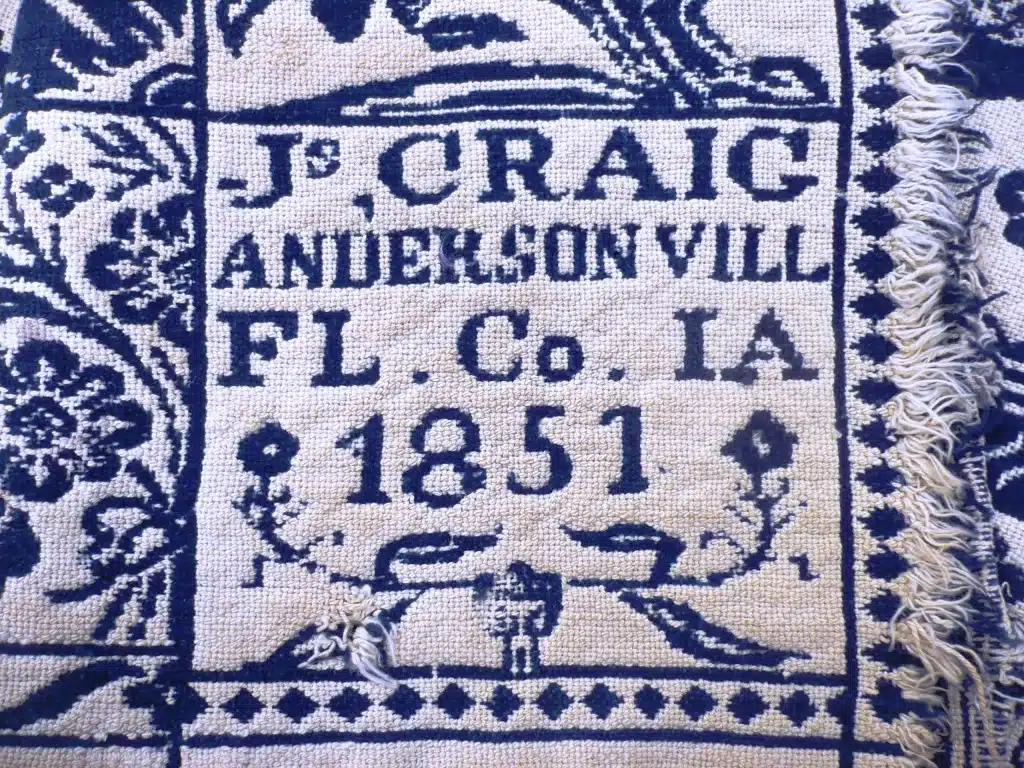
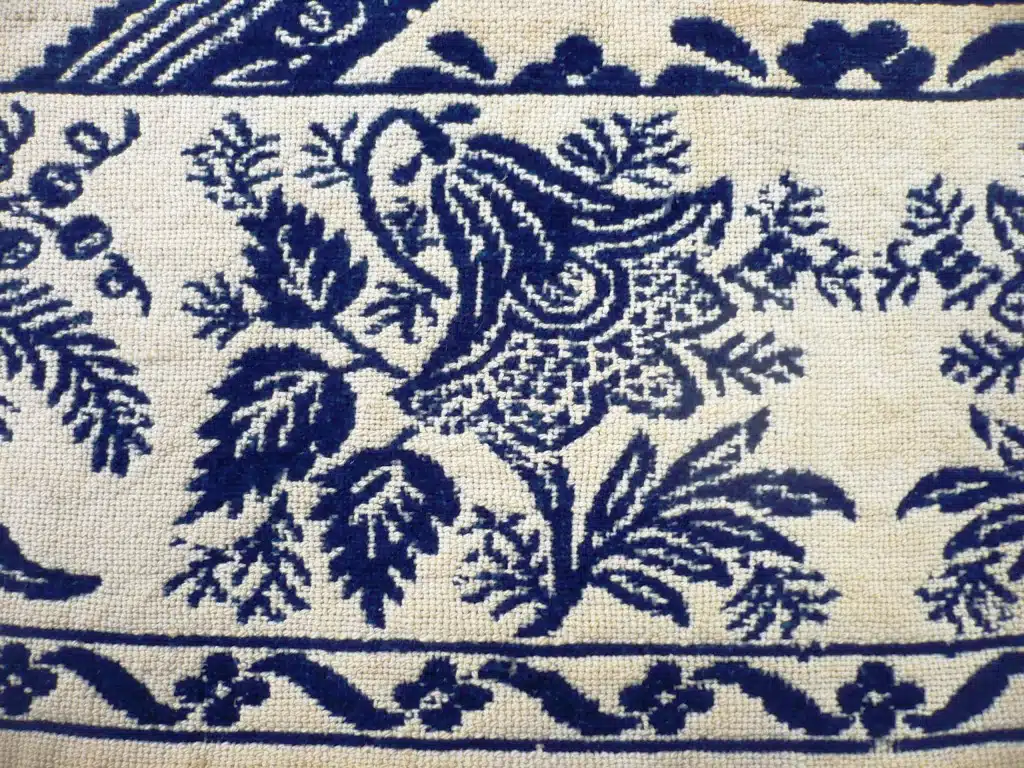
This week, what I want to discuss is an acquisition we recently got in 2025. It’s a James Craig coverlet, but one attributed to Craig’s time in Andersonville, which is in Franklin County’s Posey Township. This piece is important for many reasons, including the fact that what we have in the library’s collection seems to be an extremely rare bird. James Craig didn’t weave in the tiny village of Andersonville for very long. As a result, less time weaving in a particular location makes the end product limited in overall quantity. I would think his pieces from Andersonville are rarer than those he produced in Decatur County for a slightly longer period of time.
Almost all coverlets were woven in panels then sewn together. Two usually made the typical coverlet for a bed. Perfectly aligning the panels required skill, especially when the design was meant to appear continuous. The library’s Archives has a half of a coverlet.
Some library staff think that it had been cut apart, so more than one member of a family who inherited it could have a piece, since coverlets were prized possessions. Perhaps it’s as simple as one piece having been destroyed or worn beyond repair, and it was simply cut off. It doesn’t matter. It’s only important that we have an example of James Craig’s work from Andersonville since weaving at that particular location only occurred for approximately seven years.
While doing research on the library’s piece, what was most shocking were some of the statements I discovered regarding Craig’s Andersonville coverlets. In many volumes and on numerous websites, authors, not really familiar with our part of the country, assumed that Andersonville was in Floyd County because of the abbreviation in the weaver’s corner block, “FL.” This is false, as many early references to Franklin County were abbreviated “FL.” I’m going to go out on a limb on this one and say that any authors who claim James Craig wove in Floyd County, Indiana, are simply wrong.
I have found no evidence of Craig’s weaving in Floyd County. The Craigs that were in Floyd County at the time coverlets were woven were carpenters, draymen, laborers, and clerks. Historically, Floyd County narratives talk about glass making and manufacturing, steamboat building, and plywood and veneer plants as their major industries. Dairying and berry growing were very prevalent in their rural areas and on small farms. Nothing is mentioned in any Floyd County histories about the Craig family creating coverlets there.
I won’t address the books and the comments that are incorrect, as that would only muddy the waters and make things way more confusing for you than they need to be. I will only concentrate on the correctness. The James Craig we are most interested in descended from the William Craig line. It was William’s family who settled in, then moved away from Franklin County, and became most well-known as Decatur County weavers.
From the book Weaving a Legacy by Clarita Anderson, she claims William Craig Sr. (1800-1880) wove in the British style. He immigrated to the United States from Kilmarnock, Scotland, in 1820, and first settled in South Carolina, where his two sons, James (1823) and William Jr. (1824), were born. William moved his family to Franklin County, Indiana, in 1830 and was a landowner by 1835. He eventually moved to Decatur County. Anderson stated, “Pauline Montgomery considered the courthouse the most widely known of all the Craig logos and attributed it to the weaver’s early years in Decatur County, when they were all working together. The Craigs separated by 1845, and each had his own weaving business as well as his own logo or corner block.”
From A Checklist of American Coverlet Weavers by Abby Rockefeller, she claims, “Montgomery said he [James] moved to Andersonville, Indiana soon after his marriage in 1846. He wove there until 1854 when he moved to Decatur County.”
The Montgomery mentioned above is Pauline Montgomery. She wrote Coverlet Weavers and Their Coverlets, which seems to be the most accurate book on the subject of the Indiana weavers.
Montgomery states: “Possibly Indiana’s best known coverlet weavers were the Craigs of Decatur County, the father, William Sr., and his two sons, James, and William Jr. Not even Samuel Graham could equal them in volume, and many Craig coverlets can still be found not only in private possession in Indiana but in museums and homes all over the country.”
“The Scotch weaving center, Kilmarnock, Ayrshire, was the birthplace of William Sr. in 1800. In 1820, sensing that difficult times lay ahead for the weavers at the handloom, Craig came to America. …”
“After ten years in America, Craig began to consider a westward move. His brother Archibald, the patriarch of the family, was now the minister of the Presbyterian Church at Mt. Carmel in Franklin County, Indiana. William and his wife and family moved there in 1830.”
“Sons James and William Jr., were now old enough to be of some assistance to their father both at the loom and the plough; however]…no coverlets have been found which could be attributed to William Craig during the Franklin County period of his weaving career.
William Craig eventually moved to adjoining Decatur County. By April of 1840, he bought his land north east of Greensburg; the Franklin County interest was sold to Hugh Gilchrist.
“For five years [William] Craig and his two sons, now in their late teens, wove together on the farm.”
“In 1845 the succession of land transactions which William Sr., was to carry on almost uninterruptedly for the next twenty years began. William Jr., married Sarah Thompson (1845) and moved from the farm to establish a weaving shop in Greensburg; the following year James married Martha Montgomery and almost immediately settled in the little village of Andersonville, just over the Decatur County line.”
“In 1853, the three Craigs were on the move….James having bought the farm adjoining his father’s in Decatur County began selling his Andersonville lots preparatory to a move back…..”
“James on his return from Andersonville, continued weaving until the 1860s. Coverlets of this period are well-identified: “J. Craig 2 miles N. East of Greensburg D.C. Ia.”
After reading about James Craig, I wanted to pinpoint the exact location where he wove in Andersonville. Items at the county recorder’s office show James owned multiple pieces of property there, including lots 20, 24, and 44, and lot 57 on which Andersonville’s Masonic Lodge was built. James Craig sold that particular lot to the trustees of the lodge in 1853. Since no buildings of historic significance remain on the other lots, it’s difficult to say which lot supported his weaving trade. The lots he owned are not adjoining, so perhaps one location was a house, and one was the location of a loom or looms. Or, it’s always possible he rented a building elsewhere in Andersonville in which to weave.
So the library’s James Craig “Andersonvill” coverlet is a rare piece, and would have only been produced between the years 1846-1853-ish.
I can’t explain why Andersonville is consistently spelled without the “e” on all of his coverlets. Maybe he just ran out of room. Maybe “vill” was an accepted form of ville at that time. If it were an abbreviation, why drop the “e”? Why not use a different form of abbreviation like A’ville? No one else in any publication about coverlets addressed that oddity.
And for those of you wondering, who may be familiar with the abbreviation of “IA” for Iowa, that was not the case 180 years ago. “IA” was originally the abbreviation for Indiana.
Until one starts to do in-depth research and access local records to confirm statements, it’s amazing what is actually out there online and sometimes erroneously published that a researcher could easily take for granted as fact.
One example I found to be very misleading was information attached to an online record for the Smithsonian’s American History Library. Their description said the Craigs worked in Greensburg and “Anderson.” That is incorrect. They were not in Anderson, Indiana, but in Andersonville.
Don’t you find it interesting that the Smithsonian in Washington, D.C., considers Franklin County history significant enough to collect and curate? I do.
The well-known coverlet weaver, James Craig, died in 1889 at the age of 66 in Decatur County, Indiana. He is buried at South Park Cemetery in Greensburg.